How to Sharpen a Ceramic Knife?
So you’ve got a ceramic knife in your kitchen. You love how sharp it is, how clean it cuts, and how it doesn’t rust. But now you’re wondering: how do I keep this thing sharp? Don’t panic. Sharpening a ceramic knife isn’t as hard as you might think. Let me walk you through everything you need to know.
In this article
Why Ceramic Knives Need Special Care
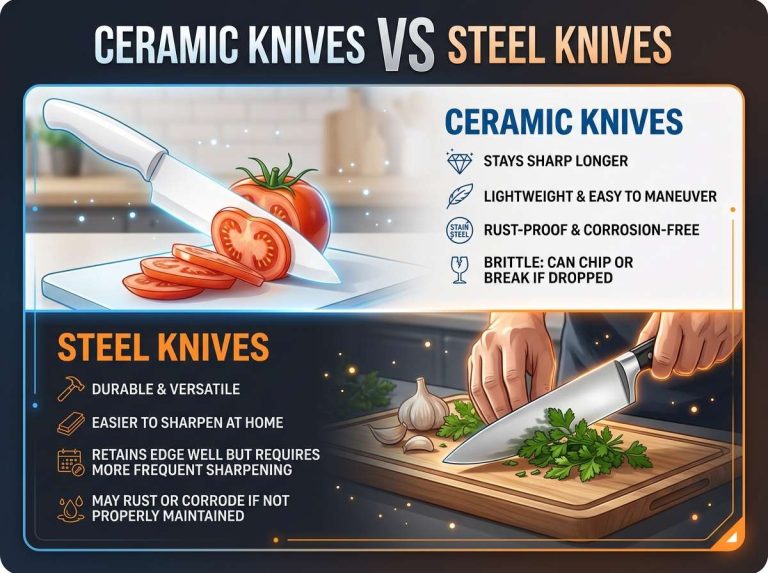
Ceramic blades are different from your regular steel knives. They stay sharp way longer than metal blades. You might go months without needing to do anything to your ceramic knife. That’s the good news.
The tricky part? Ceramic is super hard. It’s actually harder than most steel. That means it keeps its edge longer, but it also needs special treatment when it does get dull. You can’t just use any old sharpening tool you have lying around.
Ceramic is brittle too. Drop it, bang it around, or use the wrong sharpening method, and you might break the blade. The blade can chip or crack. That’s why you need to be gentle and use the right tools.
Understanding Your Ceramic Knife
Before you sharpen anything, let’s talk about what you’re working with.
A ceramic blade is made from zirconium oxide. That’s a fancy way of saying it’s a special type of ceramic. It’s not like your coffee mug. It’s much tougher. The blade goes through a special process to make it strong enough to cut food.
Ceramic knives come in different colors. Most are white or off-white. Some are black. The color depends on how they’re made. No matter the color, they all work the same way.
The edge on a ceramic knife is super thin. That’s what makes it cut so well. But that thin edge is also why you need to be careful with sharpening.
The Main Methods for Sharpening Ceramic Knives
There are a few ways to sharpen a ceramic blade. Let me break down each one so you can find what works best for you.
Method 1: Using a Diamond Honing Steel
A diamond honing steel is one of the easiest ways to keep your ceramic knife sharp. This is not the same as a regular steel rod that you use on metal knives.
A diamond honing steel has tiny diamonds stuck to the surface. Those diamonds are hard enough to work on ceramic. When you run your blade along the steel, it realigns the edge and takes off a tiny bit of material. This keeps the blade sharp.
Here’s how to use it:
First, hold the steel vertically. You can hold it point-down on a cutting board, or you can hold it in your non-knife hand with the tip pointing up. Either way works fine.
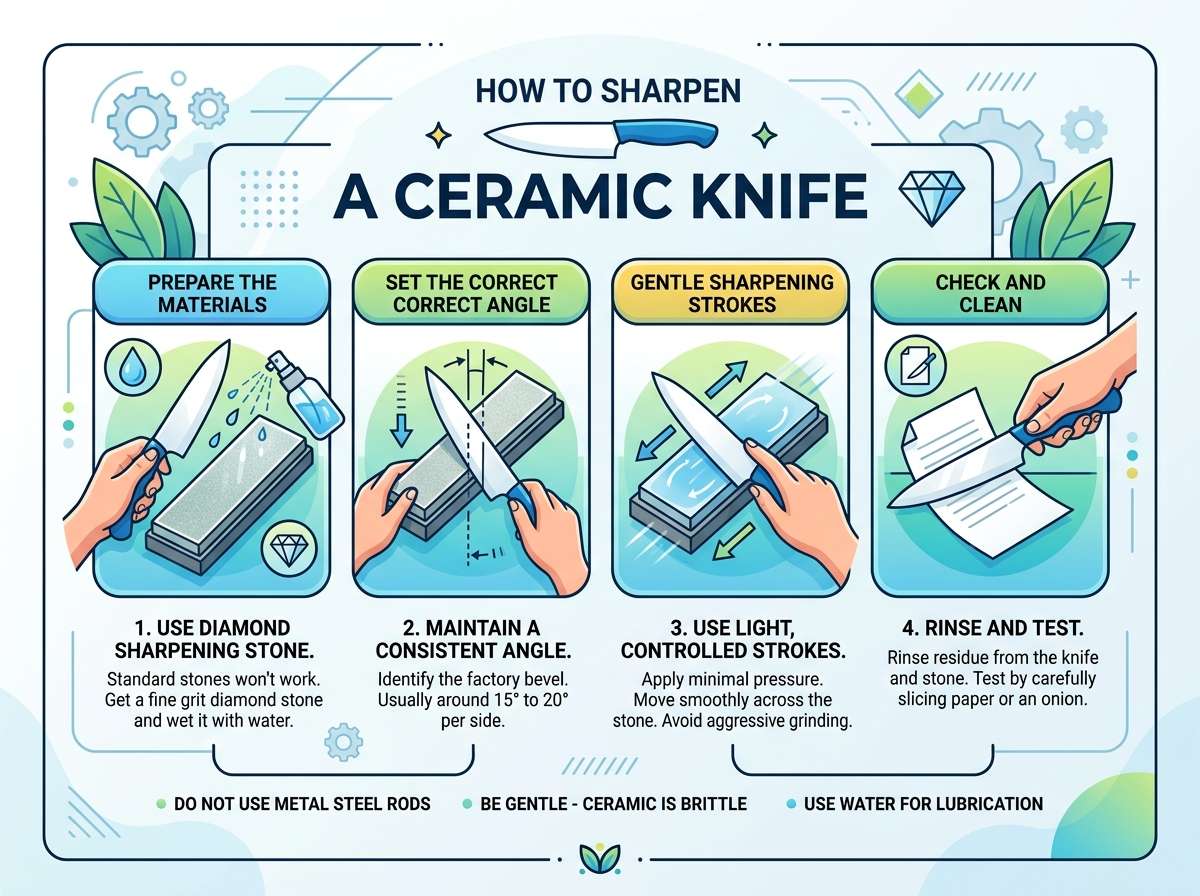
Next, place your ceramic knife at the top of the steel. The angle matters. You want your knife at about 15 to 20 degrees. Think of it like you’re trying to shave off the tiniest piece of the steel. You’re not pressing hard.
Then, pull the knife down the length of the steel. Let gravity help you. Don’t press hard. Just let the blade glide. One smooth motion from top to bottom is ideal.
Flip your knife over and do the same thing on the other side. Do this about 5 to 10 times on each side.
That’s it. You’re done. Your blade should feel sharper already.
You can do this once a week or once every two weeks, depending on how much you use your knife.
Method 2: Diamond Sharpening Stone
A diamond sharpening stone is more aggressive than a honing steel. Use this when your blade has gotten pretty dull.
Diamond stones come in different grits. Grit is a number that tells you how fine the stone is. Lower numbers are rougher. Higher numbers are finer. For ceramic knives, you want something in the middle. A 400 to 600 grit stone works well.
Here’s how to use a diamond stone:
First, soak the stone in water for about 5 to 10 minutes. This helps it work better. Some stones need water. Some don’t. Check your stone’s instructions.
Next, place the stone flat on your work surface. Put a towel under it so it doesn’t slide around.
Place your ceramic knife on the stone at the same angle as before, about 15 to 20 degrees.
Push the knife away from you in one smooth motion. Your whole blade should make contact with the stone. When you reach the tip, lift the knife up and bring it back to the starting position.
Repeat this 10 to 15 times. You should see a little cloudy water on the stone. That’s the ceramic material coming off. This is normal.
Flip the knife and do the same thing on the other side.
Once you’re done, rinse your knife under clean water and dry it right away.
The whole process takes about 5 to 10 minutes.
Method 3: Professional Sharpening Services
Not everyone wants to sharpen their own knives. That’s totally fine. You can take your ceramic knife to a professional.
A good knife sharpener knows how to handle ceramic blades. They have industrial-grade equipment that gets the job done right.
Professional sharpening costs money, but it’s not expensive. You might pay anywhere from 5 to 15 dollars per blade. That’s not bad for a service that lasts months.
The upside is you don’t have to do anything. You just drop off your knife and pick it up later, all sharp and ready to go.
The downside is it takes time. You usually can’t get your knife back the same day. Some shops take a week or more.
If you’ve got a really expensive ceramic knife or if you just don’t want to deal with sharpening yourself, this is a great option.
What NOT to Do With Your Ceramic Knife
Let me tell you what not to do. These mistakes will ruin your blade.
Don’t use a regular steel honing rod. The steel rod that works on chef’s knives won’t work on ceramic. It’s not hard enough. You’ll just waste your time.
Don’t use an electric knife sharpener. Most electric sharpeners are made for steel knives. They can chip or crack your ceramic blade.
Don’t use a pull-through sharpener. These handheld gadgets might work on steel, but they’re no good for ceramic. They apply force in the wrong way and can damage your blade.
Don’t sharpen your ceramic knife on a whetstone unless it’s a diamond stone. Regular whetstones are too soft to sharpen ceramic. You’ll damage the stone and not sharpen the knife.
Don’t drop your knife or bang it on things. Ceramic is strong, but it’s brittle. One bad drop and your blade could break or chip.
Don’t use your ceramic knife on very hard things. Don’t hack through frozen food. Don’t use it on a bone. Save that for your steel knives. Use your ceramic knife for softer things like vegetables, fruits, bread, and cooked meats.
Don’t put it in a junk drawer. Store it in a knife block or on a magnetic strip. Loose in a drawer means it could get knocked around and chipped.
Signs Your Ceramic Knife Needs Sharpening
So how do you know when to sharpen? Here are some signs.
Your knife slips on food instead of cutting. A sharp knife grabs the food and cuts through. A dull knife slides off. If you’re having trouble getting it to cut, it probably needs sharpening.
You need to use more pressure. When your knife is sharp, it does the work. When it’s dull, you have to push harder. If you catch yourself leaning on the knife, it’s time to sharpen.
The edge looks white or cloudy. If you look at the edge of your blade under good light, a dull blade looks a bit white or fuzzy. A sharp blade has a thin, dark line at the edge.
It takes longer to slice things. Prep time goes up when your knife is dull. If your favorite quick chores are taking longer, sharpening might help.
The blade feels rough or uneven to your thumb. Run your thumb gently across the spine of the blade (the back, not the sharp edge). A sharp blade feels smooth. A dull blade might feel a bit rough or like it has flat spots.
How Often Should You Sharpen?
This depends on how much you use your knife.
If you use your ceramic knife every single day, you might need to sharpen it every month or two. Heavy use dulls the blade faster.
If you use it a few times a week, maybe every three to four months.
If you use it just a few times a month, you might only need to sharpen it twice a year.
The good news is ceramic stays sharp way longer than steel. You’ll sharpen it far less often than your regular chef’s knife.
In the meantime, you can use a honing steel once a week to keep the edge aligned. Honing and sharpening are different things. Honing just realigns the edge. Sharpening actually removes metal to create a new sharp edge. You can hone between sharpening sessions.
The Right Angle for Sharpening
Getting the angle right is super important. Too steep and you won’t sharpen well. Too shallow and you might round the edge.
For ceramic knives, aim for 15 to 20 degrees. This is the angle between the blade and the stone or steel.
How do you get the angle right? Here’s a trick. Start with the blade flat on the stone. Then lift the spine just a tiny bit. The thickness of a coin is about right. That gives you the angle you want.
You can also buy angle guides if you want to be more precise. These clip onto your knife and help you keep the right angle. They’re cheap and helpful.
Practice makes perfect. After you do this a few times, your hands will remember the angle.
Caring for Your Ceramic Knife Between Sharpening
How you care for your knife matters. A well-cared-for blade stays sharp longer.
Use a cutting board made of wood or plastic. Avoid glass, marble, or stone. These hard surfaces will dull or damage your blade faster.
Hand wash your knife. Don’t put it in the dishwasher. The dishwasher bangs it around with other dishes. Heat and moisture can also cause problems. Just use warm water and soap, and dry it right away.
Store it safely. A knife block, magnetic strip, or blade guard keeps it protected. Don’t let it rattle around loose in a drawer.
Use your knife for what it’s made for. Slice and dice. Don’t use it like a scraper, lever, or hammer. Use the right tool for the job.
Keep the blade away from hard objects. Don’t cut on rocks, seeds with hard shells, or bones.
Buying the Right Sharpening Tools
If you decide to sharpen at home, you need the right gear.
For honing, get a diamond honing steel. Look for one that’s at least 10 inches long. Popular brands are well-made and affordable. You don’t need to spend a lot of money. Even a basic diamond steel works great.
For sharpening, get a diamond stone with a grit between 400 and 1000. You might want two stones, one coarse and one fine. A coarse stone does the heavy work. A fine stone polishes the edge. You can find good stones online or at kitchen supply stores.
Make sure any tool you buy says it’s safe for ceramic knives. The product description will tell you. Don’t guess. Always read the label.
Step-by-Step: Your First Sharpening Session
Let’s walk through it one more time, step by step.
Step 1: Gather your tools. Get your ceramic knife, your sharpening tool (steel or stone), and a towel.
Step 2: Inspect your knife. Look at the blade. Does it have any chips or cracks? If it does, professional sharpening is safer. If it looks fine, keep going.
Step 3: Get comfortable. Find a good spot to work. Good light is helpful. You want to be able to see what you’re doing.
Step 4: Set up your stone or steel. If it’s a stone, soak it if needed. Place it on a stable surface. Make sure it won’t slide around.
Step 5: Check your angle. Remember, 15 to 20 degrees. Practice finding this angle before you start.
Step 6: Do a few practice passes without much pressure. Get the feel for it. Your hands need to learn the motion.
Step 7: Start sharpening. Use smooth, controlled motions. Don’t rush. This isn’t a race.
Step 8: Do one side about 10 to 15 times. You should see a cloudy film on the stone (if using a stone). This is normal.
Step 9: Flip and do the other side. Same number of passes.
Step 10: Rinse your knife. Use clean water. Dry it right away.
Step 11: Test your knife. Try slicing something soft like a tomato or an apple. Did it work better? Great, you did it.
Common Questions About Ceramic Knife Sharpening
Can you use a regular whetstone? No. Regular whetstones are too soft. They won’t sharpen ceramic. You need a diamond stone.
How long does sharpening take? About 5 to 10 minutes if you’re using a steel or stone. Professional sharpening might take longer, but you’re not doing it yourself.
Can you break your blade while sharpening? It’s rare, but possible. That’s why you use a gentle touch and the right tools.
What if your blade already has a chip? You can try professional sharpening. They might be able to fix a small chip. A big one might mean you need a new knife. Better to prevent chips by using your knife right.
Is ceramic always better than steel? For sharpness and edge retention, yes. For flexibility and durability, steel might be better. They’re different tools for different jobs.
Conclusion
Sharpening a ceramic knife is not hard. You just need the right tools and a little know-how.
A diamond honing steel is the easiest method. Use it once a week and your knife will stay sharp for months.
When it does get dull, a diamond stone can bring it back to life.
Remember to be gentle. Ceramic is strong, but it’s brittle.
Use the right angle. About 15 to 20 degrees is perfect.
Store your knife safely and use it correctly, and it will stay sharp for a long time.
If you’re not confident doing it yourself, take it to a professional. That’s what they’re there for.
Either way, a sharp ceramic knife is a joy to use. It makes cooking faster and easier. The better you care for it, the longer it will serve you well. So get out there and sharpen that blade. Your kitchen prep will thank you.

Mary is a home cooking enthusiast and kitchen gear reviewer with a passion for practical cookware and food preparation tools. She enjoys testing cutting boards, knives, kitchen gadgets, and other cooking essentials to help home chefs make smarter buying decisions. Through KitchenCutting.com, Mary shares honest product reviews, buying guides, and helpful kitchen tips to make cooking easier, safer, and more enjoyable.