Knife Set vs Individual Knives
If you’ve ever stood in a kitchen store staring at wall displays of knife sets while also eyeing individual knife options, you’re not alone. This is one of the most common questions that comes up when people want to upgrade their kitchen tools. The decision between buying a complete knife set and picking individual knives piece by piece can feel confusing, especially if you’re new to cooking or just want to get organized in your kitchen.
In this article
Let me break this down for you in simple terms so you can make the best choice for your needs and budget.
What Exactly Is a Knife Set?
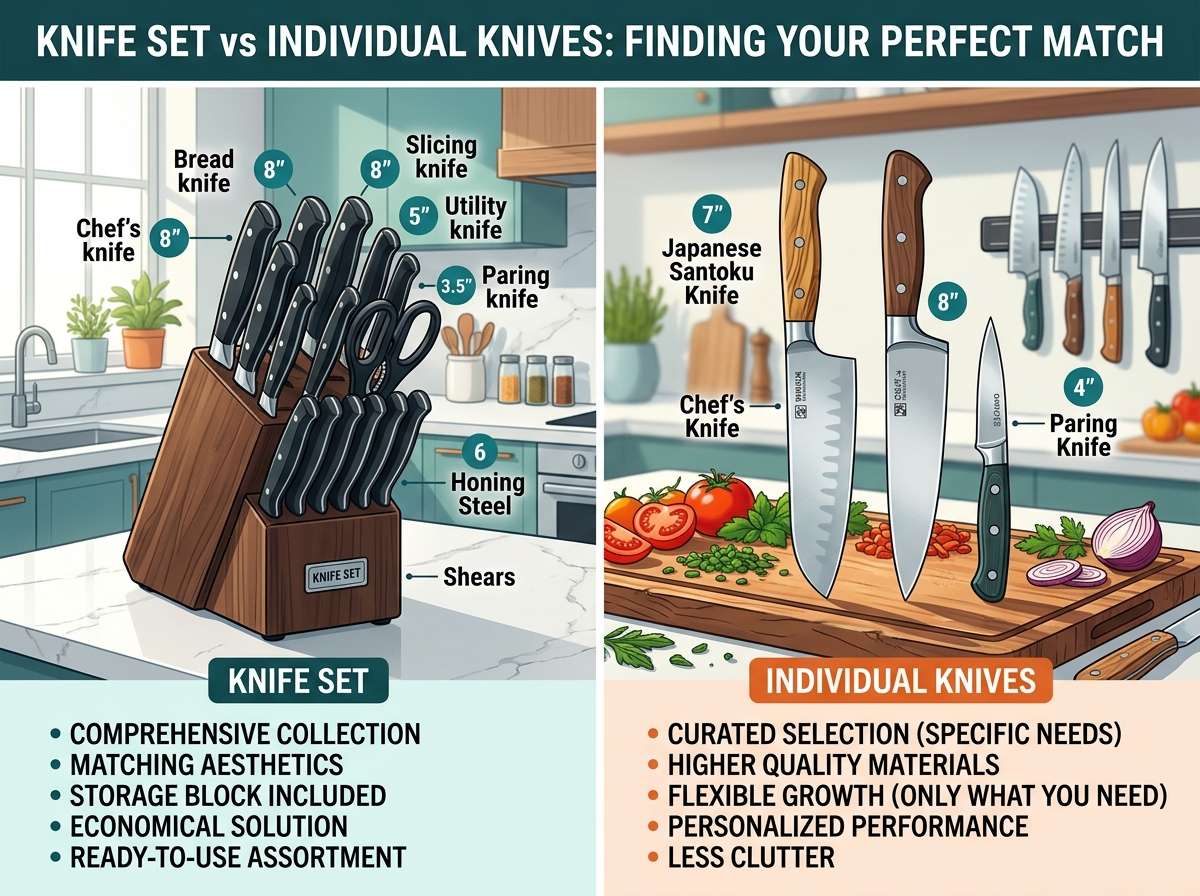
A knife set is basically a bundle of kitchen knives sold together as one package. Most sets come with a storage block or a knife roll that keeps everything organized. You’ll typically find sets with anywhere from 2 to 15 pieces, though the most common ones have between 6 and 10 knives.
Standard knife sets usually include basic cutting tools like a chef’s knife, paring knife, bread knife, and maybe a carving knife or boning knife. Some fancy sets add extra pieces like knife sharpeners, scissors, or other specialty knives you might not really need.
The main appeal of a knife set is simplicity. You buy one box, open it up, and suddenly you have multiple knives ready to go. No hunting around different stores or spending time researching individual options. It’s convenient, and that’s why lots of people love them.
The Appeal of Individual Knives
Individual knives, on the other hand, are exactly what they sound like. You pick out each knife separately based on what you actually need in your kitchen. You buy a chef’s knife from one brand, a paring knife from another, and a bread knife from yet another, if that’s what you want.
This approach takes more time and effort. You have to research each blade, compare brands, check prices, and make separate purchases. But the payoff is that you end up with knives that match your specific cooking habits and preferences.
The Cost Comparison: Money Matters
When it comes to price, knife sets often seem like the better deal at first glance. A set of six knives might cost $50 to $150, which works out to roughly $8 to $25 per knife. A quality individual knife can easily cost $20 to $100 or more depending on the brand and quality.
But here’s where it gets interesting. Most knife sets contain at least two or three knives you’ll never actually use. That’s wasted money right there. If a set costs $100 but you only use half the knives, you’ve really spent $200 per knife for the ones you actually need.
With individual knives, you buy only what you’ll genuinely use. This means you can spend more money on the knives that matter most to your cooking style. You might spend $60 on a fantastic chef’s knife that you use every single day, and only $15 on a basic paring knife for occasional work.
When you do the math honestly, individual knives often end up being cheaper in the long run because you’re not paying for blades that sit in a drawer collecting dust.
Quality Differences Matter More Than You Think
This is really important to understand. Not all knife sets are created equal, and that’s putting it mildly.
Budget knife sets, the ones under $50, typically use low-quality steel that doesn’t hold an edge well. You’ll find yourself sharpening these blades constantly, or worse, they’ll become annoying to use because they feel dull after a few weeks. The handles might also feel cheap and uncomfortable after extended use.
Mid-range knife sets, priced between $75 and $200, offer much better quality. These sets usually have knives that hold their sharpness for longer and feel more comfortable to use. You’re getting into the territory where the set might actually be worth it.
Expensive knife sets, costing $200 or more, can be excellent. But here’s the thing: many high-end knife companies don’t even sell sets. They focus on selling individual premium knives instead. So at the top quality level, you’ll probably be buying individual knives anyway.
Individual knives give you total control over quality. You can spend whatever budget you have on the specific blade you want, and you won’t be forced to buy lower-quality knives just because they’re bundled together.
Storage and Organization in Your Kitchen
Knife sets come with built-in storage solutions. That wooden block or knife roll keeps everything in one place and looks nice on your counter or in your drawer. This organized approach appeals to a lot of people who like things neat and tidy.
The problem is that not all storage solutions work for every kitchen. Some magnetic strips take up valuable counter space. Some blocks are too bulky for small kitchens. And honestly, some of them are just ugly and don’t match your kitchen style.
When you buy individual knives, you get to choose your own storage method. You can use a magnetic strip, a knife block, a knife roll, a drawer organizer, or whatever works best for your space and style. This flexibility is huge if you live in a small apartment or have specific design preferences.
You can also add to your storage over time as you buy more knives. Your setup can grow with your cooking needs instead of being fixed from day one.
Flexibility and Customization
This is where individual knives really shine. You’re not stuck with whatever random selection someone decided to put in a box.
Let’s say you cook a lot of meat. You might want an extra boning knife and a carving knife, plus a heavy-duty chef’s knife. A standard set might have only one of these, so you’d need to buy extras anyway.
Or maybe you do a ton of vegetable prep. You could buy multiple paring knives in different sizes from brands you love, skip the bread knife entirely, and get a special vegetable knife instead.
Individual knife selection lets you build exactly the knife collection you need. Your setup will match your cooking style, your budget level, and your personal preferences. You’re not making compromises for the sake of a package deal.
The Time and Research Factor
Let’s be honest here. Buying a knife set is quick and easy. You look at reviews, pick one that sounds good, order it, and you’re done. The whole process might take 30 minutes.
Buying individual knives takes longer. You need to research each type of blade, compare different brands, read customer reviews for each knife, and probably make multiple purchases. This could take hours over several weeks or months.
If you’re someone who values convenience and doesn’t want to spend time researching kitchen tools, a knife set might be the right choice despite its downsides. Your time has value, and sometimes paying a little extra for convenience is totally worth it.
But if you enjoy learning about tools and getting exactly what you want, the research process for individual knives can actually be fun.
Common Knife Types You Actually Need
Let me tell you about the knives that matter most. Knowing this helps whether you’re looking at sets or individual options.
A chef’s knife is the workhorse of the kitchen. You’ll use this for probably 90% of your cutting tasks. It handles vegetables, meat, herbs, and almost everything else. If you buy only one knife, make it a chef’s knife. An 8-inch chef’s knife is the perfect size for most people.
A paring knife is small and nimble. You use it for tasks like removing seeds from peppers, peeling garlic, or doing detailed work that a big chef’s knife doesn’t handle well. This knife is handy but not essential. Most sets include one.
A bread knife has a serrated edge with big teeth. It cuts through crusty bread without crushing it. If you eat bread regularly, this is worth having. If you never buy fresh bread, you can skip it.
A boning knife has a thin, sharp blade. You use it to separate meat from bone and to work around bone structures. This is useful if you cook with whole chickens or large meat cuts. Otherwise, it’s not necessary.
Most home cooks need really only three knives: a chef’s knife, a paring knife, and maybe a bread knife. That’s it. Everything else in a typical set is bonus stuff you might never touch.
Maintenance and Care
Different knives need different care depending on their quality and construction. High-quality knives need proper maintenance to stay sharp and work well. Budget knives might need less care because you’ll probably replace them sooner anyway.
When you buy a knife set, you’re getting whatever maintenance the manufacturer recommends. You do the same care routine for all the knives, which is simple and straightforward.
With individual knives, you might need to research and follow different care routines for each blade. A German-style knife might need different maintenance than a Japanese-style knife. This adds complexity but also lets you care for each knife in the best possible way.
The good news is that basic maintenance is pretty simple no matter what kind of knife you own. Hand wash your knives immediately after using them, dry them right away, and store them properly. That’s honestly most of what you need to do.
Sharpening and Blade Maintenance
Sharp knives are safe knives, and this applies whether you buy a set or individual options. A dull blade is dangerous because you have to apply more pressure, which makes your hand more likely to slip.
Some knife sets include a honing steel or sharpening tool. These are nice to have, but the cheap ones included in budget sets often don’t work very well. You might end up buying a better sharpening tool anyway.
With individual knives, you can choose exactly which sharpening method works best for your knives and your skill level. You might use a ceramic honing steel, a whetstone, a pull-through sharpener, or take your knives to a professional. It’s all up to you.
Building Your Knife Collection Over Time
One big advantage of buying individual knives is that you can start small and build over time. You don’t need to commit to a big purchase all at once.
Maybe you start with a good chef’s knife. You use it for six months and get really comfortable with it. Then you decide you want a paring knife, so you buy a quality one. Later, you realize you need a bread knife for your new sourdough hobby.
This approach spreads out your spending over time and lets you learn as you go. You get a chance to figure out what you really need instead of guessing when you don’t have much cooking experience yet.
When a Knife Set Actually Makes Sense
Knife sets aren’t bad. They’re just not always the best choice. But there are situations where buying a set really does make sense.
If you’re moving into your first place or getting married and starting a shared household, a nice mid-range knife set gives you everything you need to get cooking right away. You don’t have to worry about what’s missing.
If you’re on a tight budget and need multiple knives at once, a set is usually cheaper than buying several individual quality knives separately.
If you like coordinated looks and want all your kitchen tools to match visually, a set from one brand gives you that unified appearance.
If you’re not really into cooking and just need functional knives without thinking about it much, a decent set gets the job done without requiring research or decisions.
These are all legit reasons to choose a set.
When Individual Knives Win
Individual knives make more sense for most people who cook regularly and care about quality.
If you cook a lot and spend time in the kitchen, investing in individual quality knives pays off every single day. You’ll appreciate the better feel, the sharper blades, and the tools that match your actual needs.
If you have a small kitchen or specific storage preferences, building your own collection gives you way more flexibility.
If you like customization and want your kitchen tools to match your personality and cooking style, individual knives let you do that.
If you plan to keep your knives for many years and use them frequently, higher quality individual knives are a better long-term investment.
Making the Right Choice for Your Situation
Here’s my honest take: the answer depends on your specific situation, not on some universal rule about which option is better.
For beginners who are just starting to cook and want to avoid decision paralysis, a decent mid-range knife set is a totally reasonable choice. You’ll get what you need, and you can always upgrade to individual knives later as your skills improve.
For people who cook regularly and know what they like, individual knives let you build the perfect collection that matches your needs and preferences.
For anyone in between, here’s a practical approach: buy one or two excellent individual knives to start with, then see what else you need as you cook more. This gives you the best of both worlds without forcing you to commit to a full set or spend tons of money upfront.
Tips for Buying Knives, No Matter Which Route You Choose
Read real customer reviews from actual people who use the knives regularly. Online reviews tell you a lot about how knives perform in real kitchens.
Hold the knife if you can. A knife should feel balanced and comfortable in your hand. What works for someone else might not work for you.
Think about your actual cooking habits, not what you think you should cook. If you never make bread, don’t buy a bread knife. If you only cook simple meals, you don’t need specialty knives.
Don’t get distracted by fancy features or beautiful designs. A knife’s job is to cut, and that’s what matters most. Looks are a bonus.
Spend more on knives you’ll use frequently and less on the ones you’ll rarely touch.
The Bottom Line
Knife sets offer convenience, coordination, and simplicity. They’re good for getting started without overthinking decisions. Individual knives offer quality, flexibility, and customization. They’re good for people who want exactly what they need and are willing to take time to choose.
Neither option is wrong. It’s about figuring out which approach matches your cooking style, budget, kitchen space, and how much time you want to spend thinking about knives.
If you’re just starting out, a decent knife set gets you cooking without stress. As you develop your skills and figure out what you actually need, you can always trade up to individual quality knives.
The most important thing is that you have sharp, functional knives in your kitchen. Whether they come as a set or separately matters way less than actually using them to cook good food.
Start somewhere, use your knives regularly, and learn what works best for you. That’s really the path to building the right knife collection for your kitchen.

Mary is a home cooking enthusiast and kitchen gear reviewer with a passion for practical cookware and food preparation tools. She enjoys testing cutting boards, knives, kitchen gadgets, and other cooking essentials to help home chefs make smarter buying decisions. Through KitchenCutting.com, Mary shares honest product reviews, buying guides, and helpful kitchen tips to make cooking easier, safer, and more enjoyable.