5 Best Color Coded Cutting Board Set In 2026
As an Amazon Associate we earn from qualifying purchases.
Color coded cutting board sets use different colors to show which board should be used for which type of food. A common pattern is red for raw meat, blue for fish, green for fruits and vegetables, and yellow for cooked food or bread. This guide helps beginners see what a strong color coded cutting board set looks like and how five popular options differ.
All five products are plastic, come as multi-board sets, and use a color system to help keep food types apart. They differ in size, thickness, flexibility, cleaning method and price. This comparison rests on the listed features and typical use of each set, not on personal testing. Read each product page for the exact dimensions and care instructions before you buy.
Before comparing products, it helps to know why color systems exist. Raw meat, seafood and produce can carry different bacteria, so using separate boards reduces the chance of one food contaminating another. Color coding makes that separation quick to follow, even on a busy weeknight. The colors are a convention rather than a universal standard, so some households adapt the scheme to their own needs.
Color systems work best when everyone in the kitchen follows them. A set with clear labels or icons is easier to share with family members who cook occasionally. Good habits matter as much as the boards themselves, such as washing each board after use and drying it fully before storing.



1. Color Coded Cutting Boards Set of 4: best for everyday home prep with a holder
This set includes four plastic boards, each with a food icon, plus a storage holder. It suits home cooks who want clear food separation and tidy storage. The boards are a common size for daily family cooking, large enough for a few servings of vegetables without crowding the counter.
What it is and who it suits
The set uses red for meat, blue for fish, green for fruits and vegetables, and yellow for cooked food or bread. The icons help people who may not remember the color rules, including children who help in the kitchen. Households that cook several types of food each week are the most natural fit. Someone who cooks only one or two dishes may find fewer boards are enough.
Best use cases
The boards work well for chopping vegetables, slicing meat for dinner, and preparing bread or cooked items. For example, you might cut raw chicken on the red board, then move to the green board for salad ingredients without washing in between. The juice groove catches liquids from raw meat or juicy fruit, such as melon or tomatoes. The holder keeps the boards upright and off the counter after washing.
Key features in plain words
A juice groove is a small channel around the edge that traps liquid. Silicone corners and handle are soft, grippy materials that help the board stay in place. The boards are described as thicker than standard cutting mats, which means they feel more solid under a knife. Thicker boards also tend to resist warping better, though thickness alone does not guarantee durability.
Daily use and performance
In daily use, the non-slip corners help reduce sliding during chopping. The thickness adds stability, which matters when cutting dense vegetables such as squash or carrots. The ventilated holder allows air to reach the boards, which helps them dry faster and reduces the chance of trapped moisture. Users who chop large amounts of food may notice the stability difference most.
Ease of cleaning and value for money
The boards can be washed by hand or in the dishwasher, so cleanup is flexible. At the listed price, the set sits in the lower-middle range for color coded sets. Buyers get a holder and gift-ready packaging, which adds practical value. Comparing the price with the number of boards and included accessories helps show if the cost fits your budget.
Pros
- Clear food icons make the color system easy to follow
- Juice groove and non-slip corners help keep the counter tidy and the board steady
- Holder helps boards dry and stay organized
- Dishwasher safe for quicker cleanup
Cons
- Only four boards, so there is no separate color for every food category
- Plastic can show knife marks over time, as with most plastic boards
- Gift packaging adds no cooking benefit for users who are only buying for themselves
2. Hakka Commercial Cutting Board-6 Pack: best for heavy prep in busy kitchens
This six-board pack is built for large volumes of food prep. It suits restaurants, catering teams and home cooks who prepare big meals. The boards are larger and thicker than most home sets, so they handle heavier daily work.
What it is and who it suits
The set includes six colors, which gives more room to separate food types than a four-board set. Commercial kitchens often need several boards for different ingredients at once. Keeping raw meat, produce and cooked food on separate boards is easier when each has its own color. Staff can also learn the system quickly, since each color has one job.
Home cooks who batch-cook for crowds may also find this useful. If you prepare meals for a large family, a holiday gathering or a weekly meal prep routine, having several boards ready saves time. For example, you can chop vegetables on one board while meat is already portioned on another. You can keep one batch moving while another is still in progress.
Best use cases
The large 18 by 12 inch surface suits chopping big batches of vegetables, portioning meat, or preparing seafood. You can spread out a full cutting job, such as dicing a tray of onions, without crowding the board. The half-inch thickness helps the board stay steady under heavy use. The non-slip edges help keep the board in place while you work.
The set also works well for stations. Assign one color to fruit, one to vegetables and one to proteins, so each task has a dedicated surface. This habit reduces the need to wash a board between every ingredient. It also makes it easier to spot which board has been used for which food.
Daily use and performance
In busy use, the wide surface gives room to work without crowding the board. The thickness helps it resist bending, so it stays flat during long prep sessions. The non-slip edges help it stay put when cutting firmly, which matters most when you are working quickly with a sharp knife.
The high-density plastic is described as resistant to warping, cracking and heavy knife wear. Even so, all plastic boards show knife marks with heavy use. Careful cleaning helps keep the surface in good shape. Replacing a board once deep grooves form is a sensible habit, since grooves can trap food particles that are hard to remove.
Ease of cleaning and value for money
The non-porous surface helps prevent stains and odors from building up. Porous materials such as untreated wood can absorb liquids, so a non-porous surface is easier to keep hygienic. The boards are listed as safe for commercial dishwashers, which speeds up cleanup after a big shift. Check the manufacturer’s care notes before washing, since heat and harsh detergents can affect any plastic over time.
At the listed price, the six-board pack is among the higher-priced options here, which reflects its size and build. Buyers should compare the cost per board and consider if they will use all six regularly. For occasional cooking, a smaller and less expensive set may be enough. Spending more only makes sense if the extra boards will see frequent use.
Pros
- Six colors give more separation options than smaller sets
- Large, thick boards suit high-volume prep
- Non-slip edges help keep the board steady
- Non-porous surface resists stains and odors
Cons
- Large size takes up more counter and storage space
- Higher price than the smaller sets in this list
- Heavier boards can be harder to lift and move when full
3. Extra Thick Flexible Plastic Cutting Board Mats: best for portable use and easy transfers
This set of six thin, bendable mats suits people who want light, portable boards. It fits camping trips, RV kitchens and small apartments. The mats are much thinner than the solid boards in this list, so they trade some firmness for convenience.
If you often prep food away from your main kitchen, a light set like this can be a helpful addition. It is also a simple option for anyone who wants a few boards without the weight of a thick wooden or plastic slab.
What it is and who it suits
The mats are flexible plastic sheets with food icons and a color system. Each mat measures 15 by 11.5 inches, which is enough room for everyday chopping. People who need to store boards in small spaces will find them practical, since they slide into a drawer or a narrow gap easily.
A typical use case is a small apartment with limited counter space. A stack of six thin mats can sit in a cabinet slot that a single large board would not fit into. They also suit students and people who move often, since they take little room in a box.
The icons help you keep track of which mat is for which food. This is useful in a shared kitchen, where others may not remember the color system. Icons also make the set easier to use for guests who are helping with food prep.
Best use cases
The mats work well for moving chopped food from the counter to a pot. You can fold one into a funnel and pour ingredients straight in, which avoids scraping food off a rigid board. For example, you can dice an onion on one mat and tip it into a skillet in a single motion. They also suit outdoor cooking, where a light board is easier to carry to a campsite or picnic table.
Because the mats are cheap to replace, some people keep a few spares for trips. A stack of mats takes little room in a bag or cooler, and each one can be used for a different food type on the road. Separating raw meat, produce and ready-to-eat foods on different mats can also make cleanup simpler.
Key features in plain words
Flexible means the mat bends without breaking. This lets you lift it and tilt it to slide food into a container. A waffle back is a textured pattern on the underside that grips the counter. The mats are BPA-free, which means they do not contain the chemical bisphenol A, and they are described as food safe.
The extra thick label refers to the mat’s build, but these mats are still thinner than the solid boards in this list. Thickness on a mat affects how firm it feels, not how long it lasts. Check the product details for exact measurements before you buy, since listed specifications can change between sellers.
Daily use and performance
In daily use, the mats are steadiest on a clean, damp counter or over a towel. The damp surface or towel helps the waffle back grip, so the mat does not slide as you cut. Because they are thin, they will not feel as solid as a thick board under a knife. They suit light chopping better than heavy slicing.
For tougher jobs, such as breaking down a large cut of meat, a thicker board is a better choice. Use these mats for herbs, fruit, vegetables and similar light prep. Keeping the right tool for each task makes the mats last longer and feel more secure. Avoid cutting directly through the mat onto a hard surface, since this can dull knives faster.
Ease of cleaning and value for money
The mats are dishwasher safe on the top rack. Skipping the heated-dry cycle helps them keep their shape. Hand washing with warm soapy water also works well and avoids any risk of warping from heat. Rinse them soon after use so that juices and strong-smelling foods do not sit on the surface.
At the listed price, six mats are among the lowest-cost options here. For people who need a light, portable set and do not need a heavy-duty board, this is a practical value. Buyers who cut hard or heavy foods often should look at thicker options instead, since a cheap thin mat may need replacing sooner under heavy use.
Pros
- Lightweight and easy to store or carry
- Bendable design helps move food with less mess
- Low price for a six-piece set
- Dishwasher safe on the top rack
Cons
- Thin mats feel less stable than solid boards under heavy cutting
- Smaller surface than the large boards in this list
- Must be placed on a clean, damp surface or towel to stay steady
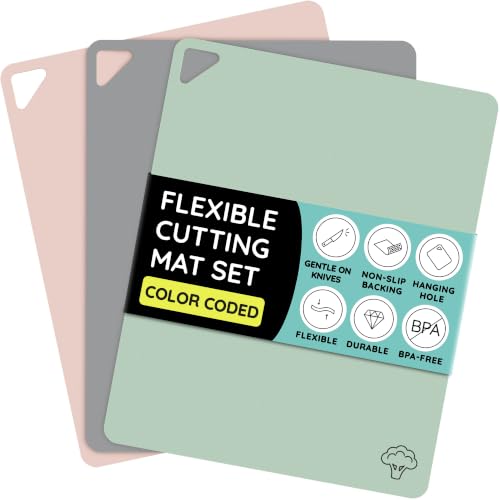
4. Flexible Plastic Cutting Board Set of 3: best for budget-minded daily prep
This three-mat set offers a basic color system at a low price. It suits people who want simple, flexible boards for cold food prep. It is not made for heat or heavy commercial use.
What it is and who it suits
The set includes three colored mats, each 15 by 12 inches. The colors are meant for raw meat, vegetables and fruit. It suits people who prepare a few types of cold food and want a simple system.
Best use cases
Best use cases
These mats suit chopping vegetables, slicing fruit and portioning raw meat or fish for cooking. The flexible design makes it easy to slide ingredients into a bowl or pot. Light weight also makes them simple to pull out of a drawer.
Key features in plain words
The waffle grip on the back helps hold the mat against the counter. Each mat is described as light, weighing under 2 ounces. A triangle hanging hole lets you hang the mat for storage.
Daily use and performance
In daily use, the waffle grip helps the mat stay put during quick cuts. Because the mats are thin and bend easily, they feel less solid than thick boards. They are best kept to cold food, since the product is not heat resistant.
Ease of cleaning and value for money
These mats are hand wash only, so each cleanup takes a little more time. The non-porous surface is described as resistant to stains and odors. At the listed price, this is one of the lowest-cost sets in this round-up.
Pros
- Very low price for a three-mat color system
- Flexible and lightweight for easy transfers
- Waffle grip helps the mat stay in place
- Hanging hole makes storage simple
Cons
- Hand wash only, which adds time to cleanup
- Not heat resistant, so it cannot be used near hot cookware
- Only three colors, which covers fewer food categories
5. 3PCS Commercial Color Coded Cutting Board Set: best for sturdy, thick boards in professional-style prep
This three-board set uses thick, rigid boards made for commercial-style food prep. It suits restaurant staff, caterers and home cooks who want a solid surface. The boards are heavier and thicker than most options here.
What it is and who it suits
The set includes red, blue and green boards for raw meat, seafood and fruit or vegetables. Each board is 18 by 12 inches and about three-quarters of an inch thick. It suits people who value a firm, steady cutting surface.
Best use cases
The boards are suited to slicing, chopping and portioning large amounts of food. The thickness gives a rigid surface under a knife. Because each board weighs about 5 pounds, they stay put once placed on a counter.
Key features in plain words
Polyethylene is a type of food-grade plastic. Non-porous means the surface does not soak up liquids, which helps reduce stains and odors. The boards are described as knife-friendly and resistant to lingering smells.
Daily use and performance
In daily use, the solid build feels steady under firm cutting. The heavy weight means the boards are less likely to slide, but they are harder to lift and move. Hand washing is recommended, since repeated dishwasher use may cause warping over time.
Ease of cleaning and value for money
Cleaning involves hand washing, which takes more effort than dishwasher-safe options. The boards stack neatly when clean and dry, which helps storage. At the listed price, this set sits in the higher range, reflecting its size and thickness.
Pros
- Thick, rigid boards give a solid cutting surface
- Non-porous surface resists stains and lingering odors
- Matching sizes make stacking and storage tidy
- Color system covers meat, seafood and produce
Cons
- Heavy boards are harder to lift and wash
- Hand washing is recommended, so cleanup takes more effort
- Only three boards, so fewer colors than the six-board pack
Frequently Asked Questions about Color Coded Cutting Board Sets
What do the colors on a color coded cutting board set mean?
The colors are a visual system that tells you which board to use for which food. This helps you keep raw and cooked foods apart, which lowers the chance of cross-contamination. A common pattern is red for raw meat, blue for seafood, green for fruits and vegetables, and yellow for cooked food or bread.
Color schemes are not the same across every brand. One set might use orange for dairy, while another uses white for bread. Always check the color key that comes with your specific set before you start cooking, and keep that key where you can see it. A quick glance at the key in the moment is far easier than trying to remember which color a brand assigned to which food.
Are plastic cutting boards safe for food?
Food-grade plastic is made for contact with food, and BPA-free plastic does not contain bisphenol A. Plastic boards are widely used in kitchens because they are lightweight, easy to clean and usually less expensive than wood. Look for food-grade or food-safe wording on the packaging or product page.
Plastic boards do wear down over time. Replace boards that become deeply grooved or cracked, since those spots can trap food and bacteria. Light scratches from normal use are generally expected, but deep cuts that you cannot clean out are a sign that it is time for a new board. Running a hand over the surface after washing is a simple way to check for rough or deeply worn areas.
Can I put color coded cutting boards in the dishwasher?
Some sets are labeled dishwasher safe, while others are hand wash only. Check the product details before washing, because high heat and strong detergents can warp or dull some boards. If the label does not mention the dishwasher, assume it is not safe for one until the maker confirms it.
For sets that say hand wash only, warm water and mild soap are the usual approach. Rinse each board right after use, then dry it fully before you store it. Standing a board on its edge in a drying rack helps air reach both sides and reduces the chance of moisture building up. Trapped moisture can encourage warping over time, so this step matters even when you wash by hand.
Do I need a separate board for every food type?
Not always. Many home cooks use two or three boards for meat, produce and bread, and that setup covers most everyday meals. You can start small and add boards later if you find you are cleaning in the middle of a task more often than you would like.
A larger set helps when you prepare many types of food in one session, such as a holiday meal with raw poultry, fresh herbs and baked goods. It reduces the need to wash boards in the middle of a task, which saves time and keeps your workflow steady. Extra boards also let you keep a board for ready-to-eat foods away from anything that has touched raw meat.
Which set is best for a beginner?
A beginner often does well with a smaller set that is easy to clean and store. A set of three to four boards covers the main food groups without taking up much counter or drawer space. Smaller boards are also easier to lift, wash and dry by hand.
The right choice depends on how much you cook, how much space you have and your budget. If you cook most meals with meat and vegetables, a set that includes those colors is a practical place to start. Matching the set to your daily habits usually works better than picking the largest option, since a board you rarely use takes up space without adding much value.

Mary is a home cooking enthusiast and kitchen gear reviewer with a passion for practical cookware and food preparation tools. She enjoys testing cutting boards, knives, kitchen gadgets, and other cooking essentials to help home chefs make smarter buying decisions. Through KitchenCutting.com, Mary shares honest product reviews, buying guides, and helpful kitchen tips to make cooking easier, safer, and more enjoyable.