
5 Best Antibacterial Cutting Board In 2026
If you have ever pulled a board out of the sink and noticed deep knife grooves, you already know that cutting boards are not as simple as they look. They sit at the center of food prep, take a beating from knives, and touch raw chicken, fresh vegetables, and bread on the same day. That is why shoppers often search for the best antibacterial cutting board. They want a surface that stays cleaner, lasts longer, and makes kitchen life a little safer.
In this article
This guide looks at five boards that are often grouped together in listings: a titanium and polypropylene dual-sided board from SUMZZZ, a three-pack of Microban plastic boards from Neoflam, a stainless steel board from SNOWCLAD, and two titanium board sets in three sizes. We will go through each one in plain language, talk about what they do well, and point out where they fall short. We will also cover what “antibacterial” really means, because that word causes a lot of confusion.
One quick note before we start. The details in this review come from the product listings, material properties, and general food safety guidance. Product specs, prices, and included accessories can change, so always check the seller page before you buy.
Quick Look at the Five Boards
Here is a short overview so you can see how the boards compare at a glance.
| Board | Main Material | Format | Standout Feature | Best For |
|---|---|---|---|---|
| SUMZZZ Titanium Board | Titanium and PP | Single board, dual-sided | Separate sides for raw and cooked food | Small kitchens, careful cooks |
| Neoflam Microban 3-Set | Antimicrobial plastic | Three boards | Color-coded set with grip handles | Families, budget-minded buyers |
| SNOWCLAD Stainless Steel | Stainless steel | Single board | Non-porous, non-toxic surface | Hard-use prep, easy sanitizing |
| Titanium Set of 3 (Upgraded) | Pure titanium claim | Three sizes, non-slip, double-sided | Size variety with non-slip design | Full kitchen setups |
| Titanium Set of 3 (M+L+XL) | Titanium | Three sizes | Similar to the upgraded set | Shoppers comparing titanium value |
What “Antibacterial” Really Means for a Cutting Board
Before we dive into the products, it helps to get clear on the word “antibacterial.” Many shoppers assume a board with that label will keep food completely free of germs. That is not how it works.
There are two different ideas hiding behind the marketing. The first is a surface that has an added agent, often a silver-based or other antimicrobial compound, that slows bacteria growth on the board itself. The Neoflam boards use this approach with Microban technology. The second idea is a surface that is naturally non-porous, meaning bacteria and food juices have a harder time sinking into it. Stainless steel and titanium fall into this group. Non-porous does not mean sterile. It means the surface is easier to clean and less likely to hold onto moisture and food particles.
Even with an antimicrobial additive, the board still needs regular washing. A board that is covered in raw chicken juice and left on the counter will not stay clean just because of a chemical treatment. Think of the antibacterial feature as an extra layer of help, not a replacement for good habits.
It is also worth knowing that the claim on the board usually refers to the plastic or surface material itself, not to your food or your hands. Keep that in mind as you read the reviews below.
How These Boards Were Judged
To keep this review fair, each board was judged on the same basic points. We looked at the material and how it handles bacteria and moisture, how easy it is to clean, how it treats your knives, how stable and comfortable it is during use, and how the price compares to what you get. We also looked at extra features such as juice grooves, handles, non-slip feet, and dishwasher safety.
None of these boards were judged on hype. If a listing made a bold claim, we looked for the reason behind it. If a feature was missing, we pointed that out. Honest trade-offs matter more than a perfect score, so you will see plenty of both strengths and weaknesses in the sections below.
Product Reviews
1. SUMZZZ Titanium Cutting Board
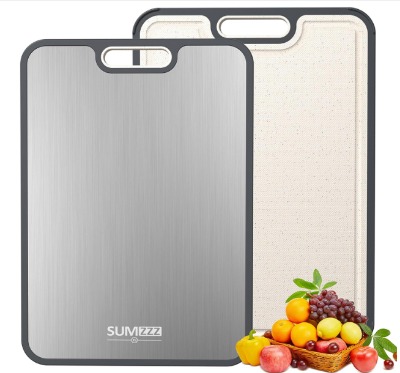
The SUMZZZ board is a single, dual-sided board with a titanium surface on one side and polypropylene (PP) on the other. The listing puts a strong focus on separating raw and cooked food, which is one of the most useful ideas in home food safety. Having one side for raw meat and the other for vegetables or bread makes it easier to avoid cross-contamination when you work fast.
Best use cases: This board works well for anyone who cooks a lot of meat and vegetables in the same session. It is also a good fit for small kitchens where you only have room for one board. If you often prep a quick dinner for two, this format keeps things simple.
Key features explained simply: Titanium is a hard, non-porous metal that does not soak up juices the way wood does. Polypropylene is a food-grade plastic that is light and easy to wash. Put together, the board gives you two different surfaces in one piece. The listing describes the board as odor resistant and easy to clean, which fits the material. Non-porous surfaces tend to hold smells less than porous ones, although no board stays odor-free forever.
Real-life usage insight: Titanium is very hard. That is good for durability, but it also means your knives will likely dull faster than they would on wood or soft plastic. Many home cooks notice this first. Keeping a honing rod nearby and sharpening knives more often helps. The PP side is kinder to blades, so many people use it for meat or softer tasks and save the titanium side for other work. The two sides also feel a little different underfoot on the counter, which is something to be aware of if you like a very stable surface.
Honest pros:
- Two sides in one board helps separate raw and cooked food.
- Titanium resists moisture and staining better than many wood boards.
- Easy to wipe down and rinse after use.
- Good option for a small kitchen.
Honest cons:
- Titanium can dull knives faster than softer boards.
- The board may slide if the counter is smooth and there is no grip underneath.
- Two different materials mean you need to clean both sides carefully to keep things sanitary.
- A single board means you still need a plan for keeping things separate if you cook for a crowd.
Performance discussion: In normal use, the board handles chopping, slicing, and dicing with no trouble. The titanium side feels solid and does not warp easily, which is a common issue with thin plastic boards. The PP side is softer and quieter under the knife, so it is more comfortable for repetitive cutting. Overall, the board performs well for everyday tasks, but it is not the best choice if you want a knife-friendly surface above all else.
Ease of use: Setup is simple, since there is nothing to assemble. Cleaning is quick with warm soapy water. Make sure you dry the board fully before storing it, especially where the two materials meet.
Value for money: This board sits in the middle of the group. You are paying for a clever dual-sided design and a hard-wearing surface. If you only want one board and you care about separating food types, it offers good value. If you need several boards for a busy kitchen, a set may make more sense.
2. Neoflam Microban Antimicrobial Plastic Cutting Board 3 Sets
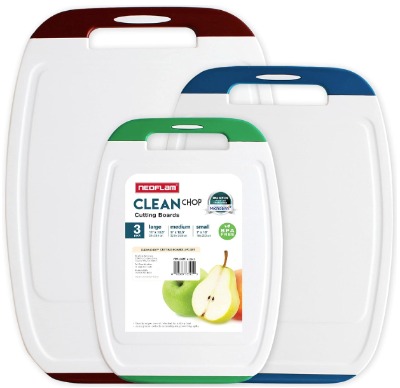
The Neoflam set is the most family-friendly option in this roundup. You get three plastic boards that are reversible, dishwasher safe, and built with Microban antimicrobial protection. The listing also highlights BPA-free plastic, non-slip EZ grip handles, a larger juice groove, and a multicolor design that helps you sort boards by task.
Best use cases: This set suits families, meal preppers, and anyone who wants a separate board for each food type without spending a lot. Color coding is especially useful if several people share the kitchen and need a clear system.
Key features explained simply: Microban is an antimicrobial additive built into the plastic. It is designed to slow bacteria growth on the board surface, which is a helpful extra layer. The grip handles make the boards easier to lift and tilt, and the larger juice groove holds more liquid from meat or fruit so it does not spill across the counter. Being reversible means you get two working sides per board, and dishwasher safety saves time on cleanup.
Real-life usage insight: Plastic boards are kind to knives, which is one of their biggest advantages. They also feel lighter and are easy to move from the counter to the sink. Over time, though, plastic can develop knife grooves. Those grooves are where bacteria and food particles can hide, even on an antimicrobial surface. Replacing boards once they look heavily scarred is a smart habit. In practice, many people keep one board for raw meat, one for produce, and one for bread or cheese, and they replace the meat board first.
Honest pros:
- Three boards give you good separation for different foods.
- Color coding makes it easy for everyone in the house to follow the system.
- Kind to knife edges compared with metal or titanium.
- Dishwasher safe, which makes cleanup faster.
- The juice groove helps keep counters tidier.
Honest cons:
- Antimicrobial additives support cleanliness but do not replace washing.
- Plastic develops knife marks over time, which can hold bacteria if not cleaned well.
- Lighter boards can slide on smooth counters unless the grip handles are used.
- Hot dishwasher cycles may cause warping over the long run.
Performance discussion: The boards perform well for everyday chopping. They feel stable enough for most home tasks and are easy to control thanks to the handles. The juice groove is useful when you slice meat or juicy tomatoes. The main performance limitation is durability. Plastic will wear out sooner than titanium or stainless steel, so you should expect to replace these boards more often.
Ease of use: This is one of the easiest sets to use. Grab a board, prep, rinse, and place it in the dishwasher. The handles make lifting simple, and the color system takes almost no thinking.
Value for money: For the price, you get three boards with a clear workflow and a cleanup routine that is hard to beat. It is probably the best value of the group if you need multiple boards and want to keep spending low. The trade-off is lifespan, since plastic does not last as long as metal.
3. SNOWCLAD Stainless Steel Cutting Board
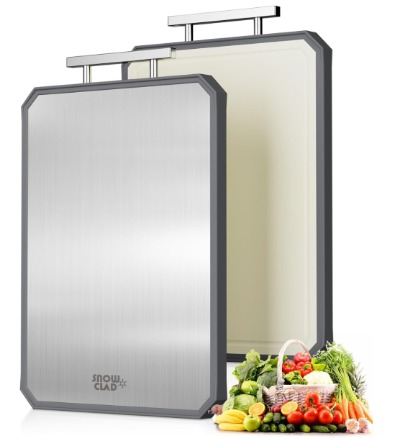
The SNOWCLAD board is a stainless steel cutting board marketed as non-toxic and suitable for kitchen chopping. The listing is brief, so it is best to treat the details as general characteristics of stainless steel rather than a long list of extra features.
Best use cases: Stainless steel works well for people who want a board that does not absorb anything and can be sanitized easily. It is a good option for cutting dry or lightly moist foods, rolling dough, or prepping items where you want a clean, flat surface. Some cooks also like it for working with sticky or oily ingredients because nothing soaks in.
Key features explained simply: Stainless steel is non-porous, so juices and oils do not seep into the metal. It does not hold odors and it is simple to wipe clean. Stainless steel is also very resistant to rust and staining. The listing calls it non-toxic, which matches the general safety profile of food-grade stainless steel when it is used normally.
Real-life usage insight: Stainless steel is hard on knives. It can dull blades quickly, and cutting on it can make a sharp, clicking sound that some people find annoying. The surface is also slippery, so the board may move around while you work unless you place a damp towel or non-slip mat underneath. Heavy use can leave light scratches, but these do not usually trap food the way deep plastic grooves do. Stainless steel is best used for tasks that are not very knife-intensive, such as chopping herbs, mincing garlic, or working with pre-cut ingredients.
Honest pros:
- Non-porous surface that resists moisture, stains, and odors.
- Easy to sanitize in hot water and mild soap.
- Will not warp, crack, or split.
- Simple, clean look that suits modern kitchens.
Honest cons:
- Hard on knife edges, which means more frequent sharpening.
- Can slide around on the counter without a grip.
- Noisy during chopping.
- Heavier than plastic, which may be a hassle for some people.
- The product listing offers limited detail about its exact grade and finish.
Performance discussion: The board is stable and reliable for light to medium prep work. It does not give under pressure and it keeps its flat surface over time. However, it is not the most comfortable choice for long, heavy chopping sessions. Many cooks find the hard surface tiring and the noise distracting. For a full meal prep day, a softer surface may feel more pleasant.
Ease of use: Cleaning is very easy. Rinse, wash with soap, and dry. Because the surface does not absorb liquids, there is little risk of lingering smells. The main effort is keeping the board from sliding, which a damp towel underneath solves well.
Value for money: The value depends on how you cook. If you want a long-lasting, low-maintenance surface for light prep, the price is reasonable for what you get. If you do a lot of knife work, the extra sharpening may add hidden costs over time.
4. 100% Pure Titanium Cutting Board Set of 3 (M+L+XL)
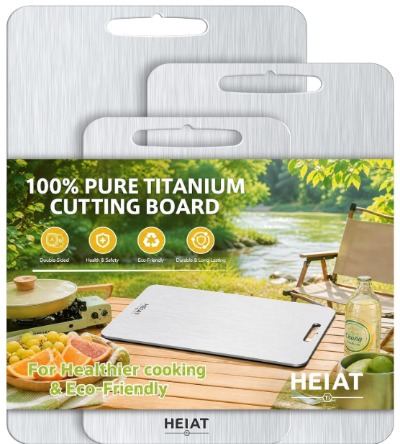
This set is part of the titanium family and is presented as an upgraded version with three sizes: medium, large, and extra-large. The listing highlights non-slip double-sided surfaces, separate use for raw and cooked food, and dishwasher safety. It is marketed as a full kitchen solution with variety in size.
Best use cases: The three-size format is handy for home cooks who want a board for every job. The medium board works for small tasks like garlic or a single fruit, the large board fits most daily cooking, and the extra-large board gives you room for bigger jobs like cutting a whole melon, a chicken, or a bunch of vegetables. This set also suits people who entertain and need extra workspace.
Key features explained simply: Titanium is hard, non-porous, and corrosion resistant. The listing says the boards are double-sided and non-slip, which is useful because a board that stays in place feels much safer. Being dishwasher safe means cleanup is easy, though you should check the care instructions to see how the finish holds up over time.
Real-life usage insight: The three sizes are the biggest practical advantage here. Having a small board for quick tasks means you do not have to drag out your largest board for a single onion. The downside is storage. Three boards take up more space in a drawer or on a rack. Titanium is also hard on knives, so the same sharpening habits apply as with the SUMZZZ board. Using a lighter touch and keeping blades sharp will reduce strain on both the knife and the board.
Honest pros:
- Three sizes cover a wide range of tasks.
- Double-sided design gives extra working room.
- Non-slip design helps keep the board stable.
- Non-porous surface resists moisture and odors.
- Dishwasher safe for quick cleanup.
Honest cons:
- Titanium dulls knives faster than softer materials.
- Three boards need more storage space.
- Titanium is heavier than plastic, so the extra-large board can be awkward to move.
- Marketing language about “100% pure” titanium is not something a shopper can verify from the listing alone.
- Non-slip features vary, and grip performance depends on your counter surface.
Performance discussion: These boards feel sturdy and do not bend or flex under normal pressure. The non-slip feature works best on a clean, dry counter. Cutting on titanium is smooth and stable, though the hardness means the knife will not glide as gently as it does on wood. The XL size is the most useful for big prep jobs, and the M size is handy for small jobs that would otherwise take over a larger board.
Ease of use: Using multiple boards is simple once you assign a task to each one. Cleaning is quick and the boards go in the dishwasher. The main effort is storage and remembering which board is for which food.
Value for money: For shoppers who want a full set of titanium boards in several sizes, the price is fair. You are paying for variety and a durable surface. If you only need one board, the set may be more than you need.
5. Titanium Cutting Board Set of 3 (M+L+XL)
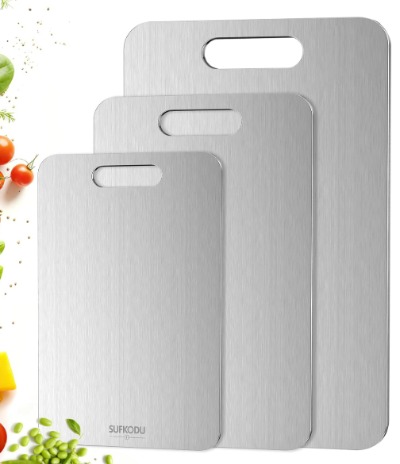
This set is very close to the previous one in size, material, and general description. It also includes medium, large, and extra-large titanium boards. The listing is similar in focus, with an emphasis on titanium as a surface for both raw and cooked food.
Best use cases: The use cases match the previous set. This is a good choice for home cooks who want multiple sizes of titanium boards without extra fuss. It suits small families and anyone who likes to keep separate boards for different food groups.
Key features explained simply: The main features are the same: titanium construction, three sizes, and an overall non-porous surface that resists moisture and odor. Titanium is a durable material that keeps its shape well and does not rust. The set is designed for everyday kitchen work and easy cleaning.
Real-life usage insight: Because this set is so similar to the previous one, the everyday experience will feel almost identical. You will still get the hardness of titanium, which means sharper knives will need more frequent attention. You will still need to think about storage space for three boards. The main thing to check is whether the finish, edges, and grip details match what you need, since these can vary between sellers and listing versions.
Honest pros:
- Three sizes give you flexibility for different jobs.
- Titanium is durable and resists staining and odors.
- Easy to clean and rinse.
- Solid, stable feel on the counter.
Honest cons:
- Titanium is hard on knives.
- Three boards take up storage space.
- The listing overlaps heavily with other titanium sets, which can make it hard to tell what is different.
- Heavier than plastic, which can make the largest board harder to handle.
Performance discussion: Performance mirrors the previous set. The boards are firm and reliable for chopping and slicing. They keep their shape and do not warp easily. The main trade-off is comfort during long sessions, since titanium is not as gentle on the hands and blades as wood or plastic.
Ease of use: Using and cleaning these boards is straightforward. Keep a system for sizes and tasks, and the set will feel simple to manage. Dry each board fully before stacking to prevent trapped moisture.
Value for money: Because this set is so similar to the previous one, price is the main factor. Compare both listings carefully, check the seller’s details, and buy the set that offers the best deal with the features you need. If the two listings are effectively the same product, the lower price wins.
Comparison Insights
Looking at all five boards together, a few clear patterns appear.
The first pattern is material. Titanium and stainless steel are both non-porous and resist moisture well, but both are hard on knives. Plastic, especially the Microban-treated boards, is much kinder to blades but wears out and grooves over time. If you care most about keeping your knives sharp, plastic or a softer surface is the better path. If you care most about longevity and a surface that stays flat for years, titanium or stainless steel will serve you well.
The second pattern is format. The SUMZZZ board is a single dual-sided piece, which suits small kitchens. The Neoflam set and both titanium sets give you multiple boards, which is more practical for busy cooks who want to keep food types separate. Three boards are easier to manage when you have a clear routine, but they need more storage.
The third pattern is cleaning and maintenance. All of these boards are easy to clean. The plastic boards and the titanium sets are dishwasher safe, which speeds up the process. The stainless steel board is simple to hand wash, and the SUMZZZ board works well with warm soapy water. Whichever you choose, the rule stays the same: wash right after use, dry fully, and store upright or flat with air flow.
The fourth pattern is value. The Neoflam set gives you the most boards for the lowest commitment, while titanium sets cost more but aim for longer life. The single stainless steel and SUMZZZ boards sit in the middle, with each offering a clear use case for different kinds of kitchens.
Finally, the two titanium sets are almost identical. Shoppers should compare the details carefully, since small differences in finish, grip, or seller policies may matter more than the headline features.
Buying Guide
Before buying any cutting board, it helps to think about how you cook. A few simple questions will point you toward the right choice.
How often do you cook? If you cook most nights, you will go through boards faster and may benefit from multiple boards in a set. If you cook a few times a week, a single well-chosen board may be enough.
What do you cut most? Heavy meat prep leans toward plastic or a board you can replace easily, since knife grooves build up. Lots of vegetables and herbs work well on almost any surface. Bread and cheese prefer a clean, dry board with no juice grooves in the way.
How many people share your kitchen? Families benefit from color-coded sets because everyone can follow the system. Solo cooks may prefer one or two boards that fit their workflow.
How much counter space and storage do you have? Large titanium boards need room, and multiple boards need a place to dry. If your space is limited, a single dual-sided board may be the better fit.
How much do you care about knife sharpness? If you own expensive knives or enjoy precise cutting, avoid hard surfaces like titanium and stainless steel for daily use. Softer plastic or other kind surfaces will protect your blades better.
Does the board need to stay put? If your counter is smooth, look for boards with non-slip feet, grips, or a damp towel underneath. Lightweight plastic boards with handles are easier to control.
Do you want the antimicrobial feature? If you do, the Neoflam set is the clearest example in this roundup. Keep in mind that antimicrobial additives add a layer of help but do not replace washing and replacing worn boards.
Terms to keep in mind as you shop include food-grade, BPA-free, non-porous, dishwasher safe, odor resistant, reversible, non-slip, juice groove, cross-contamination prevention, and knife-friendly. These phrases show up often in listings, and knowing what they mean helps you compare products quickly.
Who Should Buy These Products
The SUMZZZ dual-sided board suits people in small apartments or small kitchens who want one board that handles raw and cooked food with a clear separation. It is also a practical choice for anyone who wants a titanium surface without buying a full set.
The Neoflam Microban set fits families, meal preppers, and budget-conscious shoppers who want a full, color-coded system. It is a good match for people who run through boards quickly and want something easy to replace.
The SNOWCLAD stainless steel board suits cooks who want a non-porous, easy-to-sanitize surface for lighter prep. It works well for people who do not mind some noise and who will use a damp towel to keep the board steady.
The 100% Pure Titanium set of three fits home cooks who want a full range of sizes and a durable, non-porous surface. It is a good match for people who cook for guests and need extra room, and for those who have the storage space to keep three boards organized.
The second titanium set fits shoppers who like the same idea but want to compare listings. If the two sets are nearly identical, this one may suit someone who finds it at a better price or from a seller they trust.
Common Mistakes to Avoid
Many cutting board problems come from habits rather than the board itself. Here are some of the most common mistakes to watch for.
Relying on “antibacterial” as a full safety solution. Antimicrobial additives help, but they do not replace washing. Clean your board with hot, soapy water after each use, especially after raw meat, poultry, or fish.
Using the same board for raw meat and ready-to-eat food. This is the classic cross-contamination mistake. Use separate boards or separate sides of a dual-sided board, and wash them between tasks.
Letting boards sit wet. A wet board in a closed drawer or on a damp counter can encourage bacteria and odors. Dry boards fully before storing, and stand them on their edges when possible to help air move around them.
Ignoring deep knife grooves. Plastic boards with deep scars can trap food and bacteria. If you cannot clean the grooves completely, it is time to replace the board.
Putting titanium or stainless steel boards in harsh conditions. Harsh detergents, abrasive scrubbers, and long soaking can damage finishes over time. Mild soap and a soft sponge are usually enough.
Cutting on a slippery counter. A board that slides is a safety risk. Use a damp towel or non-slip mat under lighter boards, and check that any non-slip feet are working on your surface.
Skipping sharpening. Titanium and stainless steel will dull knives faster than softer boards. Dull knives slip more easily and can cause accidents. Keep a honing rod nearby and sharpen when you notice the blade slowing down.
Running the dishwasher on very high heat with plastic boards. High heat can warp thin plastic over time. Check the care label and use the standard cycle when possible.
Forgetting to replace worn boards. Every board has a lifespan. When a board looks heavily scarred, warped, or stained beyond cleaning, replace it. This is especially important for plastic boards used with raw meat.
Final Verdict
There is no single best board for everyone, because the right choice depends on how you cook, how many people you feed, and how much you care about your knives. That said, here is how the five boards stack up in plain terms.
The Neoflam Microban 3-set is the most practical pick for families and anyone who wants a complete, color-coded system at a low commitment. Its antimicrobial plastic and dishwasher-safe design make cleanup easy, and its grip handles and juice grooves make everyday prep more comfortable. Just remember that the plastic will wear over time, so replace boards once they get deep scars.
The SUMZZZ titanium and PP dual-sided board is a smart choice for small kitchens. It gives you two working surfaces in one piece, which helps keep raw and cooked food apart. It is a good middle-ground option if you want titanium durability without buying a full set.
The SNOWCLAD stainless steel board suits people who want a non-porous, easy-to-sanitize surface for lighter prep tasks. It is simple and reliable, but it is noisy and hard on knives, so it is better as a secondary board than a daily workhorse.
The two titanium sets of three are both solid options for shoppers who want variety in sizes and a durable, non-porous surface. The 100% Pure Titanium set has the upgraded branding and non-slip emphasis, while the second set is nearly identical in size and material. If you go with titanium, compare the listings carefully, check the seller’s details, and buy the one that gives you the best deal with the features you need.
Whichever board you pick, the most important factor is your habit. Wash boards after every use, keep raw and cooked food separate, dry them fully, and replace worn boards before they become a problem. A good board with good habits will serve you much better than the most expensive board used carelessly.
Frequently Asked Questions
Is an antibacterial cutting board safe to use with raw meat?
It can be, as long as you wash the board thoroughly after each use. The antimicrobial treatment helps slow bacteria growth on the surface, but it does not make the board sterile. Many cooks still prefer to keep a separate board for raw meat.
Do titanium cutting boards dull knives?
They can. Titanium is very hard, so knives tend to lose their edge faster on it than on wood or plastic. Regular honing and sharpening help keep blades in good shape.
Are stainless steel cutting boards good for kitchens?
They work well for light prep and for keeping a clean, non-porous surface. They are noisy and hard on knives, so they are best used for tasks that do not involve heavy cutting.
Can I put these boards in the dishwasher?
Several of these boards are listed as dishwasher safe. Still, check the care instructions for each product. Hot cycles can warp plastic over time, and harsh detergents can dull some finishes.
How often should I replace a cutting board?
Replace a plastic board when it has deep knife grooves, warping, or stains that do not clean off. Titanium and stainless steel boards last much longer, but replace them if they bend, crack, or develop finish damage that makes cleaning hard.
Do I need more than one cutting board?
It is helpful. Separate boards for raw meat, vegetables, and bread make it easier to avoid cross-contamination. If you only own one board, wash it thoroughly between tasks and consider using a dual-sided board with separate sides.

Mary is a home cooking enthusiast and kitchen gear reviewer with a passion for practical cookware and food preparation tools. She enjoys testing cutting boards, knives, kitchen gadgets, and other cooking essentials to help home chefs make smarter buying decisions. Through KitchenCutting.com, Mary shares honest product reviews, buying guides, and helpful kitchen tips to make cooking easier, safer, and more enjoyable.
3 Comments