Best Brisket Cutting Knife In 2026
As an Amazon Associate we earn from qualifying purchases.
In this article
Anyone who cooks brisket at home knows that slicing it well matters as much as cooking it well. A good brisket cutting knife gives you clean, even slices instead of ragged chunks. This guide is for beginners who want to find the best brisket cutting knife without needing any kitchen expertise.
The five knives below share a similar purpose: long, narrow blades built to carve large cuts of meat such as brisket, roast, turkey and ham.
This comparison rests on the listed features, the product descriptions and the typical way knives of this type are used. It is not based on personal testing. Read it as a guide to what each knife offers on paper, and what that usually means in a kitchen.



1. Rondauno Brisket Knife: best budget option for everyday carving
The Rondauno Brisket Knife is a 12-inch carving knife aimed at people who want a basic, affordable tool for roasts and holiday meats. It suits home cooks who carve a few times a year and do not need a premium blade. Its listed price is the lowest of the five.
What it is and who it suits
This knife has a long, straight blade made for slicing through large pieces of meat in long strokes. The blade is made from 5Cr15Mov steel, a common stainless steel used in many kitchen knives. It is a sensible starting point for a first brisket knife.
Key features in plain words
The blade is described as ultra sharp, which means its edge is ground to cut cleanly with less force. Stainless steel resists rust and stains better than plain carbon steel. The handle is shaped to sit comfortably in the hand and to resist slipping.
Real-life use and performance
In practice, a long blade like this lets you finish a slice in one or two smooth passes instead of sawing. It is listed for brisket, turkey, ribs and roasts, so it covers several common meals. Because of its price, expect a knife that handles routine carving well rather than one built for heavy professional use.
Ease of use and value for money
The balanced handle makes control feel natural for most beginners. Stainless steel also means less fuss with cleaning and drying. Given the low price, this knife offers a practical balance of function and value.
Pros
- Low price makes it an easy first purchase
- Stainless steel resists rust and staining
- Long 12-inch blade covers large cuts
- Handle is designed for a secure, non-slip hold
Cons
- Steel grade is a mid-range choice, so edge retention may not match premium knives
- Limited details on finish and sharpening come with the listing
- Customer standing is moderate, so expectations should stay realistic
2. SYOKAMI Brisket Slicing Knife: best for thin, precise slices
The SYOKAMI Brisket Slicing Knife is a 12-inch Japanese-style slicer with a wood handle and a decorative Damascus-pattern blade. It suits cooks who want thin, neat slices and who appreciate a knife that also looks good on the counter. It is also positioned as a gift item.
What it is and who it suits
This knife is a long, narrow slicing blade designed for thin cuts of roast beef, ham, and large vegetables. The blade has a satin finish. The shape is different from a standard chef’s knife, so it works best when the main job is slicing rather than chopping.
Key features in plain words
The blade has small dimples, sometimes called hollow dimples, along its side. These help food slide off the blade instead of sticking. The handle is a triple-riveted wood design with a gear-tooth grip on the spine area to help the hand stay put, even when the handle is wet.
The handle also keeps fingers raised above the cutting board, which the listing says helps prevent injuries.
Real-life use and performance
For example, a long, narrow blade with a smooth edge can produce thin, even slices of brisket or roast beef when used with long, steady strokes.
The dimples reduce friction, so each pass tends to feel easier. The listing also mentions use on bread loaves and layer cakes, though that is less typical for a meat knife.
That said, the high-carbon steel blade needs more attention than stainless steel. Drying it promptly after washing helps prevent rust and staining. Because of this, it suits people who are willing to hand-wash and dry the knife right away.
Ease of use and value for money
The wood handle and gear-tooth grip give a secure hold, which helps beginners feel in control. Still, the wood handle calls for gentle cleaning instead of long soaks or the dishwasher. At its listed price, the knife sits in the middle of the five, and buyers are paying for its look, its slicing shape and its gift packaging as much as its blade.
Pros
- Thin, neat slices are the focus of the design
- Dimples help food release from the blade
- Gear-tooth grip and triple-rivet handle aid a secure hold
- Attractive finish and gift packaging suit present-giving
Cons
- High-carbon steel needs drying to prevent rust
- Wood handle is best cleaned by hand
- Narrow shape is less suited to chopping or general prep
- Customer standing is moderate, so results may vary
3. HOSHANHO Carving Knife 12 Inch: best premium single knife for sharpness
The HOSHANHO Carving Knife 12 Inch is a single Japanese-style carving knife with a pakkawood handle and a high-carbon steel blade. It suits cooks who want a sharp, comfortable knife and are willing to pay more for a single, well-built tool. Its listed price is the highest of the single-knife options.
What it is and who it suits
This is a long carving knife meant for slicing brisket, turkey and roasts, and the listing also mentions trimming brisket and cutting watermelon. It suits home cooks who carve often and enjoy good tools. It is less suited to those who want a very cheap backup knife.
Key features in plain words
The blade uses a 15-degree edge angle, which means the blade is ground at a narrow angle to slide through meat with less resistance. The steel is listed as Japanese high-carbon steel, and it is said to be treated at very low temperatures to improve hardness. Pakkawood is a dense, resin-treated wood that resists swelling and cracking better than plain wood.
Real-life use and performance
In practice, a sharp, narrow-angle edge tends to cut cleanly and keep the meat’s texture intact. Regular honing helps the edge stay straight between uses. The curved handle is described as easing finger fatigue during longer sessions, which matters when carving a large brisket.
Ease of use and value for money
The handle is shaped to fit the fingers, so control feels steady for most hands. High-carbon steel still needs drying after washing, as with other knives in this group. At this price, buyers are paying for a single premium blade rather than a set, so the value depends on how often the knife will be used.
Pros
- Narrow 15-degree edge is designed for clean, low-resistance cuts
- Japanese high-carbon steel is said to offer good hardness
- Pakkawood handle is dense and comfortable to hold
- Works for brisket, roasts and large fruit
Cons
- Highest price among the single knives in this group
- High-carbon steel needs drying and careful storage
- A sharp edge requires careful handling around children
- Custom
- Customer standing is moderate, so the premium price should be weighed against real-world feedback
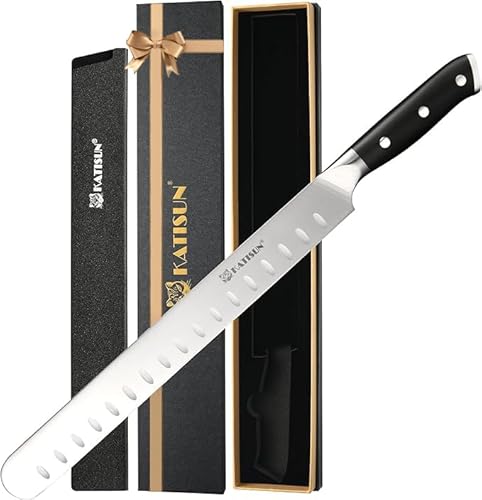
4. KATISUN Brisket Knife: best value with a sheath for storage
The KATISUN Brisket Knife is a 12-inch carving and slicing knife that comes with a protective sheath. It suits buyers who want a budget-friendly knife that stays covered in a drawer or on a shelf. It is also a practical gift choice for people who like to grill.
What it is and who it suits
This is a long slicing knife built mainly for ham, brisket and other large cuts. The listing also mentions use on fruit, vegetables and bread. It suits home cooks who want one versatile knife for everyday carving without a high price.
Key features in plain words
The blade is described as hand-forged steel with a series of engraved dimples along the side. These dimples help reduce sticking, much like the dimples on other slicing knives. The knife is listed as stainless steel, which resists corrosion and staining, and a sheath is included to protect the edge during storage.
Real-life use and performance
For example, the blade is said to glide through ham with clean, controlled cuts. The balanced weight is meant to make each slice feel more precise. Because the listing covers several foods, it can serve as a general carving knife rather than a brisket-only tool.
Ease of use and value for money
The ergonomic handle is designed to reduce hand fatigue, which can help during a long carving session. Cleaning is simple with soap and water, and the sheath keeps the blade protected between uses. The low price and included sheath give this knife one of the strongest value stories in the group.
Pros
- Affordable price with a protective sheath included
- Stainless steel resists corrosion and staining
- Ergonomic handle is designed to reduce hand fatigue
- Works on meat, fruit, vegetables and bread
Cons
- Listing gives limited detail on steel grade and hardness
- Dimples and finish may need careful cleaning in the grooves
- Customer standing is moderate, so results may vary
- Sheath protects the blade but does not replace careful drawer storage
5. HOSHANHO Carving Knife Set 3PCS: best complete set for butchery tasks
The HOSHANHO Carving Knife Set 3PCS includes a 12-inch carving knife, a 10-inch brisket knife and a 7-inch fillet knife. It suits cooks who want a full set of meat tools, including those who grill, camp or break down larger cuts at home. It is the highest-priced option in this round-up.
What it is and who it suits
This set covers three distinct jobs. The carving knife handles long slices, the brisket knife handles trimming and breaking down, and the fillet knife handles finer work on fish and smaller cuts. It suits hobby cooks who enjoy preparing meat from start to finish.
Key features in plain words
The blades are described as hand-ground with a 15-degree edge, which is the same narrow angle used in the single HOSHANHO knife. They are made from 10Cr15CoMoV Japanese high-carbon steel, which the listing says improves hardness and resists chipping. The handles are pakkawood, shaped with curves that fit the fingers.
Real-life use and performance
In practice, having three knives means each blade can stay focused on its own task. The long carving knife is suited to slicing, while the shorter brisket knife is easier to control when trimming fat. The fillet knife has a thinner profile for more delicate work.
Ease of use and value for money
The curved pakkawood handles are designed to reduce fatigue during extended use. Each knife in a high-carbon steel set needs drying and careful storage. At this price, the value depends on if you will use all three knives, since buying a single carving knife costs far less.
Buyers who only need one knife should weigh that cost against the set. Each blade still needs drying after washing and storage that keeps the edges from knocking together. A gift box is included, which can make the set a thoughtful present for a cook.
Pros
- Three knives cover carving, trimming and finer cutting
- Hand-ground 15-degree edges are designed for clean cuts
- Japanese high-carbon steel is said to offer good hardness
- Pakkawood handles are shaped for comfort during longer sessions
Cons
- Highest total price in this round-up
- Three high-carbon blades need more care than stainless steel
- Fillet and brisket knives may go unused if you only carve
- Customer standing is moderate, so the set should be judged on fit for your needs
Brisket Knife Comparison: Performance, Ease of Use and Value
All five knives aim at the same core job, which is long, clean slicing of large meat cuts. They differ mainly in steel type, blade shape, handle design and price. Those differences shape how each one feels in use.
On performance, the HOSHANHO single knife and the HOSHANHO set use narrow 15-degree edges and Japanese high-carbon steel. These are the two options that focus most on sharpness and edge geometry. The SYOKAMI knife also emphasizes slicing thin cuts, thanks to its dimpled blade and long, narrow shape.
On ease of use, the stainless steel options are the least demanding. The Rondauno and KATISUN knives resist rust and staining better, so they need less drying and attention. The high-carbon steel knives reward careful drying and storage, which some beginners may find more involved.
On value, the Rondauno and KATISUN knives sit at the low end of the price range. The KATISUN includes a sheath, which adds protection in a drawer. The HOSHANHO set costs the most, but it offers three knives, so the cost per blade can be reasonable if you use all three.
Brisket Knife Buying Guide: Key Factors Explained
Picking a brisket cutting knife becomes easier once you know what matters. Start with blade length, steel type, edge shape, handle design and care needs. Each one affects how the knife performs and how long it lasts.
Blade length and shape
A long blade, often around 12 inches, lets you slice a large cut in fewer strokes. A narrow, thin blade tends to produce thinner slices, while a wider blade can help with trimming. Consider the largest cut of meat you usually prepare.
Steel type
Stainless steel resists rust and stains and is easier to care for. High-carbon steel can hold a sharp edge well, but it needs prompt drying after washing. Pick the type that matches how carefully you are willing to maintain your knife.
Edge angle
The edge angle is the angle at which the blade is ground to meet at its tip. A narrower angle, such as the 15 degrees listed for some knives here, generally cuts with less resistance. A wider angle is often more durable and easier to maintain.
Handle design
A handle should feel secure and comfortable in your hand, especially during a long carving session. Look for grip features that help prevent slipping, especially when the handle is wet. Materials like pakkawood and wood need gentle cleaning.
Care and storage
Hand washing and drying promptly extends the life of most knives. A protective sheath or a knife block helps protect the edge and keeps the blade safe. Storing knives loose in a drawer can dull or chip the edge over time.
Who Should Buy These Brisket Knives?
The right knife depends on how often you carve and what you value most. Matching the knife to your habits makes the choice much simpler. Here is a quick guide by buyer type.
First-time or occasional carvers: The Rondauno Brisket Knife offers a low-cost, stainless steel option for holiday roasts and weekend brisket. It is easy to care for and covers for brisket, turkey, ribs and roasts without asking for much upkeep.
Budget-minded home cooks who want storage protection: The KATISUN Brisket Knife combines a low price with a protective sheath. It suits people who keep knives in a drawer and want a versatile carving tool for meat, fruit and bread.
Cooks who want thin, neat slices and a striking look: The SYOKAMI Brisket Slicing Knife is built around thin, even cuts and a Damascus-pattern blade. It also works well as a gift for someone who appreciates a well-presented tool, provided they are willing to dry it promptly.
Enthusiasts who carve often and want one premium blade: The HOSHANHO Carving Knife 12 Inch offers a narrow edge angle, Japanese high-carbon steel and a comfortable pakkawood handle. It suits regular carvers who will notice the difference in sharpness and are prepared for careful care.
Hobby cooks and grillers who break down meat at home: The HOSHANHO Carving Knife Set 3PCS covers carving, trimming and fine cutting in one purchase. It fits people who prepare large cuts from start to finish, and it makes a thoughtful gift for a dedicated cook.
Final Verdict: Which Brisket Knife Is Right for You?
There is no single winner for every kitchen. The best brisket cutting knife depends on your budget, how often you carve and how much care you want to give the blade. Each of these five knives has a clear strength.
For most beginners on a budget, the KATISUN and Rondauno knives offer solid, low-maintenance performance. For thin slices and a gift-ready presentation, the SYOKAMI stands out. For regular carvers who want a sharp, premium single knife, the HOSHANHO 12-inch is the strongest choice, and the three-piece set suits anyone who wants a full meat toolkit.
In short, start with the job you do most often. Choose the steel and price that match your care habits, and pick the knife whose shape fits the cuts you prepare. A well-matched knife makes brisket day more enjoyable.
Frequently Asked Questions
What length of brisket knife is best for beginners?
A 12-inch blade is common for brisket and roasts because it allows long, smooth slices. Shorter blades can be easier to handle but may require more strokes. Choose the length that suits the cuts you usually make.
Is stainless steel or high-carbon steel better for a brisket knife?
Stainless steel resists rust and stains and needs less care. High-carbon steel can hold a sharp edge well but must be dried promptly after washing. Neither is better for everyone, so pick based on how you plan to maintain it.
Do I need a set of knives or just one carving knife?
One carving knife covers most brisket and roast tasks. A set adds specialized blades for trimming and finer work. If you rarely prepare meat beyond carving, a single knife is usually enough.
How should I clean and store a brisket knife?
Wash the knife by hand with mild soap and water, then dry it right away. Store it in a sheath, on a magnetic strip or in a block to protect the edge. Avoid tossing it loose in a drawer.
What does an edge angle mean on a knife?
The edge angle is the angle at which the blade is ground to meet at its sharp tip. A narrower angle, such as 15 degrees, generally cuts with less resistance. A wider angle is often sturdier and easier to keep in shape.

Mary is a home cooking enthusiast and kitchen gear reviewer with a passion for practical cookware and food preparation tools. She enjoys testing cutting boards, knives, kitchen gadgets, and other cooking essentials to help home chefs make smarter buying decisions. Through KitchenCutting.com, Mary shares honest product reviews, buying guides, and helpful kitchen tips to make cooking easier, safer, and more enjoyable.