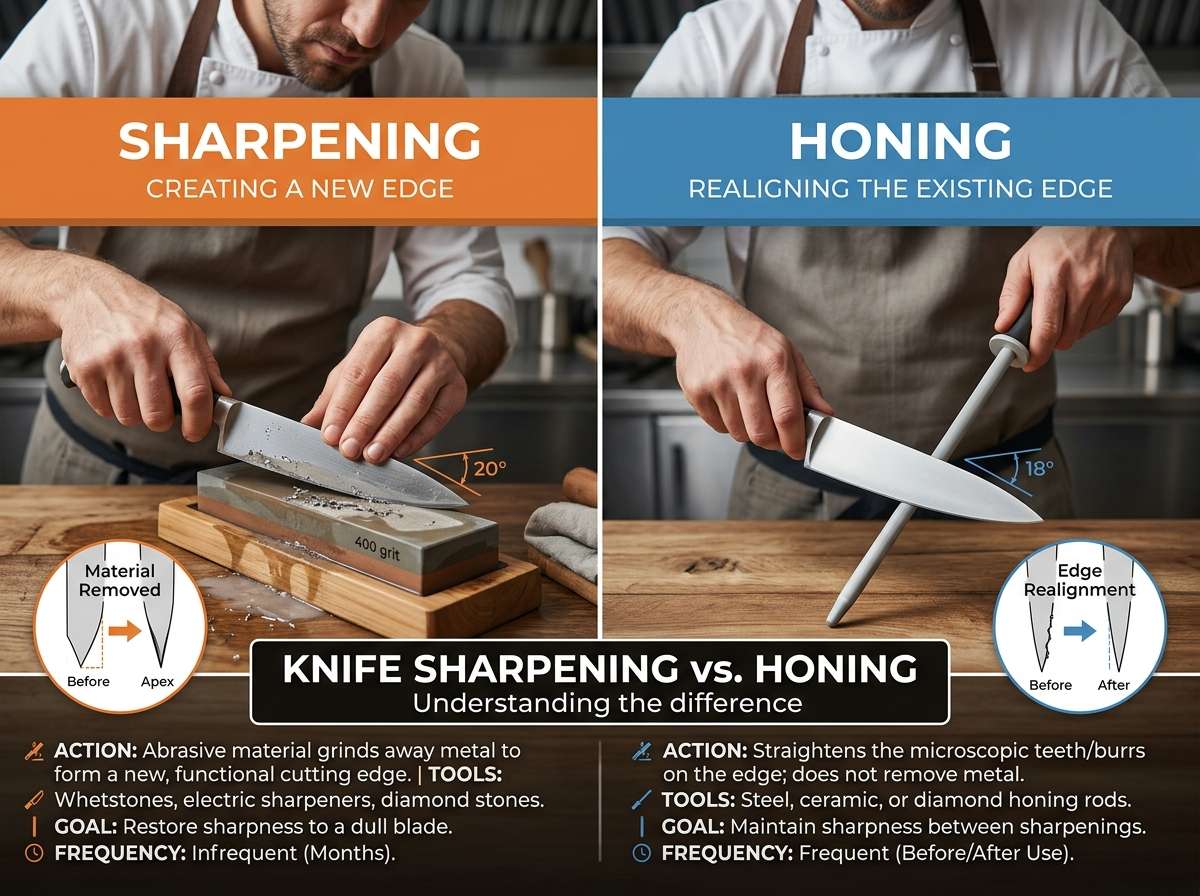
Knife Sharpening vs Honing
If you own a kitchen knife, you have probably heard two words thrown around a lot: sharpening and honing. Many people think they mean the same thing. They do not. These are two different jobs that keep your blade in good shape, and mixing them up can leave you with a dull knife that struggles to cut through a simple tomato.
In this article
In this guide, we will break down the real difference between knife sharpening and honing, why both matter, how often you should do each one, and the tools you need to keep your blades razor sharp for years. By the end, you will know exactly when to hone your knife and when it is time to actually sharpen it.
Why This Difference Actually Matters
A sharp knife is not just about speed in the kitchen. It is also about safety. A dull blade forces you to push harder, and when you push harder, the knife can slip off the food and slide into your finger. A sharp blade glides through onions, meat, and bread with almost no effort, which keeps your hands safer and your cutting board neater.
Knowing the gap between sharpening and honing helps you take care of your knives the right way. If you only hone your knife but never sharpen it, the edge will slowly get duller and duller until honing stops helping at all. On the other hand, if you sharpen your knife too often when you only needed a quick hone, you wear down the metal faster than needed and shorten the life of your blade.
What Is Knife Honing?
Honing is the process of straightening the edge of your knife, not removing metal from it. Every time you use a knife, the thin edge bends slightly to one side or the other. You cannot see this bend with your naked eye, but it is there, and it makes the blade feel dull even though the metal itself is still sharp underneath.
A honing rod, sometimes called a sharpening steel, is the tool used for this job. It is a long metal rod, often made of steel, ceramic, or diamond-coated material, with a handle on one end. When you run your knife along the rod at the right angle, it pushes the bent edge back into a straight line.
Think of honing like combing messy hair back into place. The hair is still all there, it is just not lying flat. Honing does the same thing to your blade’s edge.
How Often Should You Hone?
Many professional cooks hone their knives before or after nearly every use. This might sound like overkill for a home kitchen, but it takes only ten to fifteen seconds and keeps the blade performing well between full sharpening sessions. A good habit is to hone your main chef’s knife every time you cook with it, or at least a couple of times a week if you cook often.
How to Hone a Knife Step by Step
- Hold the honing rod straight up and down with the tip resting on a towel or cutting board for stability, or hold it out in front of you if you feel confident.
- Hold your knife in your other hand at roughly a fifteen to twenty degree angle against the rod. This angle matters because it matches the angle most kitchen knives are already ground at.
- Starting at the base of the blade near the handle, draw the knife down and across the rod in one smooth motion, moving from the heel of the blade to the tip.
- Repeat the same motion on the other side of the rod for the other side of the blade.
- Do this five to ten times on each side, alternating sides evenly so the edge stays balanced.
- Wipe the blade clean with a towel before using it, since tiny metal particles can come loose during honing.
Keep your movements slow at first until your hands get used to the angle. Speed is not the goal here, control is.
What Is Knife Sharpening?
Sharpening is a completely different task. Instead of just straightening the edge, sharpening actually grinds away a tiny layer of metal to create a brand new edge. Over time, no matter how often you hone, the blade’s edge wears down from cutting through food, hitting cutting boards, and general use. Honing cannot fix a truly dull or worn edge because there is nothing left to straighten. That is where sharpening comes in.
Sharpening uses an abrasive surface, like a whetstone, a pull-through sharpener, or an electric sharpening machine, to remove metal and reshape the blade into a fresh, sharp point. This process takes longer than honing and requires more skill, especially with a whetstone.
Signs Your Knife Needs Sharpening, Not Just Honing
- The blade struggles to slice through paper cleanly
- It cannot cut a ripe tomato without pressing down hard
- Honing no longer makes any noticeable difference
- You can see nicks or a rough edge under bright light
- The blade feels dull even right after you honed it
If you notice any of these signs, grab a sharpening stone or sharpener instead of reaching for the honing rod again.
Common Tools for Sharpening
Whetstones A whetstone, also called a sharpening stone, is a flat stone used with water or oil to grind the blade’s edge. These stones come in different grits, similar to sandpaper. A lower grit number removes more metal quickly and is good for very dull blades, while a higher grit polishes the edge for a fine, clean finish. Many cooks use a two-sided stone, starting on the coarse side and finishing on the fine side.
Pull-Through Sharpeners These handheld tools have slots with built-in abrasive wheels or plates. You simply pull the knife through the slot a few times, and it grinds a new edge automatically. They are easy for beginners but tend to remove more metal than needed and may not last as long as manual methods.
Electric Sharpeners Electric sharpeners work fast and are great for people who do not want to learn the angle-holding skill needed for a stone. They usually have multiple stages, from coarse grinding to fine polishing, all done in a few passes.
Sharpening Systems with Guides Some sharpening kits include a guide that holds the blade at a fixed angle, which takes the guesswork out of the process. These are a nice middle ground between a stone and an electric machine, giving more control than an electric tool but less skill required than freehand stone sharpening.
How to Sharpen a Knife with a Whetstone
- Soak the stone in water for about ten minutes if it is a water stone, or apply a few drops of honing oil if it is an oil stone.
- Place the stone on a damp towel so it does not slide around while you work.
- Hold the knife at around a fifteen to twenty degree angle against the coarse side of the stone.
- Push the blade across the stone in a sweeping motion, moving from the heel to the tip, as if you are trying to shave a thin layer off the stone’s surface.
- Repeat this motion ten to fifteen times on one side, then flip the knife over and do the same number of passes on the other side.
- Check for a small burr, a tiny rough edge that forms along the blade, which tells you that side is done.
- Move to the fine grit side of the stone and repeat the same steps with lighter pressure to polish the edge.
- Rinse the blade and dry it fully before storing it.
This process takes practice, so do not worry if your first few tries are not perfect. Like riding a bike, your hands will learn the right feel over time.
Sharpening vs Honing: The Core Differences
| Feature | Honing | Sharpening |
|---|---|---|
| Purpose | Straightens the bent edge | Removes metal to form a new edge |
| Tool | Honing rod or steel | Whetstone, pull-through, or electric sharpener |
| Frequency | Every use or few times a week | Every few weeks to a few months |
| Metal removed | None | A small amount |
| Skill needed | Low | Moderate to high, depending on the tool |
| Time needed | Ten to fifteen seconds | Several minutes |
Looking at this side by side makes it clear that honing is a quick maintenance step, while sharpening is the deeper fix that actually restores a cutting edge.
How Often Should You Sharpen Your Knives?
For a knife used almost daily, sharpening every one to three months is a solid target. If you barely use a knife, once or twice a year might be enough. The real test is not a calendar date but how the blade performs. If it struggles with basic tasks and honing does not help anymore, that is your signal.
Kitchen knives used for heavy tasks, like breaking down a whole chicken or cutting through squash, dull faster than knives used mainly for soft vegetables and herbs. Pay attention to how each knife in your collection behaves rather than treating them all the same.
Tips to Keep Your Knife Sharp for Longer
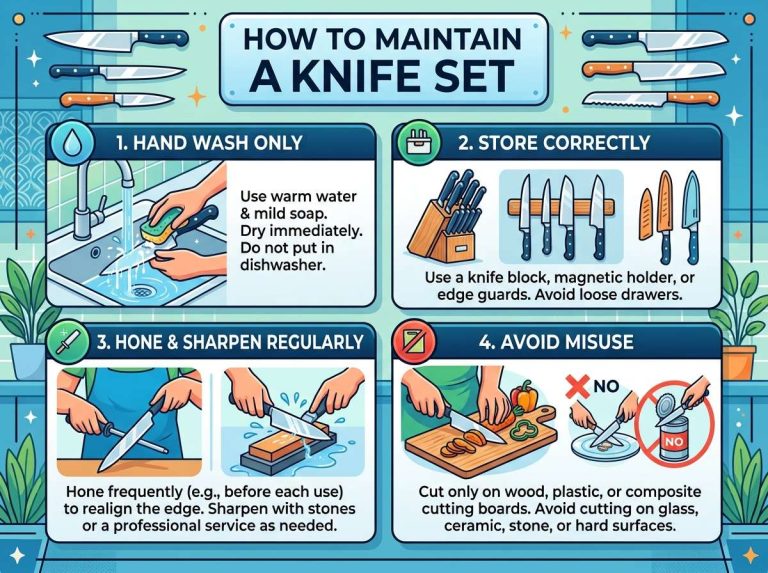
- Use a wooden or plastic cutting board instead of glass or stone, since hard surfaces wear down the edge fast.
- Wash knives by hand instead of tossing them in the dishwasher, since the movement and heat inside can bang the blade against other items and dull it.
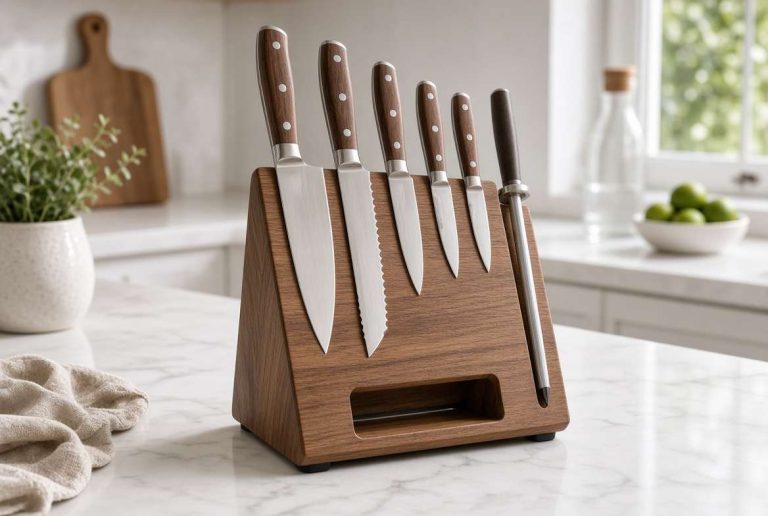
- Store knives in a block, on a magnetic strip, or with blade guards rather than tossing them loose in a drawer.
- Avoid cutting on bones or frozen food with a thin kitchen knife, since this can chip the edge.
- Hone regularly so your blade needs full sharpening less often.
Small habits like these add up over months of use and can double the life of a good edge.
Do All Knives Need the Same Care?
Not exactly. Different blade materials and knife types call for slightly different approaches.
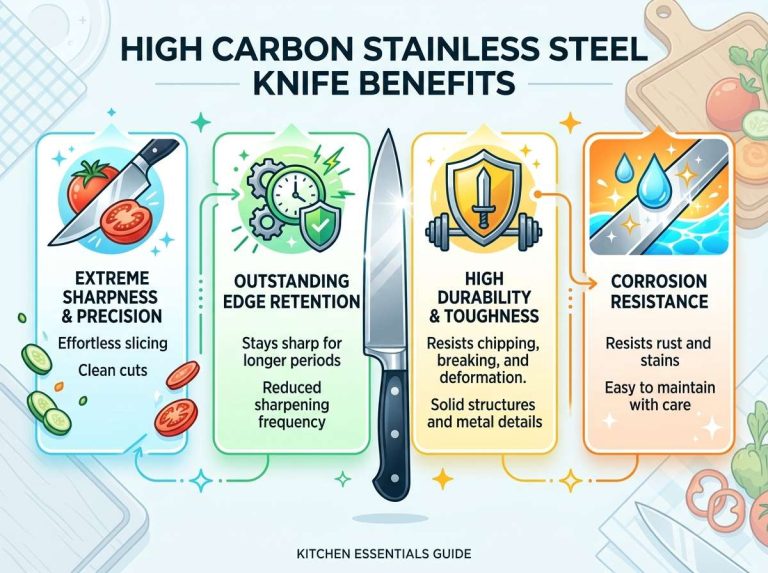
Stainless steel knives are common in most kitchens and hold up well with regular honing and occasional sharpening.
Carbon steel knives get sharper edges but can rust if not dried properly. They also tend to need sharpening less often since the steel is usually harder, but honing them gently is still helpful.
Ceramic knives stay sharp much longer than metal blades but cannot be honed with a steel rod. They need special diamond sharpening tools when they finally dull.
Serrated knives, like bread knives, are not meant to be honed the normal way at all. Their teeth need a special tapered sharpening tool designed for serrations.
Knowing what kind of blade you own helps you pick the right maintenance routine instead of using one method for every knife in the drawer.
Common Mistakes People Make
Skipping honing entirely Some people only sharpen a knife once it feels dull and never hone in between. This leads to faster wear since the edge keeps bending out of shape and then needs a deeper fix through sharpening more often than necessary.
Using the wrong angle Holding the blade too flat against the stone or rod barely touches the edge, while holding it too steep can round off the edge instead of sharpening it. Aim for that fifteen to twenty degree range and try to stay consistent.
Pressing too hard More pressure does not mean a sharper blade. Light, even pressure with consistent passes gives a cleaner edge than pushing down with force.
Sharpening too often Every sharpening session removes a small layer of metal. Doing this too frequently wears the blade thin over years of use and shortens its lifespan. Save full sharpening for when honing genuinely stops working.
Ignoring the knife’s original angle Every blade comes ground at a certain angle from the factory. Trying to match that original angle as closely as possible keeps the edge geometry consistent and performing the way it was designed to.
Final Thoughts
Honing and sharpening work together as a team, not as two options to pick between at random. Honing is your everyday habit that keeps the edge straight and performing well, while sharpening is the occasional deeper task that restores a truly worn blade. Both matter, and skipping one for too long puts more strain on the other.
Once you get into a rhythm of honing often and sharpening only when needed, you will notice your knives cutting cleaner, lasting longer, and feeling much safer to use every single day in the kitchen. Good knife care is not complicated. It just takes a little consistency and the right tool for the right moment.

Mary is a home cooking enthusiast and kitchen gear reviewer with a passion for practical cookware and food preparation tools. She enjoys testing cutting boards, knives, kitchen gadgets, and other cooking essentials to help home chefs make smarter buying decisions. Through KitchenCutting.com, Mary shares honest product reviews, buying guides, and helpful kitchen tips to make cooking easier, safer, and more enjoyable.