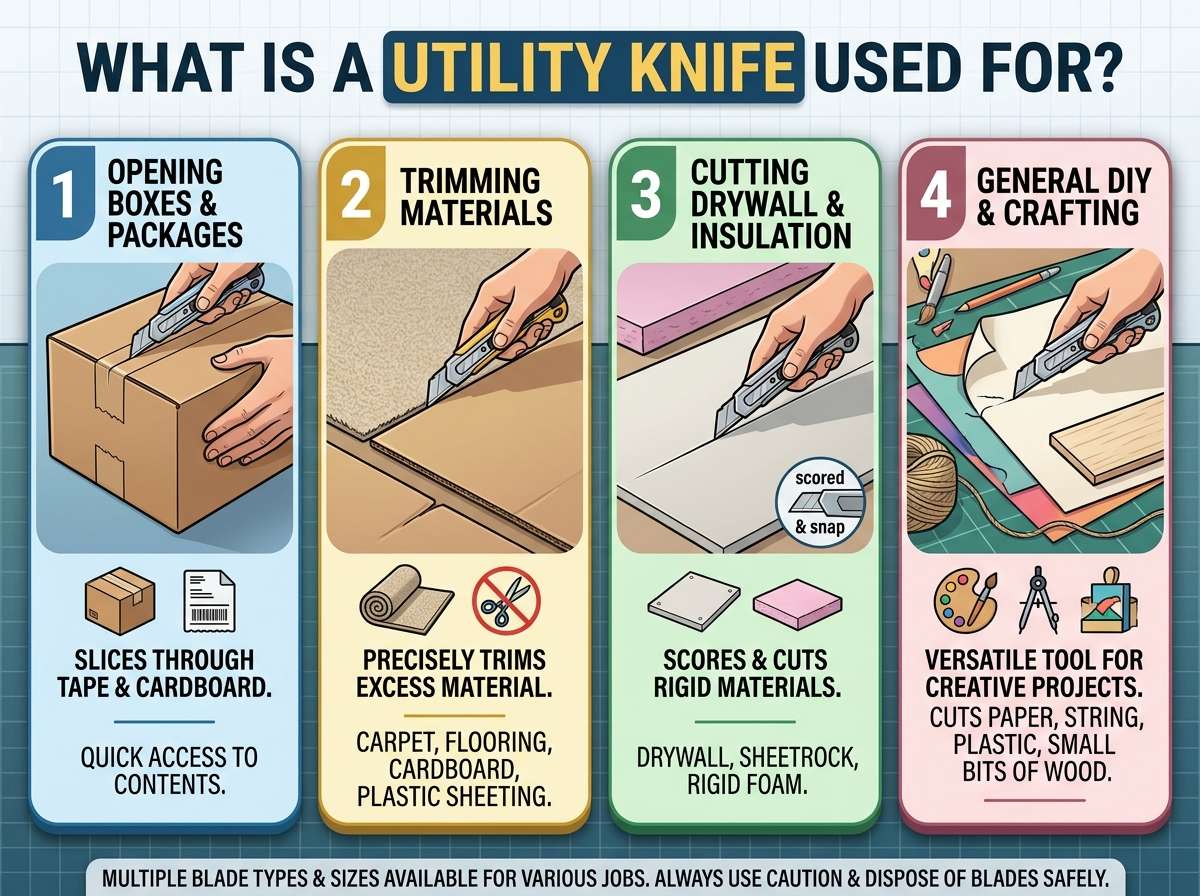
What Is a Utility Knife Used For?
If you have ever opened a big cardboard box, cut a piece of carpet, or sliced through thick tape, there is a good chance you used a utility knife or wished you had one. This little tool sits in almost every garage, kitchen drawer, and toolbox, yet many people still ask the same question: what is a utility knife actually used for?
In this article
In simple words, a utility knife is a small hand tool with a short, sharp blade made for cutting, trimming, scoring, and slicing all kinds of materials. It is not just one single item either. It covers a whole family of blades and handles built for tough jobs that a regular kitchen knife just can’t handle well.
This guide walks you through everything about this handy tool in plain language. No hard terms, no confusing talk, just clear facts so even a total beginner can understand it in one read.
A Quick Look At The Utility Knife
A utility knife is a compact cutting tool with a sharp blade, usually made of steel, attached to a sturdy handle. The handle can be plastic, metal, or rubber-coated for a better grip. The blade is often short and thick compared to other knives, which makes it strong enough to cut through hard or layered material without snapping.
Some people call it a box cutter, a Stanley knife, or a razor knife, depending on where they live or what job they do. All these names point to the same basic idea: a small blade built for rough, everyday cutting tasks rather than fine slicing like you would do with food.
The blade on most models can slide in and out of the handle. That means you can pull it out when you need to cut something, then push it back in when you are done, keeping the sharp edge safe and hidden. This simple feature is one big reason the tool became so popular across homes, warehouses, and job sites.
The Main Jobs A Utility Knife Handles
Now let’s get into the real question: what do people actually use this tool for? The list is long, but here are the most common tasks that show off its true value.
Opening Boxes And Packages
This is probably the number one reason people reach for a utility knife. Online shopping means boxes show up at the door almost every day, and tearing them open by hand takes too long and often leaves a mess. A quick slice along the tape line with a utility knife opens the box in seconds without damaging what’s inside.
Cutting Cardboard And Paper Products
Beyond just opening boxes, this tool cuts through thick cardboard sheets, paper rolls, and packing material with ease. Warehouse workers and shipping staff rely on it all day long because it saves time and keeps their hands away from sharp cardboard edges.
Trimming Carpet And Flooring
Anyone who has laid carpet or vinyl flooring knows that a clean, straight cut matters a lot. A sharp utility blade trims carpet edges along walls and corners with much better control than scissors or a regular knife. Flooring installers often carry several spare blades because carpet fibers dull a blade fast.
Scoring Drywall
In home construction and remodeling, drywall sheets need to be cut down to size often. Instead of sawing through the whole thick sheet, workers score a line on the surface with a utility knife, then snap the board along that line. This method is faster, cleaner, and much easier on the arms than full sawing.
Cutting Rope And Twine
Thick rope, twine, and cord can be tough for regular scissors to handle. A sharp utility blade slices right through these materials, which makes it a go-to tool for movers, campers, and anyone working with heavy packing straps.
Stripping Wire And Cable
Electricians and DIY folks often use a utility knife to strip the outer coating off wires and cables before making connections. The thin blade lets you score the coating gently without cutting too deep into the wire itself.
Trimming Wallpaper And Vinyl
Home decorators use this tool to trim wallpaper edges around corners, windows, and outlets. It also works great for cutting vinyl sheets and adhesive film smoothly, giving a neat finish that scissors struggle to match.
Cutting Foam, Plastic Sheets, And Insulation
Foam board, plastic sheeting, and insulation panels used in building projects often need custom sizes. A sharp blade glides through these soft yet bulky materials far better than a saw or scissors could.
Opening Sealed Bags And Sacks
Farmers, gardeners, and warehouse staff often deal with heavy sealed bags of feed, seed, soil, or supplies. A quick cut along the top with a utility knife opens these bags fast without spilling the contents everywhere.
General Craft And Hobby Work
Many hobbyists keep one nearby for cutting mat board, thin wood sheets, leather, fabric, and other craft materials. It gives a level of control that regular scissors simply cannot offer, especially for detailed shapes and straight lines.
Kitchen And Food Packaging Tasks
Some food workers use a specific type of utility knife for opening plastic wrap, boxes, or bags in a kitchen setting, though it is not meant for actual food prep like slicing vegetables or meat. It stays strictly a packaging and cutting helper in this setting.
Different Types Of Utility Knives
Not every utility knife looks or works the same way. Knowing the different styles helps you pick the right one for your task.
Retractable Blade Knives
This is the most common style. The blade slides in and out through a button or dial on the handle. When not in use, the blade tucks safely inside the body, lowering the chance of an accidental cut.
Folding Utility Knives
Similar to a folding pocket knife, this style lets the blade fold flat into the handle. It’s compact, safe for carrying in a pocket or bag, and opens quickly with one hand.
Fixed Blade Utility Knives
These have a blade that stays in one set position and does not move or fold. They tend to feel sturdier for heavy cutting jobs, though they need a sheath or cover for safe storage since the blade stays exposed.
Snap-Off Blade Knives
This style uses a long blade made of several small segments. Once the tip gets dull, you simply snap off that section along a scored line to reveal a fresh, sharp edge underneath. It saves you from buying new blades often since one long blade gives many uses.
Rotary Or Wheel Blade Cutters
Though these differ slightly in design, some people group rotary cutters with utility knives since they serve a similar cutting purpose, especially for fabric, paper, and craft material. The blade spins in a circular wheel shape instead of a fixed edge.
Why People Trust Utility Knives Over Other Tools
You might ask, why not just use scissors or a regular knife for these jobs? Here’s why the utility knife wins out so often:
- Strength: The blade is thick and sturdy, made to handle rough material without bending or breaking.
- Sharpness: Fresh blades cut cleanly through tough surfaces, giving smoother results than dull household scissors.
- Replaceable blades: Once a blade grows dull, you swap it out fast instead of tossing the whole tool.
- Compact size: It fits easily in a pocket, tool belt, or drawer, ready whenever needed.
- Safety features: Retractable and folding designs keep the sharp edge hidden until the moment you need it.
- Low cost: Compared to many specialty cutting tools, a basic utility knife costs very little, making it accessible for almost anyone.
How To Pick The Right One For Your Needs
If you are shopping for your first utility knife, a few small details make a big difference in how well it works for you.
Think About The Blade Type
Standard straight blades work fine for most everyday tasks like boxes and packaging. Hooked blades suit roofing or thick material work. Serrated blades handle rope and fibrous items better than smooth edges.
Check The Grip
A rubber or textured handle gives better control, especially if your hands get sweaty or if you’re cutting for long periods. Smooth plastic handles can slip more easily during tougher jobs.
Look At The Locking Mechanism
Good models include a lock that holds the blade firmly in the open position during use, then locks it closed when stored. This lowers the risk of the blade slipping back unexpectedly while cutting.
Blade Storage
Some handles include a small compartment inside to hold spare blades, so you always have a fresh one on hand without carrying a separate box around.
Size And Weight
A small, light knife works well for quick tasks like opening mail or boxes. A heavier, larger model suits construction or long work sessions where more force and control are needed.
Basic Safety Tips When Using A Utility Knife
Since the blade is sharp and often exposed during use, following a few safety habits keeps you free from injury.
- Always cut away from your body, never toward it.
- Keep fingers clear of the blade path at all times.
- Retract or close the blade right after finishing a cut.
- Replace dull blades quickly, since a dull edge often needs more force and slips more easily than a sharp one.
- Store the knife in a drawer, sheath, or case rather than leaving it loose on a table or counter.
- Never leave it within reach of small children.
- Cut on a stable, flat surface rather than holding material in the air.
How To Replace A Utility Knife Blade
Swapping blades is usually a quick job and does not require any special tools.
- Make sure the blade is fully retracted or closed first.
- Locate the release button, screw, or latch on the handle, depending on the model.
- Open the handle or slide the release to expose the old blade.
- Slide the used blade out carefully, holding it by the back edge, not the cutting side.
- Place the used blade in a safe container for disposal, never loose in the trash.
- Insert a fresh blade in the same slot, matching the direction shown on the packaging or handle.
- Close the handle securely and test the lock before use.
Following these steps keeps the tool working smoothly and keeps your hands safe during the swap.
Common Places You’ll Find A Utility Knife In Use
This tool shows up across a wide range of settings, proving just how flexible it really is.
- Warehouses and shipping centers: for opening and breaking down boxes all day.
- Construction sites: for scoring drywall, cutting insulation, and trimming material.
- Home improvement projects: for flooring, wallpaper, and general repairs.
- Offices: for opening mail and packages.
- Kitchens and food service: for cutting packaging, though not for actual food prep.
- Craft rooms: for cutting paper, foam board, and fabric.
- Outdoor and camping trips: for cutting rope, tarps, and other gear.
- Retail stores: for stocking shelves and breaking down shipment boxes.
Utility Knife Versus Other Common Blades
People often mix up a utility knife with other cutting tools, so here’s a simple breakdown of the differences.
Utility knife vs pocket knife: A pocket knife usually has a single fixed or folding blade meant for general everyday carry and light tasks. A utility knife focuses more on heavy-duty cutting jobs like boxes, carpet, and building material, and often allows blade swaps.
Utility knife vs box cutter: In many cases, these terms describe the exact same tool. Some people just prefer one name over the other based on region or habit.
Utility knife vs craft knife: A craft knife, sometimes called a hobby knife, has a thinner, more precise blade meant for detailed cutting on paper or thin material. A utility knife carries a thicker blade built for tougher jobs.
Utility knife vs kitchen knife: Kitchen knives are designed purely for food prep, with blade shapes suited for slicing, chopping, and dicing. A utility knife stays away from food tasks and focuses on packaging, material, and construction work instead.
Simple Maintenance Tips To Make It Last Longer
Taking care of your utility knife keeps it working well for a long time.
- Wipe the blade clean after each use to remove dust, tape residue, or material bits.
- Store it in a dry place to avoid rust on the metal parts.
- Check the locking mechanism now and then to make sure it still holds firmly.
- Replace the blade at the first sign of dullness rather than pushing a worn edge too far.
- Keep spare blades in their original packaging until ready to use, so they stay sharp and protected.
Frequently Asked Questions
Is a utility knife the same as a box cutter? In most everyday use, yes. The names are often used to mean the exact same tool, though a few specialty designs might differ slightly in blade shape.
Can a utility knife cut through metal? No, standard blades are not built for cutting metal sheets or wire cores. They handle wire coating, thin plastic, cardboard, and similar soft-to-medium material, but not solid metal.
How often should I replace the blade? This depends on how much you use it, but a good rule is to swap the blade once it starts requiring more pressure to cut cleanly, or once you notice tearing instead of a smooth slice.
Is it safe for beginners to use? Yes, as long as basic safety steps are followed, such as cutting away from the body and retracting the blade after use. Many models also include safety locks to lower risk further.
What blade type is best for home use? A standard straight blade works fine for most home tasks like opening boxes, cutting tape, and light craft work. If you plan on cutting carpet or drywall often, a hook or specialty blade might serve you better.
Can I use a utility knife for food? It’s best to avoid using one for food prep since it is not designed with food-safe material or shapes in mind. Stick to kitchen knives for that job instead.
Final Thoughts
A utility knife might look like a small, simple tool, but it plays a big role in everyday tasks across homes, job sites, and businesses. From opening boxes and trimming carpet to scoring drywall and stripping wire, its sharp, sturdy blade handles jobs that regular scissors or kitchen knives just cannot manage as well.
With so many styles available, from retractable to folding to snap-off blade models, there’s a version suited for almost every need and skill level. Add in the low cost, replaceable blades, and compact size, and it’s easy to see why this tool remains a staple in toolboxes around the world.
As long as you follow basic safety steps and keep the blade fresh, a utility knife will serve you well for years, making countless cutting tasks faster, cleaner, and much easier to handle.

Mary is a home cooking enthusiast and kitchen gear reviewer with a passion for practical cookware and food preparation tools. She enjoys testing cutting boards, knives, kitchen gadgets, and other cooking essentials to help home chefs make smarter buying decisions. Through KitchenCutting.com, Mary shares honest product reviews, buying guides, and helpful kitchen tips to make cooking easier, safer, and more enjoyable.