5 Best Knife For Chopping Vegetables In 2026
As an Amazon Associate we earn from qualifying purchases.
Finding the best knife for chopping vegetables can feel confusing when every product page promises sharpness and comfort. This guide is for beginners who want a clear, honest look at five popular options before they spend money. It explains what each knife is, who it suits and how it compares on performance, ease of use and value.
All five products share a similar design. Each one is a knife with a flat, straight edge, often described as a nakiri or a general kitchen knife, and each is sold for everyday prep work. The comparison below rests on the listed features and typical use of each product, not on personal testing, so treat it as a guide to reading the specifications rather than a hands-on verdict.



1. Sunnecko Nakiri Knife: best for budget-minded home cooks
The Sunnecko Nakiri Knife is a 7-inch blade sold at a low price point. A nakiri is a Japanese-style knife with a wide, flat blade that suits cutting vegetables with straight up-and-down strokes. This model is marketed for vegetables, fruits and boneless meat, so it aims to handle many small jobs in one tool.
What this knife is and who it suits
This knife suits someone setting up a first kitchen or replacing a worn-out block knife. It is also a practical choice for a gift, since the listing highlights gift-ready packaging. Buyers who want a single, simple tool for daily chopping will find it easy to understand.
Key features in simple words
The blade is made from high-carbon steel, a type of metal that holds a sharp edge well and is usually easier to sharpen than many cheaper stainless blades. The listing says it resists rust, which is useful because knives that get wet often need extra care. The edge is described as a 12-degree double-bevel, meaning both sides of the blade are ground to a narrow angle, which helps the knife slide through food.
Daily use and handling
In everyday use, the wide blade is most useful for lifting chopped vegetables from the board to a pan. The Pakkawood handle is described as non-slip, and its shape is meant to give balance between handle and blade. The wavy pattern on the blade is said to reduce food sticking, which can make chopping starchy foods like potatoes a little easier.
Performance and ease of use
Because the edge is set at a narrow angle, the knife is designed to cut cleanly through soft produce. A beginner should keep it on a cutting board and avoid frozen foods or bones, which can chip thin edges. Basic hand washing and drying after each use will help it last.
Value for money
At this price, the knife offers a lot of features on paper for a small outlay. Buyers who expect premium balance or a long-term heirloom finish may feel the materials are modest. For a first good knife, the value is reasonable.
Pros
- Low price for a full-size nakiri-style blade
- High-carbon steel with a narrow, sharp edge
- Pakkawood handle designed for grip and balance
- Comes with a sheath and gift-ready packaging
Cons
- Lower price can mean less refined finishing than pricier knives
- The thin edge needs careful use and regular honing
- High-carbon steel requires drying to prevent rust
- Not designed for heavy bone chopping
2. HOSHANHO 7 Inch Nakiri Knife: best for a sharper, more refined feel
The HOSHANHO 7 Inch Nakiri Knife sits at a higher price than the budget options in this round-up. It is a Japanese-style nakiri with a 7-in blade made from a high-carbon stainless steel, which the listing describes as a sharper and more refined option.
Its angled edge is set at 15 degrees, a little wider than the 12-degree edge on the Sunnecko knife. A slightly wider edge is often more durable, though it may feel less keen at first.
What this knife is and who it suits
This knife suits a home cook who wants a step up from a basic kitchen knife. It also fits someone who cooks vegetables often and values a more polished feel in the hand.
Beginners who are willing to spend a little more for a better-finished blade will find it appealing.
Key features in simple words
The blade is made from a stainless steel type called 10Cr15CoMoV, which the listing says reaches a hardness of about 60 on the HRC scale after heat treatment. Hardness here means how well the steel holds its edge against wear. The scalloped hollow pits along the side of the blade are meant to reduce food sticking, and the matte finish gives it a more modern look.
Daily use and handling
Day to day, the knife is built to handle chopping, slicing and dicing without much change in technique. The ergonomic Pakkawood handle is shaped to follow the natural curve of the hand. This design is meant to reduce fatigue during longer prep sessions, such as preparing a large pot of soup.
Performance and ease of use
The 15-degree edge is set to cut smoothly through vegetables and fruit while still standing up to firmer produce. Because the blade is stainless steel, it is generally easier to care for than high-carbon steel, though it still benefits from drying after washing. A beginner should keep the edge clean and avoid dropping it on hard surfaces.
Value for money
The price is higher than the entry-level options, so buyers should weigh if the finish and steel are worth the extra cost. For someone who uses a knife every day, the added comfort and build quality may justify the spend. For occasional cooks, a less expensive knife may cover their needs just as well.
Pros
- Stainless steel with a hardness rating described as high for everyday use
- Ergonomic handle shaped to reduce hand fatigue
- Stylish finish with a scalloped blade design
- Versatile for vegetables, fruit and meat
Cons
- Costs more than the budget options in this round-up
- The 15-degree edge is slightly less keen than a narrower edge
- Pakkawood handles need drying and occasional care
- Not intended for heavy bone or frozen-food work
3. PAUDIN Nakiri Knife: best for a balanced all-round blade
The PAUDIN Nakiri Knife is a 7-inch blade positioned between the budget and premium options. It is marketed as an all-purpose tool for slicing, dicing, chopping and mincing. The listing also highlights its wave pattern and its suitability as a gift for many occasions.
What this knife is and who it suits
This knife suits a home cook who wants one reliable knife for most vegetable prep. It is a practical choice for people who prefer a familiar, classic shape. Someone who wants a balanced everyday knife without paying top prices may find it a good fit.
Key features in simple words
The blade is made from 5Cr15Mov stainless steel, which the listing describes as rust-resistant and durable, the same general type used by many cutlery brands. The product listing states it is not real Damascus steel, despite its patterned look. The wave pattern is decorative and is also said to reduce food friction, so ingredients slide off the blade more easily.
Daily use and handling
In daily use, the knife is designed for straightforward prep such as chopping onions, slicing peppers and dicing carrots. The soft Pakkawood handle is integrated with the blade, which gives a comfortable, one-piece feel. The thin blade is meant to move easily, though it is best used with steady, controlled strokes.
Performance and Performance-wise, the listing presents the knife as a capable all-round cutter for soft and medium-firm vegetables. Its thin blade and balanced handle are meant to keep cuts precise without much effort. Beginners should expect the knife to feel light and quick rather than heavy and forceful.
Value for money
The price sits in the middle of this round-up. For buyers who want a stainless steel knife with a classic shape and a comfortable grip, the value is sound. Those who want a more refined finish or a larger range of features may prefer a higher-priced option.
Pros
- Versatile for slicing, dicing, chopping and mincing
- Stainless steel blade described as rust-resistant
- Soft Pakkawood handle integrated with the blade
- Decorative wave pattern that may reduce food sticking
Cons
- The Damascus-style look is decorative, not true Damascus steel
- Thin blade needs careful, controlled use
- Stainless steel still needs regular honing to stay sharp
- Less refined finish than the higher-priced nakiri options
4. Kitchen Knife: best for a starter set on a tight budget
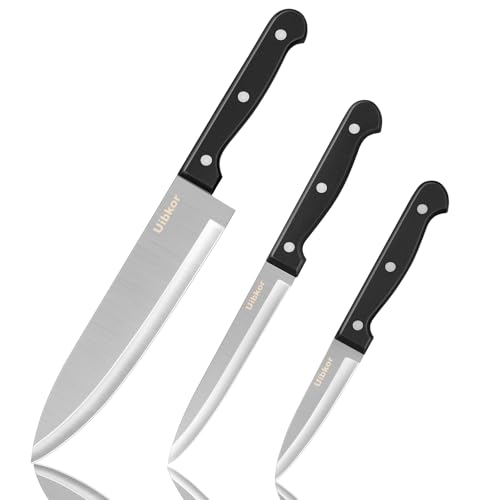
This listing is a three-piece set from Uibkor, with an 8-inch chef knife, a 5-inch utility knife and a 3.5-inch paring knife. It is the lowest-priced product in this round-up. The set is aimed at people who want several basic knives for a range of tasks.
What this knife is and who it suits
This set suits a first-time buyer who needs a starter kit for a new kitchen or a shared home. It is also useful for someone who wants a spare knife for small jobs. A beginner who wants a single specialist vegetable knife may prefer a nakiri instead.
Key features in simple words
The listing describes the blades as high-carbon German steel, with a hardness rating of 56 plus or minus 2 on the HRC scale. The set includes matching sheaths, which protect the edges when the knives are stored. The handles are made from ABS, a sturdy plastic, and are described as soft and comfortable.
Daily use and handling
In everyday use, the chef knife handles most vegetable tasks, while the utility and paring knives cover small jobs like trimming and peeling. The set is suitable for chopping, slicing, dicing and mincing. Having three sizes can make prep quicker, since each blade is matched to a different job.
Performance and ease of use
The blades are described as sharp, though the set is priced for everyday use rather than heavy professional work. ABS handles are easy to wipe clean, which helps daily care. Beginners should store the knives in their sheaths or a block to keep the edges protected.
Value for money
The price is very low for three knives, which makes it attractive for a starter kit. The listing also mentions a lifetime warranty, though buyers should check the terms directly from the seller before relying on it. Buyers who want a long-lasting premium blade may find the materials modest.
Pros
- Three knives for a very low price
- Includes matching sheaths for safe storage
- Covers chopping, slicing and small trimming tasks
- Soft ABS handles that are easy to wipe clean
Cons
- Lower price may mean less refined finishing
- No dedicated nakiri shape for vegetable-only chopping
- Blade sizes in the listing differ between the title and features
- Plastic handles may feel less solid than wood
5. Huusk Japanese Kitchen Knife Set of 2: best for a gift-ready pair
The Huusk Japanese Kitchen Knife Set of 2 includes an 8-inch chef knife and a 6.5-inch knife, and it sits at the upper end of the price range in this round-up. The listing frames it as a pair, one general-purpose blade and one vegetable-focused blade. It is also presented as a gift option for cooks.
What this knife is and who it suits
This set suits a home cook who wants a matched pair of knives for meat and vegetables. It also suits someone shopping for a present, since the listing highlights premium packaging. A beginner who wants only one vegetable knife may find the second blade unnecessary.
Key features in simple words
The blades are made from Japanese high-carbon steel with a hand-hammered texture, which the listing says reduces food sticking. The silver finish is described as free of black coating, so it does not peel. The edge is set at 16 degrees, double-bevel, and the blades are described as 2 mm thick. The handles are pakkawood and are fused to the blade, which the listing says improves balance compared with riveted handles.
Daily use and handling
In everyday use, the 6.5-inch nakiri is aimed at dicing, slicing and julienning vegetables. The 8-inch chef knife handles larger jobs such as slicing meat and chopping herbs. Because the blades are high-carbon steel, the listing advises cleaning, drying and oiling them after each use.
Performance and ease of use
The 16-degree edge is set a little wider than some options here, which may make the blades a bit more durable against chipping. The hand-hammered surface and integrated handle are meant to make the knives feel secure in use. Beginners should be prepared to add a short care routine, since high-carbon steel can rust if left wet.
Value for money
The price is higher than the single-knife options, but it covers two blades with a more detailed finish. For a cook who wants a matched pair, the value is reasonable. Buyers who only need one knife may prefer a lower-cost single nakiri.
Pros
- Two knives covering vegetables and larger cutting tasks
- Hand-hammered blade surface described as reducing food sticking
- Pakkawood handles fused to the blade for balance
- Premium packaging suited to gift giving
Cons
- Higher price than the single-knife options
- High-carbon steel needs regular drying and oiling
- The second blade may be unnecessary for vegetable-only cooks
- Care routine is more involved than with stainless steel
Comparison insights: how the five knives differ
The five products differ mainly in price, steel type and blade focus. The two Japanese-style nakiri knives from Sunnecko and PAUDIN sit at the lower and middle price points. The HOSHANHO and Huusk options cost more and emphasize a more refined finish.
On performance, the edge angle is one of the clearest differences. The Sunnecko uses a 12-degree edge, while the HOSHANHO uses 15 degrees and the Huusk uses 16 degrees. A narrower edge can feel sharper at first, while a wider edge is often more durable.
Ease of use depends on care needs. Stainless steel knives, such as the HOSHANHO and PAUDIN, are generally easier to maintain. High-carbon steel knives, such as the Sunnecko and Huusk, need drying and sometimes oiling to prevent rust.
Value for money depends on how much a buyer needs. The Kitchen Knife set offers three blades for the lowest price, which suits a starter kit. Single-knife buyers who want refined finish may find the mid-range options more satisfying.
Buying guide: key factors for picking a vegetable knife
A vegetable knife is a kitchen knife designed for cutting produce. Nakiri knives have a flat, straight edge that suits up-and-down chopping. Chef knives are more curved and handle a wider range of tasks.
Blade steel is the first factor to consider. High-carbon steel can hold a sharp edge well but needs drying to prevent rust. Stainless steel resists rust more easily but may not reach the same sharpness.</p
Edge angle and sharpness
The edge angle is the angle at which both sides of the blade meet.
A narrower angle, such as 12 degrees, can feel sharper, but it may chip more easily. A wider angle, such as 15 or 16 degrees, is often more durable for everyday chopping.
Size and blade shape
A 7-inch blade is a common size for vegetable prep, since it offers enough length without being hard to control. A flat blade suits chopping and dicing, while a slightly curved blade can help with rocking motions. Buyers should choose the shape that matches how they cut most often.
Handle comfort and balance
The handle should sit comfortably in the hand and feel balanced with the blade. Pakkawood handles are wood layered with resin, and they are often valued for grip. Plastic handles are lighter and easy to clean, but they may feel less solid.
Care and storage
Every knife needs some care. Drying after washing and storing the blade safely will protect the edge. Using a cutting board, not a plate or stone, also helps keep the blade in good shape.
Budget and what you actually need
Price should match how often the knife will be used. A beginner who cooks a few times a week may be well served by a budget option. Someone who cooks daily may prefer to spend more on comfort and finish.
Who should buy these products
Each knife suits a different type of buyer. The right choice depends on budget, cooking habits and if the knife is for personal use or a gift. The matches below are general guidance based on the listed features.
Budget-minded first-time cooks
The Sunnecko Nakiri Knife suits a cook who wants a full-size vegetable knife at a low price. It works well as a first good knife in a new kitchen. Buyers should accept that the finish is simpler than pricier options.
Cooks wanting a refined daily knife
The HOSHANHO 7 Inch Nakiri Knife suits someone who cooks vegetables often and values a polished feel. Its stainless steel and ergonomic handle may suit longer prep sessions. The higher price is worth weighing against how often the knife will be used.
Home cooks wanting one reliable all-rounder
The PAUDIN Nakiri Knife suits a buyer who wants one balanced knife for most vegetable tasks. Its stainless steel blade and integrated handle make it a practical middle choice. It is a sensible pick for someone who values simplicity.
Buyers setting up a starter kit
The Kitchen Knife set suits a first-time buyer who needs several basic knives at once. Its low price and matching sheaths make it a practical starter kit. Buyers who want only a vegetable specialist may prefer a single nakiri.
Cooks wanting a matched pair or a gift
The Huusk Japanese Kitchen Knife Set of 2 suits a cook who wants two knives for vegetables and larger tasks. Its premium packaging also makes it a thoughtful present. Buyers who need only one knife may find the second blade less useful.
Final verdict
No single knife is the best choice for every cook. The right pick depends on budget, how often the knife is used and how much care the buyer is willing to give. Each product here has clear strengths and trade-offs.
For a low-cost start, the Sunnecko or the Kitchen Knife set are practical options. For a balanced middle ground, the PAUDIN knife offers a familiar, versatile shape. For a more refined daily knife, the HOSHANHO or the Huusk pair may be worth the higher price.
In short, match the knife to your habits rather than chasing the highest price. Reading the steel type, edge angle and care needs will help you choose well.
Frequently Asked Questions
What is a nakiri knife?
A nakiri is a Japanese-style vegetable knife with a flat, straight blade. It suits up-and-down chopping and slicing of produce.
Is stainless steel or high-carbon steel better for vegetables?
<
High-carbon steel can hold a sharper edge, but it needs drying to prevent rust. Stainless steel is easier to care for, though it may not reach the same sharpness. Either type can work well if the buyer matches it to their care habits.
What edge angle should I look for?
A narrower edge angle, such as 12 degrees, can feel sharper at first. A wider angle, such as 15 or 16 degrees, is often more durable for everyday chopping. The best choice depends on if sharpness or durability matters more to the buyer.
Do I need more than one knife?
Many home cooks manage with one good vegetable knife. A second smaller knife can help with trimming, peeling and other small tasks. A set can cover these needs, but a single nakiri may be enough for vegetable-only prep.
How should I care for a vegetable knife?
Wash the knife by hand and dry it right away. Store it in a sheath or on a block, and use a wooden or plastic cutting board. Regular honing helps keep the edge straight between sharpenings.

Mary is a home cooking enthusiast and kitchen gear reviewer with a passion for practical cookware and food preparation tools. She enjoys testing cutting boards, knives, kitchen gadgets, and other cooking essentials to help home chefs make smarter buying decisions. Through KitchenCutting.com, Mary shares honest product reviews, buying guides, and helpful kitchen tips to make cooking easier, safer, and more enjoyable.