5 Best and Safest Cutting Boards In 2026
A cutting board seems like the simplest tool in the kitchen. You put food on it, you cut, you rinse it off. But the board you pick affects how sharp your knives stay, how safe your food is, and how much work cleanup takes. A bad board can dull a good knife in a few weeks or hold onto smells that never fully leave.
In this article
This guide looks at five cutting boards, mostly made from titanium and stainless steel, with one non-slip plastic option for comparison. I wrote it for people who cook at home and want a clear answer without reading a materials science textbook. You will find what each board is good for, where it falls short, and which one fits your kitchen best.
I have not used these boards for long stretches in a kitchen, so I am not going to make up test results. Instead, I focus on what each product’s listing says, how each material behaves in real kitchen conditions, and what the common trade-offs look like. Where a detail is something you should confirm yourself, like exact dimensions or dishwasher instructions, I say so.
Quick Comparison at a Glance
Before the detailed reviews, here is a short overview. Use it as a starting point, then read the sections that match your cooking style.
| Product | Main Material | Best For | Knife Friendliness | Cleanup | Price Position |
|---|---|---|---|---|---|
| SUMZZZ Titanium Dual-Sided Board | Titanium and polypropylene | Separating raw and cooked food | Moderate | Easy | Mid-range |
| SNOWCLAD Stainless Steel Board | Stainless steel | Heavy-duty prep, sanitizing | Low | Easy | Mid-range |
| Titanium Board Set of 3 (M, L, XL) | Titanium | Full kitchen setup, sorting tasks | Moderate | Easy | Mid-range to higher |
| GORILLA GRIP Board | Polypropylene (plastic) | Daily use, knife-friendly prep | High | Easy | Budget-friendly |
| SMIRLY Titanium 3-Pack | Titanium | Color-free sorting, multi-task prep | Moderate | Easy | Mid-range |
Keep in mind that prices shift often, so check the current listing before you buy.
What Makes a Cutting Board Safe and Useful?
Before we get into the products, it helps to know what matters most. Most people think of “safe” as “doesn’t make you sick.” That matters, but a board also needs to be practical in daily life.
A safe board should be non-porous or close to it. Porous materials like untreated wood can soak up juices and bacteria in tiny cracks, and those cracks are hard to clean fully. Non-porous surfaces, like metal or tight plastic, wipe clean more easily. Food-grade materials are also important, because they are made to contact food without leaking harmful substances.
A useful board also needs to be kind to your knives. A surface that is harder than your knife edge will dull the blade faster. This is the main trade-off with metal boards. They are very easy to sanitize, but they can wear down a good knife much faster than wood or plastic.
Grip matters too. A board that slides around while you chop is a safety problem, not just an annoyance. Many home cooks put a damp towel under a board for stability, but a built-in non-slip design is more convenient.
Finally, think about cleanup and storage. A board that goes in the dishwasher saves time, but repeated hot cycles can wear down some surfaces over time. A board that is heavy or awkward to store may end up sitting on the counter instead of in a drawer, which affects how often you use it.
Product Reviews
1. SUMZZZ Titanium Cutting Board, Food Grade Titanium/PP Dual-Sided Surface
Product Description
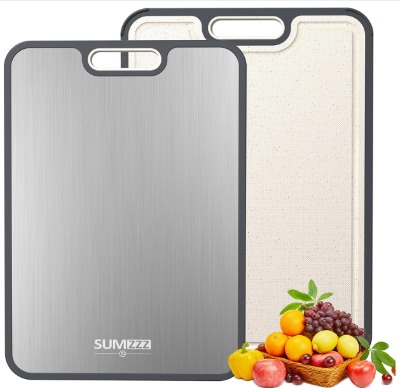
The SUMZZZ board combines two materials in one piece. One side is titanium, and the other side is polypropylene, a food-grade plastic. Its main selling point is that you can use each side for a different job. The listing describes it as a way to keep raw and cooked food on separate surfaces, which is a useful idea in any kitchen.
It is marketed as odor resistant and easy to clean. Those points fit the general behavior of both materials. Titanium does not soak up smells the way wood can, and polypropylene is also fairly resistant to absorbing odors.
Best Use Cases
This board works well for people who prepare both raw meat and vegetables often. You can use the plastic side for raw poultry or fish, then flip to the titanium side for fruit, bread, or cooked food. It also suits small kitchens where one board needs to handle several tasks.
It is also a good pick for anyone who wants a bit of variety. Some people like the feel of a firmer surface for dicing onions, while others prefer plastic when cutting meats.
Key Features Explained Simply
The dual-sided design is the main feature. One side is hard and sleek, and the other is softer and kinder to knives. The surface is meant to resist stains and odors, and the listing presents it as food grade.
A reviewer should be honest here: a dual-sided board is only as useful as your habits. If you flip the board carelessly and let raw juice touch the cooked side, you lose the benefit. The design helps you separate food, but you still need to wash your hands and the board between tasks.
Real-Life Usage Insight
In daily cooking, the best part of this board is that you do not need to grab a second board every time you switch tasks. That saves counter space and cuts down on washing. The plastic side tends to be easier on knives than the titanium side, so most cooks will end up using it for most of the knife work.
The titanium side will feel more solid under the blade. That can be pleasant for chopping, but the surface is much harder than a wood or plastic board, so you should expect more knife wear over time. Sharpen your knives regularly if you use this side often.
Honest Pros
- Two surfaces let you separate raw and cooked food with one board.
- Both materials resist odors better than wood.
- Easy to rinse and wipe clean.
- Compact enough for smaller kitchens.
Honest Cons
- The titanium side can dull knives faster than plastic or wood.
- Dual-sided boards can cause confusion if you do not have a clear habit for flipping them.
- Plastic surfaces can grow grooves over time, which need careful cleaning.
Performance Discussion
Performance here depends mostly on which side you use. The plastic side gives a more forgiving cut, while the titanium side feels firm and stable. Neither side slides much on a clean counter, though a damp towel underneath is still a good idea.
For everyday chopping of vegetables, herbs, and fruit, the board handles the work well. For heavy-duty tasks like breaking down a whole chicken, the surface will feel a bit less cushioned, so take your time and watch your knife angle.
Ease of Use
This board is simple to use. There is no learning curve beyond remembering which side is for what. Rinse it with warm water and mild soap, dry it, and store it upright if you can.
Value for Money
For a single board that covers two jobs, this is a reasonable buy. You get some of the benefits of two separate boards without paying for two. It makes the most sense for people who need flexibility and do not want to buy a full set.
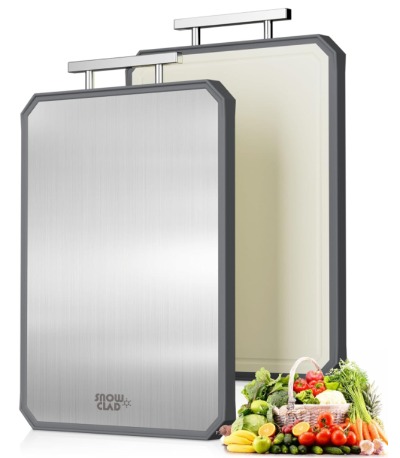
2. SNOWCLAD Stainless Steel Cutting Board, Non-Toxic Chopping Board for Kitchen
Product Description
The SNOWCLAD board is made from stainless steel. The listing calls it non-toxic and suitable for kitchen chopping. Stainless steel is a common choice for food prep surfaces in professional kitchens, mostly because it is easy to clean and sanitize.
A metal board is different from a plastic or wood one in feel, weight, and sound. It is solid, cool to the touch, and does not change shape.
Best Use Cases
This board suits people who want a surface they can sanitize quickly and completely. It works well for prepping raw meat, fish, or poultry, as long as you clean it thoroughly afterward. It is also useful for tasks where you want a flat, rigid surface, such as rolling dough or rolling out a sheet of pastry.
It is less ideal for people who cook with sharp, expensive knives or who want a quiet, cushioned cutting feel.
Key Features Explained Simply
Stainless steel is non-porous, which means liquids and bacteria cannot seep into the surface the way they can with wood. It does not absorb odors, and a quick wash with hot soapy water removes most residue. Stainless steel is also rigid and does not warp.
The “non-toxic” label is a common claim for stainless steel. Food-grade stainless steel is generally considered safe for food contact, but you should still follow basic hygiene habits. No board can make food safe on its own.
Real-Life Usage Insight
Stainless steel boards are loud. Every knife strike rings out, and the noise can be surprising the first few times. They also feel slippery under the hand if the surface is wet, so a non-slip mat or damp towel underneath is a must.
The biggest real-world issue is blade wear. Stainless steel is harder than most kitchen knife edges, so you will notice dulling faster than with plastic or wood. Many cooks reserve a metal board for tasks that do not need a lot of knife work, like cutting bread or breaking down small items, and use a softer board for the rest.
Honest Pros
- Very easy to clean and sanitize.
- Non-porous, so it resists stains and odors.
- Rigid and stable once it is placed on a non-slip surface.
- Built to handle frequent washing.
Honest Cons
- Very hard on knife edges, which means faster dulling.
- Noisy during chopping.
- Slippery when wet, so it needs a stable base.
- Can feel cold and heavy in some kitchens.
Performance Discussion
Performance is strong when your task is about prep and hygiene rather than knife comfort. You get a flat, consistent surface that does not shift in shape. For tasks that involve a lot of slicing and dicing, though, the board will feel harsh. Expect to spend a bit more time sharpening.
Ease of Use
Cleanup is quick. Wash it with hot water and soap, rinse, and dry. Because it is non-porous, you do not need to worry about deep grooves forming. The main ease-of-use challenge is keeping it still during use, which a non-slip mat solves.
Value for Money
This board is a good buy for someone who wants a hygienic, durable surface for specific tasks. It is not the best pick as a full-time daily board for most home cooks, mainly because of knife wear. If you use it alongside a softer board, it can be a practical addition.
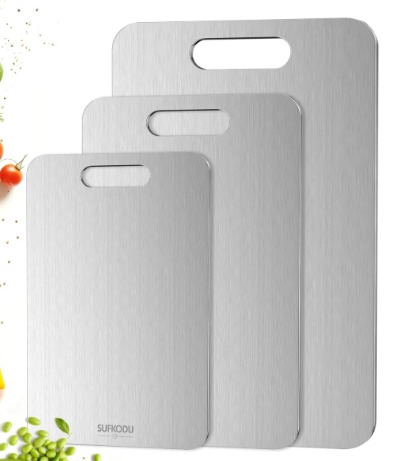
3. Titanium Cutting Board Set of 3 (M, L, XL)
Product Description
This set includes three titanium boards in medium, large, and extra-large sizes. The main idea is simple: a board for each size of job. A small board works for garlic, herbs, or a single fruit. A large board suits a whole onion, a loaf of bread, or a pile of vegetables. The extra-large board can handle bigger tasks like a full meal’s worth of prep.
Titanium is a hard, corrosion-resistant metal. It is generally considered inert, which means it does not react with food. It also does not absorb smells or liquids the way wood does.
Best Use Cases
This set suits people who prep meals for a family or who like to keep several tasks going at once. It is also useful for people who want to keep a clear separation between different foods without relying on a single board. Using one board for fruit, another for vegetables, and a third for bread can make the kitchen feel more organized.
It is less ideal for anyone who wants a soft, forgiving cutting surface, or who uses expensive knives they want to keep sharp for years.
Key Features Explained Simply
The three boards give you size options, which is the main reason to buy a set over a single board. The titanium surface resists odors and staining. Titanium is also quite light for a metal, so the boards are easier to lift than a stainless steel version of similar size.
The sizing is useful for storage as well. Smaller boards can stack and fit in tight cabinet spaces, while the larger one lives on the counter for big jobs.
Real-Life Usage Insight
In real kitchens, sets like this tend to get used most for quick, small tasks. The medium board is often the workhorse, while the large and extra-large boards come out when you are making a bigger meal. Many people find they start using a small board for things like cutting lemons or garlic and then reach for a bigger one only when needed.
Titanium surfaces are hard. They can make knives feel less bitey, and the edge will dull faster than on wood or plastic. Use a honing rod regularly and plan to sharpen more often.
Honest Pros
- Three sizes cover a wide range of tasks.
- Resistant to odors and stains.
- Lightweight for a metal board.
- Easy to store in stacks.
Honest Cons
- Hard surface that can dull knives quickly.
- Smaller boards may slide more on the counter than larger ones.
- Metal surfaces can feel cold and less comfortable for long prep sessions.
Performance Discussion
Performance is solid for most light-to-medium prep tasks. Each board gives a clean, firm surface for cutting. The smaller sizes do move around more than the larger one, so placing a damp towel or non-slip mat underneath is important.
For heavy cutting, like chopping through dense squash or breaking down large cuts of meat, the hardness of titanium makes the job more tiring on your wrist and more demanding on your knife edge.
Ease of Use
Cleanup is quick. Each board rinses and dries easily. Because the surfaces are non-porous, scrubbing is rarely a problem. The main challenge is keeping track of three boards, which is a small price for the flexibility.
Value for Money
This set offers good value if you need multiple sizes. Buying three separate boards would cost more and take up more space. It is a strong choice for families or anyone who cooks often and wants a clean, organized setup.
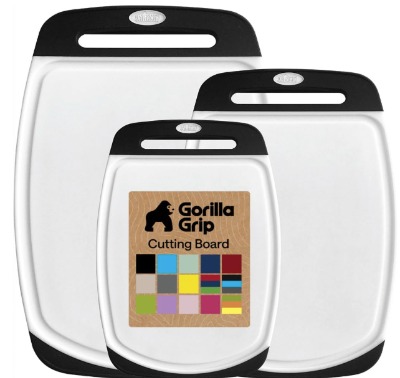
4. GORILLA GRIP Cutting Board, Slip Resistant and Nonporous, BPA-Free, Black
Product Description
The GORILLA GRIP board is made from a black plastic that is labeled BPA-free and nonporous. Its main selling point is a slip-resistant design, meant to keep the board stable while you cut. It is the only plastic board in this roundup, and it stands out for being much easier on knives than the metal options.
Plastic boards are a common choice for home kitchens. They are light, inexpensive, and usually dishwasher-safe, though you should always confirm the care instructions on the listing.
Best Use Cases
This board is a good everyday choice. It suits people who cook regularly, prep vegetables and meat, and want a board that does not wear down their knives quickly. It is also a strong pick for beginners who want a simple, low-maintenance board without a big investment.
It is less ideal for anyone who wants a board that resists deep scratches over many years. Plastic surfaces show wear more visibly than metal ones.
Key Features Explained Simply
The non-porous surface means juices and smells do not soak in as easily as they do with wood. The BPA-free label means the plastic does not contain that specific chemical, which many people look for when buying kitchen products. The slip-resistant design helps the board stay in place on the counter.
The black color can also be a practical feature, since it hides minor stains better than white plastic does.
Real-Life Usage Insight
Plastic is kind to knives. In daily prep, this board lets your blade keep its edge longer than a metal or titanium surface would. Most cooks find that a plastic board is comfortable for long chopping sessions, since it gives a little under the blade rather than bouncing back hard.
Over time, plastic boards can develop knife grooves. These grooves can trap food particles and water, so they need to be replaced when they get deep. Check the surface regularly and replace the board when cleaning no longer reaches the bottom of the cuts.
Honest Pros
- Gentle on knife edges compared with metal surfaces.
- Slip-resistant design helps during use.
- BPA-free and non-porous.
- Budget-friendly and light.
Honest Cons
- Deep grooves can develop over time, which affects hygiene.
- Plastic can show scratches and stains more visibly than metal.
- Not as rigid as a metal board, so it may flex slightly under heavy pressure.
Performance Discussion
This board performs well for typical home tasks. It gives a comfortable cutting surface, holds its position well thanks to the grip design, and works for vegetables, fruit, bread, and meat. For very heavy chopping, the flex can be a little noticeable, but it is not a deal-breaker for most kitchens.
Ease of Use
Cleanup is straightforward. Wash with warm, soapy water, rinse, and dry. Check the listing before putting it in the dishwasher, since some plastic boards are not suited for high heat. Storing it upright helps it dry evenly.
Value for Money
This is probably the strongest value in the roundup. It is affordable, gentle on knives, and easy to use. For someone who wants a good everyday board without spending much, this one is a sensible pick. The main trade-off is that you may need to replace it sooner than a metal board.
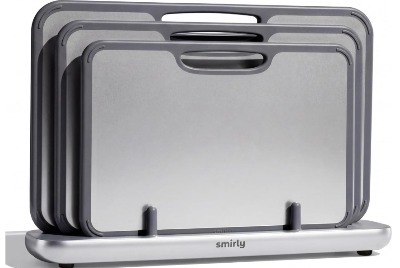
5. SMIRLY Titanium Cutting Board for Kitchen, Dishwasher Safe, 3 Pack, Silver
Product Description
The SMIRLY set is a 3-pack of silver titanium boards. The listing emphasizes that they are dishwasher safe, which is a practical perk for busy cooks. The three boards give you several surfaces for different foods, so you can keep tasks apart without constant rinsing.
Titanium is the core material, and its silver finish gives the boards a clean, modern look that fits many kitchen styles.
Best Use Cases
This pack suits people who want to separate food groups, such as one board for fruit, one for vegetables, and one for proteins. It also works well for busy households where cleanup needs to be fast. The dishwasher-safe claim makes it attractive for people who run the dishwasher daily.
It is less ideal for someone who wants a soft cutting surface for long, careful knife work.
Key Features Explained Simply
The three-board pack gives you multiple surfaces. Titanium is hard, resists odors, and does not absorb liquids. The dishwasher-safe feature means you can clean the boards with a standard cycle, though you should check the specific care instructions to avoid warping or finish wear.
Real-Life Usage Insight
With three boards on hand, you can stop washing one board between each task. Many cooks use one board for a few minutes, rinse it, and set it aside while they move on. This habit saves time and reduces cross-contamination risk when you keep boards for specific foods.
As with all titanium boards, expect knives to dull faster than with plastic. Plan to hone your blades more often, and sharpen them regularly if you use these boards daily.
Honest Pros
- Three boards give you flexibility for separating food.
- Dishwasher-safe, which saves time.
- Resistant to stains and odors.
- Clean, simple silver look.
Honest Cons
- Titanium is hard on knife edges.
- Boards may slide on the counter if the surface is not stable.
- Dishwasher cycles can wear down finishes over time if used constantly.
Performance Discussion
Performance is solid for everyday prep. The boards give a firm, stable cutting surface and handle most kitchen tasks without trouble. Heavy chopping feels firm, and you may notice more vibration than with a plastic board. Using a non-slip mat under each board keeps them steady.
Ease of Use
Cleanup is easy, especially with the dishwasher-safe feature. For longer-term care, hand washing with mild soap is gentler on the surface and helps the boards look newer for longer. Drying them fully after washing helps keep the finish clean.
Value for Money
For a three-pack, this is a reasonable buy. You get multiple boards, dishwasher convenience, and a solid material. It works best for people who want several boards and do not mind the hardness of the surface.
How These Materials Compare in Daily Use
Titanium and stainless steel boards share a lot of traits. Both are non-porous, both resist odors, and both are easy to sanitize. Both are also harder than your knife edge, which makes them harsher on blades. Titanium tends to be lighter and a bit warmer to the touch, while stainless steel feels heavier and colder. Stainless steel is also typically louder under the knife.
Plastic boards, like the GORILLA GRIP option, take a different approach. They are softer, so they are gentler on knives. They also give a little under pressure, which many cooks find more comfortable for long prep sessions. The trade-off is that plastic wears down faster, and deep grooves can form. Once grooves appear, they need replacing or extremely careful cleaning.
The SUMZZZ board sits in the middle. It gives you a metal side for firm chopping and a plastic side for gentler cutting. If you want a balance between hardness and comfort, this kind of design is useful.
For knife care, the general rule is simple. Softer boards protect your edge better. Harder boards keep your food hygienic but ask more from your knives. You can have a good board and a good knife, as long as you match the board to how you cut.
Buying Guide: What to Look for Before You Buy
Start by thinking about how you cook. If you prep a lot of vegetables and fruit, a plastic or softer board will protect your knives better. If you handle raw meat often and want a board that is easy to sanitize, a non-porous metal board may suit you. If you cook for a crowd, multiple boards help you keep tasks separate.
Look at the size. A small board is handy for quick jobs, but it can feel cramped when you prep a full meal. A large board takes up counter space and may be harder to store. Many home cooks find that one medium and one large board covers most needs.
Check the material and its finish. Food-grade labels, non-porous surfaces, and clear care instructions are signs of a well-made product. Avoid boards with unclear material descriptions or vague claims.
Think about grip. A slip-resistant base or a non-slip mat under the board is important for safety. A board that slides while you cut is a common cause of kitchen accidents.
Consider cleanup. Dishwasher-safe boards save time, but hand washing often keeps surfaces in better shape. Decide how you prefer to clean, then choose a board that fits your routine.
Finally, consider your knives. If you own expensive knives, avoid very hard boards for daily use. Save metal boards for tasks where you do not need precise, repeated cutting.
Who Should Buy These Products?
If you want a simple, budget-friendly everyday board that is kind to your knives, the GORILLA GRIP board is a good first choice. It suits beginners, students, and anyone who wants a practical board without a high price.
If you cook often with both raw meat and produce, the SUMZZZ dual-sided board gives you two surfaces in one. It works well for small kitchens where counter space is limited.
If you want a set of boards for different sizes and tasks, the titanium set of three fits families and people who cook in batches. The larger boards handle big jobs, and the smaller ones cover quick prep.
If you want several boards that clean up quickly, the SMIRLY three-pack is a practical option. It suits busy households and people who run the dishwasher often.
If you want a metal board for sanitary prep, the SNOWCLAD stainless steel board can be a useful addition. It works best as a secondary board, paired with a softer everyday option.
Common Mistakes to Avoid
One common mistake is using a hard board for every task. Metal and titanium boards are great for hygiene, but they can dull knives quickly. Keep a softer board for daily cutting and save hard boards for tasks that need them.
Another mistake is skipping the non-slip step. Even a grip-friendly board can shift on a smooth counter. A damp towel or non-slip mat underneath solves this easily.
Many people also forget to separate raw and cooked food. Using the same surface without cleaning it in between can spread bacteria. Wash the board and your hands between tasks, especially after handling raw meat or fish.
Ignoring grooves is another problem. Deep cuts in plastic boards can trap bacteria and food particles. If you cannot clean a groove fully, it is time to replace the board.
Some people put every board in the dishwasher without checking the care label. High heat can warp or damage certain materials and finishes. Read the instructions before you run a cycle.
Finally, do not rely on a board alone to keep food safe. Good hygiene habits matter more. Wash produce, keep raw meat away from ready-to-eat food, and store cooked food properly.
Final Verdict
There is no single best board for everyone, but each product in this roundup has a clear strength. The GORILLA GRIP board is the best choice for most home cooks who want an affordable, knife-friendly everyday board. Its grip and plastic surface make it easy to use and gentle on blades.
The SUMZZZ dual-sided board is a smart pick for people who want two surfaces in one. It helps separate raw and cooked food and works well in smaller kitchens.
The titanium set of three is a strong buy for families or anyone who needs several sizes. The variety covers most prep tasks, and the boards store neatly.
The SMIRLY three-pack suits busy kitchens where dishwasher cleanup matters. The boards are practical and simple to use, though they are hard on knives.
The SNOWCLAD stainless steel board is a good secondary board for sanitary prep, but it is not the best choice as a daily cutting surface. Pair it with a softer board to protect your knives.
In short, if you want one board to start with, choose the GORILLA GRIP. If you want variety and better separation, go for the titanium set or the SUMZZZ dual-sided board. Match the material to your cooking habits, keep a non-slip base under every board, and replace any board with deep grooves. Those simple steps will do more for your kitchen safety than any marketing claim.
Frequently Asked Questions
Are titanium cutting boards safe to use?
Titanium is generally considered inert and non-porous, which makes it a practical choice for food prep. Clean the board after each use and follow the care instructions on the listing.
Do metal cutting boards dull knives?
Yes, they can. Stainless steel and titanium are harder than most knife edges, so they tend to dull blades faster than wood or plastic. Hone your knives regularly if you use metal boards often.
Is a plastic cutting board safe for raw meat?
Plastic boards are commonly used for raw meat, as long as you wash them thoroughly with hot, soapy water after each use. Replace any board that has deep grooves you cannot clean.
Can I put cutting boards in the dishwasher?
Some can, but you should always check the care instructions. Heat and harsh detergents can wear down certain surfaces over time, so hand washing often keeps boards in better condition.
How many cutting boards do I need?
Many home cooks do well with two or three. Keep one for raw meat, one for produce, and one for bread or ready-to-eat food. This habit helps reduce cross-contamination.
Should I use a non-slip mat under my cutting board?
Yes. A non-slip mat or damp towel under the board prevents slipping during use and makes cutting safer, especially with smaller boards.

Mary is a home cooking enthusiast and kitchen gear reviewer with a passion for practical cookware and food preparation tools. She enjoys testing cutting boards, knives, kitchen gadgets, and other cooking essentials to help home chefs make smarter buying decisions. Through KitchenCutting.com, Mary shares honest product reviews, buying guides, and helpful kitchen tips to make cooking easier, safer, and more enjoyable.