5 Best Hand Held Knife Sharpener In 2026
As an Amazon Associate we earn from qualifying purchases.
A hand held knife sharpener is a small, manual tool you pull a blade through by hand. It suits people who want a simple way to bring back an edge without learning stones or electric machines.
Many everyday knives go dull through normal cutting, and a pull-through tool can restore a usable edge in under a minute when the blade is only mildly worn. Cutting boards, food types and how often you cook all affect how quickly an edge fades.
This guide helps beginners who want to pick the best hand held knife sharpener for their kitchen, hunting or outdoor gear.
The five products covered here share a few traits. Each one is a pull-through or manual tool, each uses hard carbide or ceramic parts, and each has a guard or grip meant to keep fingers away from the edge.
The comparison rests on the listed features and typical use, not on personal testing, so the details below reflect what each product says and what this kind of tool usually does. Where a claim is the maker’s own, this guide says so. Readers should also check the product page for current specifications before buying.




1. AccuSharp Gourmet Series: best for gourmet 15-degree kitchen knives
What it is and who it suits
The AccuSharp Gourmet Series is a hand-held sharpener made for gourmet knives that use a 15-degree edge. The angle is the slope of the blade where it meets the sharp point. A narrower angle like this cuts thinly but can dull faster on hard foods, which is one reason a matched sharpener helps. This tool suits home cooks who own knives in that style and want a simple way to keep them in shape.
It is listed for both straight-edge and serrated knives. That makes it a fit for a varied kitchen knife set, though the 15-degree focus is the main selling point. Owners of wider-angle knives, such as many traditional Western chef’s knives, should check the angle before buying. A mismatched angle can leave the edge less sharp than before, even after several pulls.
Key features in simple words
The blades are made from diamond-honed tungsten carbide. Tungsten carbide is a very hard material often used for sharpening, because it removes small amounts of steel quickly. The blades can be reversed, so the maker says the life of each blade roughly doubles before it needs replacing. That claim comes from the manufacturer and will depend on how often and how hard the tool is used.
The handle is ergonomic, which means shaped to fit the hand. A full-length finger guard sits along the tool to protect your fingers during each pull. Grip matters here, since a steady hand keeps the blade at the same angle from stroke to stroke. A loose or tilted grip is a common reason beginners get uneven results.
Daily use and ease of use
In practice, you hold the tool steady, place the blade in the slot and pull it through a few times. Pull the blade toward you, away from the cutting edge, and keep light pressure rather than pushing hard. The guard keeps your hand clear of the cutting part. Most people find the motion simple, though the first few tries take a little care.
Because it works at one set angle, you do not need to judge the angle yourself. That helps beginners get consistent results on the right knives. After sharpening, wiping the blade with a clean cloth removes the fine metal dust the process leaves behind. Rinsing and drying the knife before storing it keeps the edge in better condition.
Performance and value for money
Performance depends on how dull the knife is. For light touch-ups on a 15-degree blade, this type of carbide sharpener is generally effective. Very damaged edges may need more passes or a different method, such as a whetstone or a professional service. A simple test is to see if the blade slices a sheet of paper cleanly after sharpening.
At its listed price, it sits at the lower end of the group. For a small kitchen tool with replaceable blades, that is reasonable value. Compare the cost of replacement blades over time with the cost of professional sharpening, since that comparison often decides if the tool makes sense for a given household. Frequent cooks with many knives may find the math favors a tool like this, while occasional cooks may prefer a service.
Pros
- Designed specifically for 15-degree gourmet knives
- Reversible carbide blades can extend use
- Full-length finger guard supports safer use
- Handles both straight and serrated edges
Cons
- Best suited to 15-degree knives, so other knives may not match well
- Very dull or chipped blades may need more than a few strokes
- Blades need eventual replacement, adding small ongoing cost
2. Smith’s CCKS 2-Step Knife Sharpener: best for portable outdoor sharpening
What it is and who it suits
The Smith’s CCKS 2-Step is a small pull-through sharpener aimed at anglers, hunters and anyone who carries a knife outdoors. It is meant for fillet knives, pocket knives and hunting knives. Its size makes it easy to carry in a pocket, a tackle box or a day pack.
This tool suits people who sharpen a few blades now and then and want something quick. A camper who wants a fresh edge on a folding knife before a trip is a good example. It is less suited to someone who needs precise control over a specific edge angle or who sharpens many knives every week.
Key features in simple words
The tool has two stages. The coarse stage, with tungsten carbide, restores an edge on a dull blade. The fine stage, with ceramic rods, works on a blade that already has a decent edge. A ceramic rod is a fine, smooth material that polishes the edge.
The angles are preset, so you do not need to set the blade angle yourself. Each stroke follows the same path through the slot, which keeps the process simple for beginners. The maker lists the sharpener as lightweight and small enough for a pocket.
Daily use and ease of use
To use it, you pull the blade through the coarse slot a few times, then move to the fine slot. Keep the blade flat against the guide and use steady, even strokes. Many people find that a few passes in each slot is enough for a light touch-up. Starting with a clean, dry blade helps the stones grip the edge more evenly.
Outdoor users often use it at the water’s edge or in the field, where a full workbench is not available. The rubber feet help keep it steady on a flat surface, such as a tailgate or a stump. Placing a towel underneath can add extra grip on a slippery surface.
The tool floats, which many anglers find useful if it drops near water. Cleaning is simple with a damp cloth, as the maker notes. Keep the slots free of metal debris so the stones keep working well. Wiping the blade dry afterward also helps prevent rust on carbon steel knives.
Performance and value for money
The coarse slot can bring back an edge on a fairly dull blade with a few strokes. The fine slot refines the edge for a cleaner finish, which is useful before a day of cutting fish or game. Heavily worn or very damaged blades will take longer and may not reach full sharpness.
At its listed price, this is one of the lowest-cost tools in the group. For occasional outdoor use, the value is strong. If you need to sharpen a large kitchen knife set or a very long blade, a larger bench system may serve you better.
Pros
- Two stages cover both restoring and refining an edge
- Very compact and light for carrying outdoors
- Floats in water and has a lanyard hole
- Low price for a simple, portable tool
Cons
- Plastic body feels less sturdy than metal designs
- Heavily damaged blades need more time and may not fully recover
- Small size can make longer blades feel awkward to pull
3. AccuSharp Hand-Held Carbide Blade Sharpener: best for everyday chef knives
What it is and who it suits
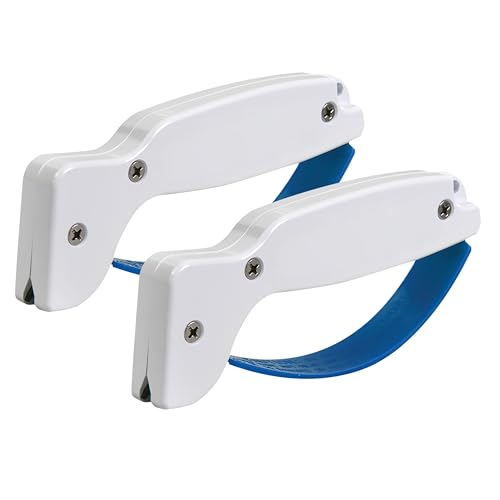
This AccuSharp model is a general kitchen sharpener designed for many knife types. It is listed for chef knives, paring knives, serrated knives, fillet knives and cleavers. It suits households that own a mix of kitchen knives, especially when one tool needs to cover most of the knife block.
The pack contains two sharpeners, so one can stay in a drawer while the other is in use. That detail is useful for people who want a spare. It also helps when a shared kitchen has more than one person doing the sharpening, since each person can keep a tool within reach.
A home cook who mainly owns one good chef knife may find the tool more than enough. A household with a full set, including bread knives and boning knives, will get more value from the range of listed knife types.
Key features in simple words
Like the Gourmet model, the blades are diamond-honed tungsten carbide and can be reversed. The maker says most users see five to ten years between blade replacements. That figure is the maker’s own and will vary with how often and how hard the tool is used.
The handle is shaped to fit either hand, so the grip stays comfortable if you are right- or left-handed. A full-length guard protects the fingers during each stroke, which matters most when the blade is close to the hand. The tool can be cleaned with soap and water or in a dishwasher, though the maker’s guidance on the body and the blades should always be checked first.
Because the carbide edges do the sharpening, there is no oil, water or stone to set up. You simply hold the tool steady on a flat surface or in your hand and draw the knife through. This makes it a practical choice for people who want a quick touch-up without a larger setup.
Daily use and ease of use
Using it is quick. You pull the knife through the carbide slot a few times, then test the edge on paper or a tomato. A clean slice through a ripe tomato is a simple check that the blade has picked up an edge. Because the handle works for left and right hands, shared households find it easy to hand over.
The maker says the sharpener gives a sharp edge in about ten seconds. Real results depend on how dull the blade is and how steady the pull is. A light, even pressure with a consistent angle usually works better than rushing through the strokes.
A paper test is a useful habit after each session. If the blade slides through a sheet of printer paper without tearing or catching, the edge is in good shape. If it snags or pushes the paper aside, another few passes may help.
Performance and value for money
For regular touch-ups on everyday kitchen knives, carbide sharpeners like this usually do well. They are most useful when a blade has only lost its edge through normal cutting rather than through chips or bends. Very dull or damaged blades may need more strokes, and in some cases a stone or professional service will give a better result.
Serrated edges are handled, but the results can differ from a straight edge. A serrated blade often needs a different slot or technique to reach each scallop, so expect a less uniform result than on a plain chef knife. Check the instructions for the knife type before you start.
At its listed price for a two-pack, the value looks solid for households that want a spare. The long blade life adds to the case for the tool, provided the maker’s figure holds up in your own kitchen. Compare the price with the cost of a single replacement sharpener or a service visit before deciding.
Pros
- Works on many knife types, including serrated and straight edges
- Handle fits both right- and left-handed users
- Two-pack offers a spare sharpener
- Blades can be reversed and are dishwasher-safe on the body
Cons
- Carbide slots can leave a rougher edge than a fine stone or ceramic rod
- Blade life claims are the maker’s and may vary with use
- Larger than pocket tools, so less handy for outdoor carry
4. Smith’s JIFF-S 10-S ec Knife & Scissors Sharpener: best for sharpening knives and scissors together
What it is and who it suits
The Smith’s JIFF-S is a pullover sharpener that handles both knives and scissors. It suits people who want one small tool for the kitchen, the tackle box and the sewing drawer. Households that own a mix of blades often find this kind of tool handy.
Key features in simple words
The knife side has a V-shaped slot with two crossed carbide blades set at a preset angle. The scissors side has a ceramic rod built into the handle. The rod floats so it can match the angle of the scissor blades.
The scissors sharpener is listed for both right- and left-handed scissors. The blades are reversible and replaceable, which the maker says supports long-lasting use.
Daily use and ease of use
For a knife, you pull the blade through the V-slot a few times in the same direction. For scissors, you open them and run the blade along the ceramic rod. A full-length finger and thumb guard keeps your hands clear during each stroke.
The packaging includes step-by-step instructions. That helps beginners who are unsure about technique.
Performance and value for money
The knife slot works well on straight-edge blades with a moderate dulling. It is not designed for serrated knives, so check your blades before buying. Scissor results depend on how worn the blades are.
At its listed price, it sits in the mid-range of the group. Covering both knives and scissors gives it good value for a shared household tool.
Pros
- Sharpens both knives and scissors with one tool
- Scissors side works on right- and left-handed scissors
- Full-length finger and thumb guard supports safer use
- Includes clear written instructions
Cons
- Knife slot is designed for straight edges, not serrated knives
- Results on heavily worn scissors may be limited
- Pullover design takes a little practice to feel natural
5. Henckels Handheld Knife Sharpener: best for a two-stage kitchen tool with a non-slip base
What it is and who it suits
The Henckels Handheld Knife Sharpener is a manual pull-through tool for kitchen knives. It suits home cooks who want a simple two-stage sharpener with a comfortable grip. Its design leans toward everyday use in the kitchen.
Key features in simple words
The sharpener has a coarse ceramic stage and a fine ceramic stage. The coarse stage restores an edge, and the fine stage refines it. The handle is contoured for comfort, and a safety grip keeps fingers away from the blade.
The rubberized base is non-slip. That helps keep the tool steady on the counter while you pull the blade through.
Daily use and ease of use
You hold the sharpener firmly on the counter, then pull the knife through the coarse stage before moving to the fine stage. The contoured handle and safety grip make the motion feel controlled. Storage is simple because the tool is compact.
Because the stages are clearly marked, the steps are easy to follow. Beginners usually find this layout straightforward.
Performance and value for money
Ceramic stages generally give a smooth, refined edge. They can take longer than carbide on a very dull blade. For regular kitchen maintenance, the results are generally good.
At its listed price, it sits in the upper part of the group. The value depends on if the comfort, base and two-stage design matter to you.
Pros
- Two ceramic stages suit regular kitchen maintenance
- Contoured handle and safety grip feel comfortable
- Non-slip base keeps the tool steady
- Compact and simple to store
Cons
Cons
- Ceramic stages can be slower than carbide on very dull blades
- Higher listed price than some simpler pull-through tools
- Limited detail on blade type and replacement, so longer-term costs are unclear
Who should buy these products
The right choice depends on where and how you plan to use the sharpener. Each product fits a different kind of buyer. The matches below are based on the listed features, so compare them against your own knives and habits before you decide.
Home cooks with 15-degree gourmet knives will find the AccuSharp Gourmet Series the closest match. It is built for that specific edge angle and keeps the job simple. If your knives are a different angle, check the product details before you buy, because a sharpener set for the wrong angle can leave an edge that feels dull or uneven.
Anglers, hunters and campers who want something small for the field will likely prefer the Smith’s CCKS 2-Step. Its size, floating body and two stages suit outdoor kit. A compact tool that stays with your gear is easier to use when you are away from home, especially if you want to touch up a blade on a trip rather than carry a full kitchen setup.
Households with a mix of everyday kitchen knives and a spare sharpener in mind will look at the AccuSharp Hand-Held Carbide Blade Sharpener. Its two-pack and wide knife range suit shared kitchens. One sharpener can stay in the main kitchen while the other goes in a drawer or a travel bag, so nobody has to wait for a single shared tool.
People who sharpen both knives and scissors will find the Smith’s JIFF-S a practical single tool. Its scissors side covers a job most knife sharpeners leave out. Keeping one tool for both tasks means less clutter in the kitchen or workshop, and fewer items to store and find when you need them.
Cooks who want a comfortable two-stage tool with a steady base for regular kitchen upkeep will consider the Henckels Handheld Knife Sharpener. Its ceramic stages and grip suit daily use. A stable base helps you keep the blade at a consistent angle as you draw it through, which is the key to getting a clean, even edge with a manual tool.
Final verdict
No single sharpener suits every buyer. The best choice depends on your knives, your setting and how often you plan to sharpen. Matching the tool to your main use matters more than any one feature, and a sharpener that fits your routine will get used far more often than one that does not.
For specialised 15-degree kitchen knives, the AccuSharp Gourmet Series is the most focused option. For outdoor carry, the Smith’s CCKS 2-Step is the most portable. For a mixed kitchen with a spare, the AccuSharp two-pack stands out, since it gives you a backup without buying a second brand.
In short, buyers who want one tool for knives and scissors should look at the Smith’s JIFF-S. Those who value a comfortable two-stage kitchen tool should consider the Henckels. Read the listed features against your own blades before deciding, and check the edge angle and blade type your knives use, since those details will tell you more than any general ranking.
Frequently Asked Questions
What is a hand held knife sharpener?
It is a small manual tool that you pull a knife blade through by hand. The slots or rods inside restore or refine the edge. It needs no power and is easy to store in a drawer or a pack.
Most of these tools are compact enough to keep in a kitchen drawer or take on a camping trip. Because they run on your own hand pressure, they work anywhere, even without an outlet nearby.
Can a pull-through sharpener damage my knife?
Used correctly, a pull-through sharpener is generally safe for most kitchen knives. Using too much pressure or the wrong angle can wear the edge faster. Follow the instructions that come with the tool, and draw the blade through slowly with light, even pressure.
A good habit is to start with the blade at the entry slot and pull it toward the handle in one smooth motion. Repeating the pass a few times is usually enough, so there is no need to press harder when the knife still feels dull.
Do these sharpeners work on serrated knives?
Some do, and some do not. The AccuSharp models list serrated knives, while the Smith’s JIFF-S is designed for straight edges. Check each product’s listed use before buying, since a tool built for straight edges may not clean up the scalloped teeth of a bread knife.
If a product does not list serrated blades, it is best to leave your bread knife for a tool made for that purpose. Using a straight-edge tool on serrations can round off the points and leave the knife cutting less cleanly than before.
How often should I sharpen my knives with one of these tools?
It depends on how often you use the knife and on what. Many home cooks touch up their blades every few weeks, but this varies widely. Sharpen when you notice the knife tearing food rather than cutting cleanly, or when a tomato skin resists the blade.
A knife you use daily on hard foods, such as squash or frozen items, will dull faster than one used mainly for soft fruit. Paying attention to how the knife performs is a more reliable guide than counting days on a calendar.
Is a two-stage sharpener better than a single-stage one?
A two-stage sharpener first restores an edge, then refines it. That often gives a smoother result than a single coarse stage. If it is better for you depends on how dull your knives get. A knife that is only slightly dull may need just the finer stage.
If your knives are badly worn or have small chips, the coarse first stage does the heavy lifting. For routine upkeep between fuller sharpenings, using only the fine stage can keep the edge tidy without removing much metal.

Mary is a home cooking enthusiast and kitchen gear reviewer with a passion for practical cookware and food preparation tools. She enjoys testing cutting boards, knives, kitchen gadgets, and other cooking essentials to help home chefs make smarter buying decisions. Through KitchenCutting.com, Mary shares honest product reviews, buying guides, and helpful kitchen tips to make cooking easier, safer, and more enjoyable.