5 Best Affordable Knife Sharpener In 2026
A dull knife is annoying and unsafe. It slips off tomato skins, crushes bread, and makes simple prep feel like a chore. The good news is that you don’t need a pricey whetstone kit or a trip to a pro to fix it. The best affordable knife sharpener can bring a tired blade back to a usable edge in a few minutes, and most cost less than a decent takeout meal.
In this article
This roundup covers five popular budget options: a 3-stage sharpener with a cut-resistant glove, the KitchenIQ 50009 Edge Grip, the Longzon 5-in-1, the SHARPAL 191H, and the AIERLIAN rolling sharpener kit. Each one gets a plain-language breakdown of what it does, who it suits, how it feels to use, and where it falls short. You will also find a comparison table, a buying guide, a list of common mistakes, and a final verdict.
Everything here sticks to realistic expectations. A cheap manual sharpener will not turn a supermarket knife into a razor-sharp Japanese blade. It will, however, make a dull kitchen knife cut cleanly again, and that is what most home cooks need.
Quick Comparison Table
| Product | Type | Stages / System | Angle Guide | Best For |
|---|---|---|---|---|
| 4-in-1 3-Stage Sharpener with Glove | Pull-through | 3 stages (repair, restore, polish) | Fixed slots | Beginners who want a simple all-rounder |
| KitchenIQ 50009 Edge Grip | Pull-through | 2 stages (coarse and fine) | Fixed slots | Small kitchens and quick touch-ups |
| Longzon 5-in-1 | Pull-through | 4 stages, plus scissors slot | Fixed slots | Households with knives and scissors |
| SHARPAL 191H | Handheld | Multi-stage, knife and scissors | Fixed slots | Grab-and-go sharpening, multiple tools |
| AIERLIAN Rolling Kit | Roller with discs | Diamond and ceramic discs | 15 and 20 degree magnetic guide | Learners who want control over the angle |
What Makes a Knife Sharpener “Affordable” Yet Worth Buying?
Budget sharpeners get a bad reputation, and some of it is fair. Cheap ones often use fixed angles, small abrasive slots, and lightweight plastic bodies. Still, a good one does a few things well:
- It removes a small amount of metal to form a new edge.
- It keeps the blade at a steady angle while you work.
- It feels stable in your hand or on the counter.
- It gives a finishing pass so the edge does not feel rough.
If a sharpener does those four things, it earns its price. The five products below all aim at that goal, but they go about it in different ways. Some use a pull-through slot, and one uses a rolling disc system. That difference matters more than you might think, so keep it in mind as you read.
1. 4-in-1 Kitchen Knife Accessories: 3-Stage Knife Sharpener with Cut-Resistant Glove
Product Description
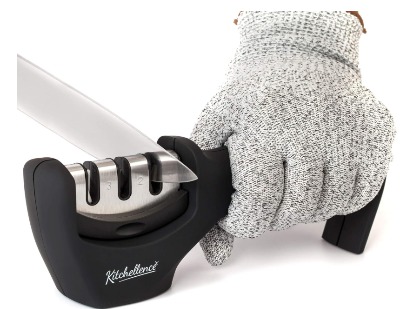
This is a classic pull-through manual sharpener with three slots. The listing describes them as stages that repair, restore, and polish a blade. A cut-resistant glove comes in the box, which is where the “4-in-1” name comes from. The body is black plastic with a grip area on top and a base that rests on your counter.
The idea is easy. You drag the knife through the first slot to fix a badly dull edge, then move to the second slot to refine it, then finish in the third to smooth things out. It suits people who want a clear step-by-step routine without any guesswork.
Best Use Cases
This sharpener fits everyday kitchen knives like chef’s knives, utility knives, and paring knives. It works well for a household that has let its knives go dull for a long time and needs a simple way to get them cutting again. The glove makes it a friendly pick for anyone who feels nervous about handling a blade near an abrasive.
Key Features Explained Simply
- Three stages: The first slot is coarser and removes more metal. The middle slot refines the edge. The last slot is gentle and polishes it.
- Cut-resistant glove: You wear it on the hand that holds the knife, or the hand that steadies the sharpener. It adds a layer of protection against slips.
- Fixed-angle slots: The slots guide the blade, so you do not need to learn a sharpening angle first.
- Compact body: It stores in a drawer or cabinet without much fuss.
Real-Life Usage Insight
In typical home use, the routine goes like this. Set the sharpener on a flat, dry surface and hold the handle firmly. Put the heel of the blade into the coarse slot, then pull it toward you with light, even pressure. A few passes usually do the job. Repeat in the second slot, then finish with a few passes in the polish slot.
Users often say the biggest difference shows up on a dull kitchen knife that could barely slice a tomato. After a few minutes, the same knife cuts through the skin without pressure. That kind of quick win is why pull-through sharpeners stay popular.
One thing to watch: the glove is a nice safety extra, but it does not replace good technique. Keep your fingers away from the blade edge and keep the pull smooth.
Pros and Cons
Pros
- Easy to use with no learning curve
- Three stages give a clear routine
- Glove adds a safety layer
- Small and easy to store
- Low cost
Cons
- Fixed angles may not match every knife
- Not ideal for very high-end or very hard steel
- Plastic body feels light compared with pricier models
- Removes metal faster than a whetstone, so heavy use shortens a blade’s life over time
Performance Discussion
For basic kitchen knives, performance is solid for the price. The coarse stage handles neglected edges, and the fine stages leave the blade smooth enough for slicing vegetables, chicken, and bread crust. It will not give you a mirror-polished edge, and it is not built for that. Think “useful and sharp” rather than “surgical.”
Serrated knives are a gray area. Many multi-stage pull-through sharpeners handle straight edges best. If you own several serrated knives, check the listing details before you buy.
Ease of Use
Very easy. The slots do the angle work for you, so you only need to pull with steady pressure. The main skill is patience. Do not rush and do not press hard.
Value for Money
This one offers good value if you want a simple, low-cost fix. You get the sharpener and a glove, which is a nice bonus at this price. It will not replace a proper stone setup for serious hobbyists, but for casual cooks it is a strong entry-level deal.
2. KitchenIQ 50009 Edge Grip 2-Stage Knife Sharpener
Product Description
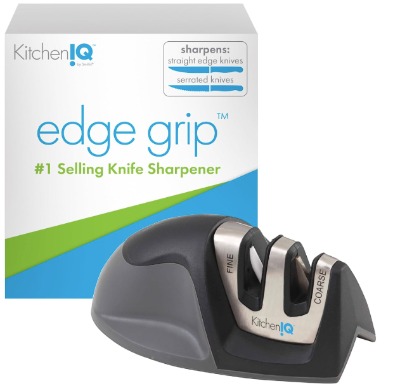
The KitchenIQ 50009 Edge Grip is a compact two-stage sharpener with a coarse slot and a fine slot. It has a soft grip rubber handle and a non-slip base that keeps it steady on the counter. It is made for straight and serrated knives, which sets it apart from many budget models.
The design is simple on purpose. There are two slots, one handle, and no extras. That simplicity is a big part of the appeal.
Best Use Cases
This model works well for small kitchens, dorm rooms, first apartments, and anyone who wants a no-nonsense tool for routine touch-ups. It also suits people who own a mix of straight-edge and serrated knives, such as a chef’s knife and a bread knife. Because it is compact, it also fits in a camping kitchen kit or a caravan drawer.
Key Features Explained Simply
- Coarse and fine stages: The coarse slot rebuilds a dull edge. The fine slot smooths it. Two steps are enough for most everyday sharpening.
- Non-slip base: The base grips the counter so the sharpener does not slide while you pull the knife through.
- Soft grip handle: The rubber handle gives your hand a comfortable hold, which helps you keep control.
- Straight and serrated compatibility: This is a handy bonus for households that use bread knives or steak knives.
- Compact size: It takes almost no storage space.
Real-Life Usage Insight
A stable base makes a bigger difference than most people expect. With cheaper sharpeners that slide around, you end up pinning the body with one hand and pulling with the other, and the angle wobbles. The grippy base and handle here let you hold the sharpener steady and focus on the pull.
A common routine is three to five passes in the coarse slot for a dull knife, followed by a few passes in the fine slot. For a knife that is only slightly dull, skipping straight to the fine slot may be enough. Testing the edge on a piece of paper or a soft tomato tells you when you are done.
Pros and Cons
Pros
- Stable, non-slip base
- Comfortable soft handle
- Works with straight and serrated knives
- Very easy to store
- Simple, beginner-friendly design
Cons
- Only two stages, so the finish is less refined than multi-stage options
- Fixed angle may not be perfect for every blade
- Not meant for very hard or specialty steel
- No glove or extras in the package
Performance Discussion
For a two-stage tool, it performs well on everyday kitchen knives. The coarse slot removes enough metal to fix a dull edge, and the fine slot cleans it up. The result is a sharp, usable edge that handles daily cooking. It will not compete with a whetstone for fine slicing work, but that is not the goal here.
Serrated knives need a little extra care, since any pull-through slot only touches part of a serrated edge. Go slowly and use light pressure.
Ease of Use
Excellent. The handle and base make the whole process feel controlled. Beginners will feel comfortable within the first few passes, and there is almost nothing to set up.
Value for Money
This is one of the safest budget buys in the group. It does not try to be fancy. It gives you a stable, easy-to-use sharpener that handles the most common kitchen jobs. If you want a dependable tool and do not need a glove or extra slots, it delivers strong value.
3. Longzon 5-in-1 Knife Sharpener, 4 Stage with Cut-Resistant Glove
Product Description
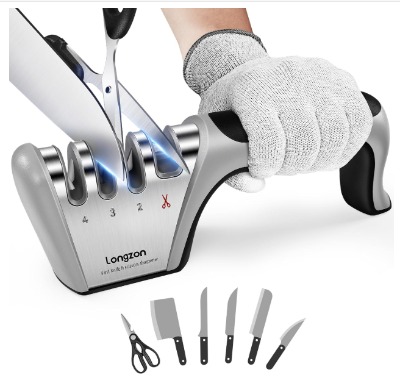
The Longzon 5-in-1 is a manual sharpener with four stages and a cut-resistant glove. The listing also says it handles scissors, which is where much of the “5-in-1” idea comes from. It comes in a black and silver finish and targets home kitchens.
It builds on the standard pull-through concept and adds more steps, plus a scissors slot, so you can sharpen more than one kind of tool.
Best Use Cases
This sharpener makes sense for households that want one tool for knives and scissors. Think of a kitchen with a set of everyday knives, a pair of kitchen shears, and maybe a craft drawer with scissors that no longer cut cleanly. It also suits people who like having an extra stage in the routine for a smoother finish.
Key Features Explained Simply
- Four stages: More steps let you move from repair to finish in a gradual way. The extra stage can help make the final edge feel smoother.
- Scissors slot: A dedicated area for scissors means you do not need a second gadget.
- Cut-resistant glove: It adds a safety layer while you handle the blade.
- Manual operation: No power, no cord, and no batteries. You do the work by hand.
- Fits most knives: The listing says it works with most common kitchen knives.
Real-Life Usage Insight
The extra stage is the main difference in practice. Users who like a more gradual routine often prefer having a middle step between rough sharpening and final polish. The process still stays simple: coarse first, finer next, then finishing passes.
The scissors slot is handy but needs a slightly different technique. Scissors have a small cutting angle, so you sharpen each blade separately with slow, careful passes. Do not rush it. A quick pass on the wrong angle can leave scissors worse than before.
It also helps to wipe the blade after each stage. Metal dust builds up on the knife, and cleaning it makes it easier to judge your progress.
Pros and Cons
Pros
- Four stages for a more gradual sharpening routine
- Includes a scissors slot
- Glove included
- No power needed
- Low price for the feature count
Cons
- More stages mean a slightly longer routine
- Fixed angles limit flexibility
- Scissors sharpening takes patience and care
- Plastic construction feels basic
- Not the right tool for premium or very hard blades
Performance Discussion
Performance is decent for the price. The extra stage helps smooth the edge, so it feels a bit more refined than a bare two-stage design. For everyday knives, it brings back a clean bite and makes slicing easier. Scissors also improve, though results depend on how careful you are with the passes.
As with all pull-through models, do not expect a professional edge. This is a maintenance and revival tool, not a precision instrument.
Ease of Use
Easy, with a small learning curve for the scissors part. Knife sharpening is straightforward because the slots guide the blade. Scissors need more focus, but the steps are still simple.
Value for Money
Good value for households that have both knives and scissors to fix. You get more stages, a glove, and extra functionality for a low cost. If you only own kitchen knives, the scissors feature may not add much, but the extra stage still gives a little more finish.
4. SHARPAL 191H Knife Scissors Sharpener
Product Description
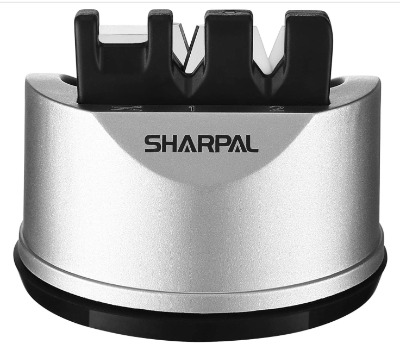
The SHARPAL 191H is a handheld sharpener built for knives and scissors. It is a compact tool that you hold in one hand while pulling the blade through the slots. The name says “knife scissors sharpener,” which sums up its purpose.
SHARPAL is a brand known for a range of sharpening tools, and this model sits in the budget end of the lineup. As with any product in this category, check the current listing for exact stage details and materials, since brands sometimes update specs.
Best Use Cases
This one suits people who want a portable, grab-and-go sharpener. It is a good fit for a kitchen drawer, a camping box, a workshop, or a craft room. Because it handles both knives and scissors, it appeals to anyone with a mix of tools that need occasional touch-ups.
Key Features Explained Simply
- Handheld design: You hold it directly, so there is no base to set down. This makes it quick to grab and use.
- Knife and scissors slots: One tool covers two jobs.
- Multi-stage sharpening: Like other tools here, it uses more than one abrasive step so you can sharpen and then smooth the edge.
- Compact size: It is easy to carry and store.
Real-Life Usage Insight
A handheld sharpener feels different from a base model. You grip it with one hand and pull the knife through with the other, so you need a firm hold and a steady motion. Some people like the freedom. Others find a stable base easier.
The best routine is to place the sharpener on a towel or non-slip mat if it feels shaky, then pull the blade in slow, even strokes. Never pull toward your fingers. Keep your grip well behind the slot.
For scissors, open them fully and sharpen one blade at a time. Use light strokes. If the scissors are badly dull, a few careful passes can bring them back to a usable state.
Pros and Cons
Pros
- Portable and compact
- Works on knives and scissors
- Simple to use
- Low price
- Handy for mixed-tool households
Cons
- Handheld grip needs more attention than a base model
- Fixed angles limit control
- Not ideal for high-end blades
- Results depend heavily on technique
- Less stable than sharpeners with grippy bases
Performance Discussion
For quick touch-ups, it does its job. Dull kitchen knives cut better after a few passes, and scissors regain some bite. It will not give you a fine, polished edge, and it is not designed for heavy restoration of damaged blades.
Think of it as a maintenance tool. Use it often, use light pressure, and you will keep everyday knives in good shape.
Ease of Use
Easy once you get a feel for it. The handheld style asks a bit more from your grip, so beginners should take their time and keep their movements slow.
Value for Money
This is a solid budget choice for people who want portability and dual functionality. It costs little and covers both knives and scissors. If you value stability above all, a base-style sharpener like the KitchenIQ may feel more comfortable. If you value flexibility, this one makes sense.
5. AIERLIAN Rolling Knife Sharpener Kit with 15 and 20 Degree Magnetic Angle
Product Description
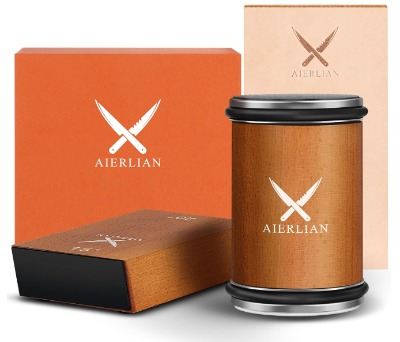
The AIERLIAN kit takes a very different approach. Instead of a pull-through slot, it uses a rolling design. You place the knife on a magnetic angle guide, then roll a sharpening tool with diamond and ceramic discs along the blade. The listing mentions two angle options, 15 and 20 degrees, and says it works on steel of any hardness. The kit comes in a brown finish.
This style borrows from more advanced sharpening methods. It gives you control over the angle instead of forcing the blade through a fixed slot.
Best Use Cases
It fits people who want to learn better sharpening habits without buying a full whetstone setup. It also suits owners of different knife types, since the two angle choices let you match the blade more closely. Many Western kitchen knives sit near 20 degrees, while many Japanese-style knives are sharpened at a lower angle, often around 15 degrees. Always check your knife maker’s guidance if you are unsure.
Key Features Explained Simply
- Rolling design: The sharpener rolls along the blade instead of pulling the blade through a slot. This makes each pass feel more controlled.
- Diamond and ceramic discs: Diamond removes metal and reshapes the edge. Ceramic refines it. Diamond is very hard, which is why the listing says it suits steel of any hardness.
- 15 and 20 degree magnetic angle guide: A magnet holds the knife at the set angle so you do not need to guess.
- Kit format: The set comes with the parts you need to get started.
Real-Life Usage Insight
This system takes a bit longer to learn than a simple pull-through tool, but it teaches good habits. You place the knife on the angle guide, hold it steady, and roll the sharpening tool along the edge. Then you flip the knife and repeat on the other side. Keeping the number of passes even on both sides gives you a balanced edge.
Because the angle is fixed by the magnet, the process is more predictable than freehand stone sharpening. Users who have struggled with stones often find rolling systems a friendly middle step.
The kit does need more setup and space on the counter. It is not a “grab and pull” tool. Plan to spend a few minutes per knife, especially at first.
Pros and Cons
Pros
- Angle control with two magnetic options
- Diamond and ceramic surfaces
- Suits harder steel as well as softer steel
- Teaches better sharpening habits
- Feels more precise than slot-style sharpeners
Cons
- Takes longer than pull-through models
- More parts to store and handle
- Needs a little practice
- Costs more than the simplest options in this group
- Not as fast for a quick touch-up
Performance Discussion
Performance is the strongest of the five, provided you follow the process. The angle guide helps you keep the edge consistent, and the diamond disc handles hard steel that softer abrasives struggle with. The ceramic disc finishes the edge, leaving it smoother than what most slot sharpeners produce.
It still is not a professional stone system. Results depend on how steady you are and how many passes you make. But for a home kit at this price range, the edge quality is a clear step up for users who take their time.
Ease of Use
Moderate. It is easy to understand once you try it, but the first session takes longer than with a pull-through tool. Beginners can master it with a little patience.
Value for Money
Good value for anyone who wants better edge control without a big spending jump. If you want the fastest, simplest fix, a pull-through model will feel easier. If you want better results and a chance to learn, this kit offers the best return.
Comparison Insights: How the Five Sharpeners Stack Up
Putting all five side by side shows a few clear patterns.
Speed and Simplicity
The pull-through models win here. The 3-stage glove set, the KitchenIQ, and the Longzon all guide the blade through a slot. You can go from dull to usable in a couple of minutes. The SHARPAL is also quick, though it asks for a steadier hand.
Edge Quality
The AIERLIAN rolling kit leads on edge quality. The magnetic angle guide, diamond disc, and ceramic disc combine to give you a cleaner, more consistent edge. The pull-through models trail behind, though they still make dull knives useful.
Safety
The 3-stage set and the Longzon include cut-resistant gloves, which is a helpful extra for nervous beginners. The KitchenIQ counters with a non-slip base and soft handle, which help keep your hands and the tool steady. The SHARPAL’s handheld design needs the most care.
Versatility
The Longzon and the SHARPAL both handle scissors, so they cover more tools. The KitchenIQ handles straight and serrated knives. The AIERLIAN suits a wide range of steels and gives two angle options.
Storage
The KitchenIQ and the SHARPAL are the easiest to tuck away. The AIERLIAN kit needs the most room because of its extra parts.
Overall Ranking by Need
| Need | Best Pick |
|---|---|
| Easiest for total beginners | KitchenIQ 50009 Edge Grip |
| Best for extra safety | 4-in-1 3-Stage with Glove |
| Best for knives and scissors together | Longzon 5-in-1 |
| Best for portability | SHARPAL 191H |
| Best edge quality | AIERLIAN Rolling Kit |
Buying Guide: What to Look For in a Budget Knife Sharpener
A few simple points will help you avoid wasted money.
Sharpener Type
Pull-through sharpeners are the easiest. You pull the knife through slots that hold a fixed angle. They work fast and suit beginners, but they remove metal quickly and offer less control.
Rolling sharpeners use a magnetic guide and rolling discs. They take more time but give better control.
Whetstones are the traditional method. They give the best results but need practice and are not covered here.
Abrasive Material
Sharpeners use different materials, and each has a job:
- Carbide: Common in coarse slots. It cuts metal quickly.
- Diamond: Very hard. It handles tough steel and reshapes edges well.
- Ceramic: Used for fine finishing. It smooths the edge.
A sharpener with a coarse step and a fine step covers most home needs.
Number of Stages
More stages do not always mean better results. Two well-made stages can beat four weak ones. Still, an extra polishing stage can leave a smoother edge, which helps with slicing.
Angle Guide
Most Western kitchen knives use an angle near 20 degrees per side. Many Japanese-style knives use a lower angle. If your knife has a very different angle, a fixed slot may not match it well. A rolling kit with angle options gives you more flexibility.
Stability and Grip
A sharpener that slides around is hard to use and unsafe. Look for a non-slip base, a comfortable handle, or both. A soft rubber grip helps a lot during longer sessions.
Safety Extras
A cut-resistant glove is a helpful bonus. It does not replace careful habits, but it adds a safety layer for new users.
Knife Types You Own
Check what you plan to sharpen. If you have serrated bread knives, look for a model that lists serrated compatibility. If you have scissors, pick one with a scissors slot. If you own very hard or expensive knives, a rolling diamond system is a safer bet than an aggressive pull-through slot.
Budget Reality Check
Cheap sharpeners are maintenance tools. They can rescue a dull knife and keep it useful, but they will not match a professional sharpening service or a full stone setup. Keep your expectations realistic and you will likely be happy with the result.
Who Should Buy These Products?
Every buyer is different, so here is a simple guide.
Total beginners should look at the KitchenIQ 50009. The stable base and simple design keep things easy. It is hard to get wrong.
Nervous first-timers who worry about slips will like the 3-stage set with the glove. The glove adds a comfort layer, and the three-step routine is easy to follow.
Households with lots of scissors and knives should consider the Longzon 5-in-1. One tool handles both, and the extra stage helps with finish.
Frequent movers, campers, and workshop users will appreciate the SHARPAL 191H. It is compact, quick, and easy to carry.
People who want better results and a bit of learning should go for the AIERLIAN rolling kit. The angle control and diamond and ceramic discs make it the most capable of the five.
Owners of high-end or very hard knives should lean toward the AIERLIAN. Fixed-slot pull-through sharpeners can be too aggressive for premium blades.
Anyone who wants a full pro-level edge should look beyond this list. Whetstones or a professional service will do better.
Common Mistakes to Avoid
Even the best affordable knife sharpener will disappoint if you use it the wrong way. Watch out for these habits.
Pressing Too Hard
Heavy pressure does not make the knife sharper. It removes extra metal and can leave an uneven edge. Use light, steady pressure and let the abrasive do the work.
Rushing the Passes
Fast, jerky pulls create a rough, uneven edge. Slow, smooth strokes work better. Count your passes so both sides get equal attention.
Skipping the Cleanup
Metal dust and grit build up on the blade. Wipe the knife with a damp cloth after sharpening and wash it before you cook. Rinse or brush off the sharpener too.
Sharpening a Dirty Knife
Food residue and grease can clog the abrasive. Wash and dry the knife before you sharpen it.
Using the Wrong Slot
Coarse slots are for dull, damaged edges. If your knife is only a little dull, start with the fine slot. Overusing the coarse stage wears the blade down faster than needed.
Ignoring Blade Type
Serrated knives, ceramic knives, and very hard specialty knives need care. Some sharpeners cannot handle them. Always read the product description before you start.
Letting the Sharpener Slide
If the base moves, the angle changes. Set the sharpener on a stable, dry surface. A towel under it helps if the base feels slippery.
Expecting Miracles
A budget sharpener can restore a dull knife, but it cannot fix a chipped, bent, or badly damaged blade. If your knife has serious damage, a professional will do a better job.
Skipping Regular Maintenance
A quick touch-up every few weeks is easier than a full restoration every few months. Frequent light sharpening keeps the edge in shape and protects the blade.
Forgetting Safety
Always keep your fingers clear of the edge. Pull the blade away from your body, not toward it. Use the glove if one comes in the box.
Simple Tips for Better Results with Any Budget Sharpener
A few small habits make a big difference.
- Test the edge. Try slicing a ripe tomato or a sheet of paper. If it cuts cleanly without pressure, you are done.
- Sharpen the whole blade. Start at the heel and finish at the tip, so the entire edge gets even attention.
- Match the passes. Use the same number of passes on each stage so the edge stays balanced.
- Use a honing rod between sharpenings. A honing rod straightens the edge and keeps it sharp longer, which means you need to sharpen less often.
- Store knives safely. Loose knives in a drawer knock together and dull quickly. A block, sheath, or magnetic strip protects the edge.
- Cut on the right surface. Wood and plastic boards are gentler on edges than glass or stone.
- Dry your knives. Moisture can cause rust on some blades, which hurts sharpness.
Final Verdict: Which Is the Best Affordable Knife Sharpener?
There is no single winner for everyone, but the choice gets easy once you match the tool to your needs.
Best overall for beginners: The KitchenIQ 50009 Edge Grip wins for its stable base, comfortable handle, and simple two-stage routine. It handles straight and serrated knives and asks almost nothing from you.
Best for safety and simplicity: The 4-in-1 3-Stage Sharpener with Cut-Resistant Glove is a friendly pick for new users who want a clear three-step process and a bit of extra protection.
Best for knives and scissors: The Longzon 5-in-1 gives you four stages, a glove, and scissors capability for a low cost.
Best for portability: The SHARPAL 191H is a compact, handy option for people who want to sharpen knives and scissors in different places.
Best for edge quality and control: The AIERLIAN Rolling Knife Sharpener Kit stands out for its magnetic angle guide, diamond and ceramic discs, and better finish. It takes more time, but it gives the most control and the best long-term results.
If you want the fastest fix with the least fuss, go with the KitchenIQ. If you want the best edge and do not mind a short learning period, go with the AIERLIAN. Either way, a sharp knife makes cooking safer, quicker, and a lot more fun.
Frequently Asked Questions
How often should I sharpen my kitchen knives?
It depends on how often you cook. A home cook who uses a knife daily may benefit from a light touch-up every month or two. A honing rod between sharpenings keeps the edge straight and delays the need for full sharpening.
Are pull-through sharpeners bad for knives?
They are not bad, but they remove metal quickly and use a fixed angle. Use them sparingly and with light pressure. For expensive knives, a rolling system or whetstone is gentler.
Can I sharpen serrated knives with these tools?
Some models list serrated compatibility, like the KitchenIQ 50009. Results vary because only part of a serrated edge touches the abrasive. Check the product details first.
Is a cut-resistant glove enough to keep me safe?
A glove adds protection but does not remove all risk. Good technique still matters. Keep your fingers away from the edge and pull the blade in a controlled way.
What is the difference between honing and sharpening?
Honing straightens an edge that has bent slightly. Sharpening removes metal to create a new edge. Both help, but they do different jobs.
Do I need diamond or ceramic abrasives?
Diamond reshapes and removes metal well, even on hard steel. Ceramic gives a fine finish. Many good sharpeners combine both, which is why the rolling kit performs so well.
Are cheap knife sharpeners worth it?
Yes, for everyday kitchen knives. They will not match a professional service, but they bring dull knives back to a useful state at a very low cost.
Wrap-Up
A sharp knife changes how cooking feels. Slicing gets easier, cuts look cleaner, and the risk of slipping drops. You do not need to spend a lot to get there. Any of the five sharpeners in this roundup can help, and the right pick depends on how you cook, which knives you own, and how much time you want to spend.
Start with the tool that fits your comfort level, use gentle pressure, and keep up with light maintenance. Your knives will thank you, and your prep time will shrink.

Mary is a home cooking enthusiast and kitchen gear reviewer with a passion for practical cookware and food preparation tools. She enjoys testing cutting boards, knives, kitchen gadgets, and other cooking essentials to help home chefs make smarter buying decisions. Through KitchenCutting.com, Mary shares honest product reviews, buying guides, and helpful kitchen tips to make cooking easier, safer, and more enjoyable.