
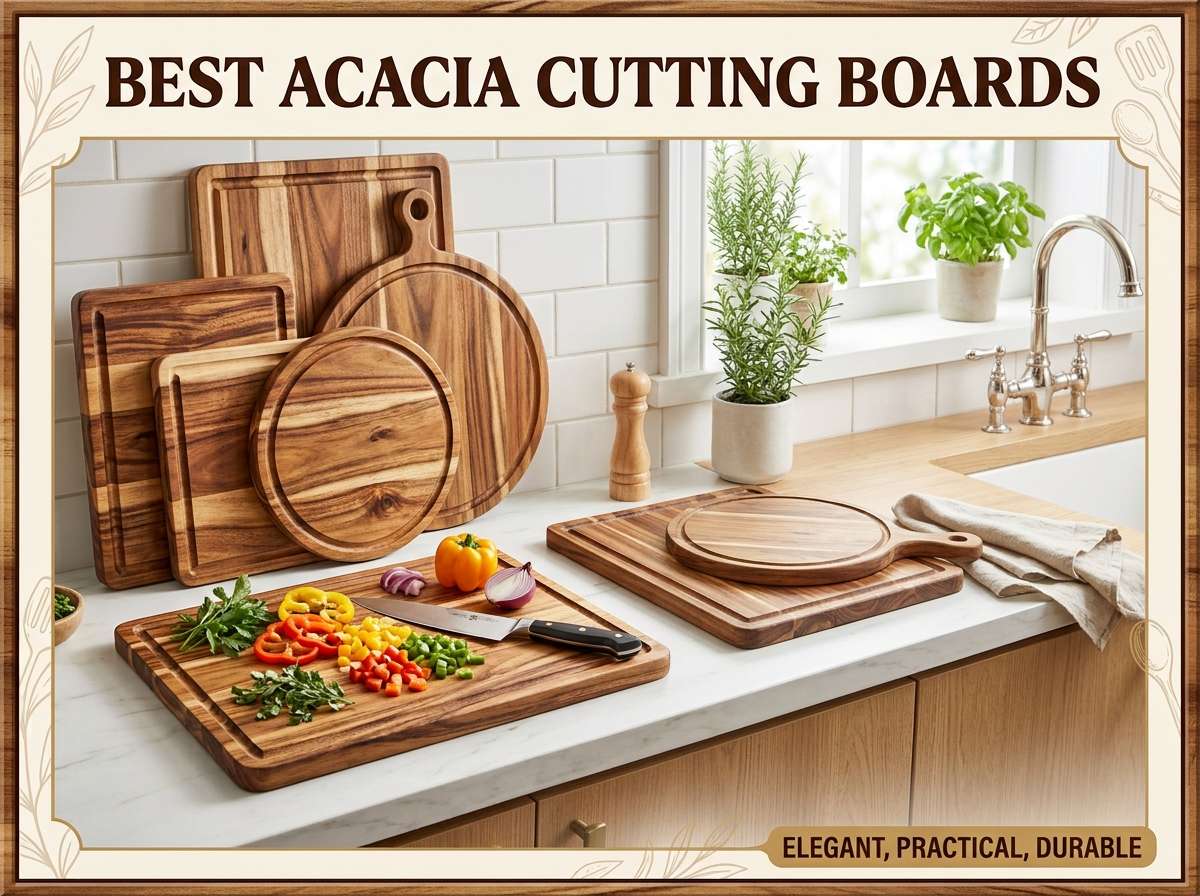
5 Best Acacia Cutting Boards In 2026
If you have shopped for a cutting board lately, you already know acacia wood is everywhere right now. Walk into any kitchen store or scroll through any home goods page and you will spot rows of these warm, honey-toned boards stacked up like little works of art. There is a reason for that. Acacia wood is dense, it holds up to knife work better than soft woods, and it has a grain pattern that makes even a plain chopping board look like a display piece.
In this article
But not all acacia boards are built the same way. Some are thin and prone to warping. Some come with finishes that flake off after a few washes. Some are so heavy that lifting them off the counter feels like a workout. So how do you sort the good ones from the ones that look nice in a photo but fall apart in real use?
That is exactly what this guide is for. Below, you will find an honest, detailed look at five popular acacia cutting board sets and single boards, each broken down by build quality, everyday usability, and overall value. By the end, you should have a clear idea of which board fits your kitchen, your cooking style, and your budget, without any of the usual marketing fluff.
Let’s get into it.
Why Acacia Wood Cutting Boards Are Worth Considering
Before jumping into the reviews, it helps to know why acacia wood keeps showing up as a top pick for cutting boards, charcuterie trays, and serving boards.
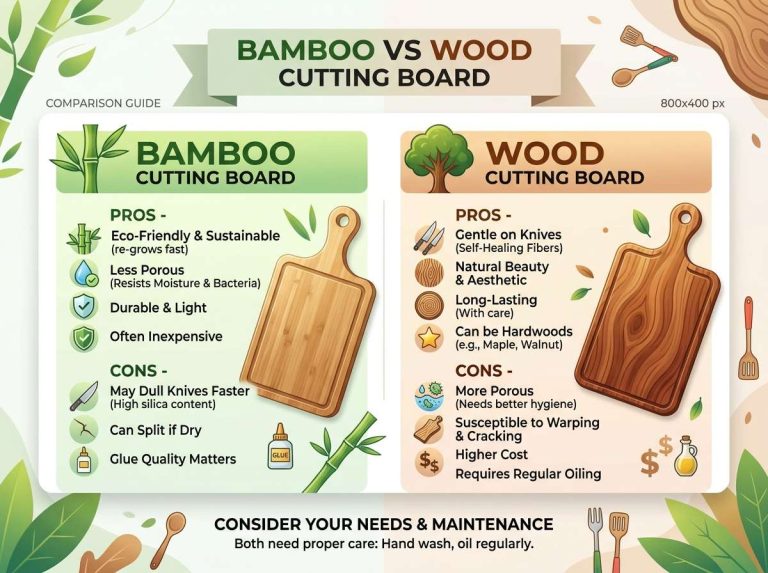
Acacia is a hardwood, which means it is naturally tough and resistant to scratches and dents from regular knife use. Compared to bamboo, which can be harder on knife blades and prone to cracking over time, acacia tends to be gentler on your knife edge while still holding its shape well. It also has a tight grain structure, which makes it naturally resistant to water absorption compared to softer woods like pine. That matters a lot for food safety, since a board that soaks up moisture and juices can become a breeding ground for bacteria if it is not cared for properly.
On top of the practical side, acacia has a striking look. The grain patterns range from light golden tones to deep chocolate streaks, and no two boards look exactly alike. This is why so many people use acacia boards for serving cheese, charcuterie, or bread at the table instead of hiding them away in a drawer.
That said, acacia is not maintenance-free. It still needs regular oiling to stay strong and crack-free, and it should never go into a dishwasher. Keep that in mind as you read through the reviews below, since long-term durability often comes down to how well a board is cared for, not just how it is built.
How These Boards Were Evaluated
Each product here was reviewed based on a few core factors that actually affect daily kitchen use:
- Build quality: thickness, wood density, and how well the boards resist warping or cracking.
- Design and features: juice grooves, handles, double-sided use, included stands, and overall functionality.
- Ease of use and care: how simple it is to clean, dry, and maintain the board over time.
- Performance in the kitchen: how the board holds up during chopping, slicing, and everyday meal prep.
- Value for money: what you get for the price compared to similar boards on the market.
Now let’s break down each product one by one.
1. Kikcoin Acacia Wood Cutting Board Set of 3
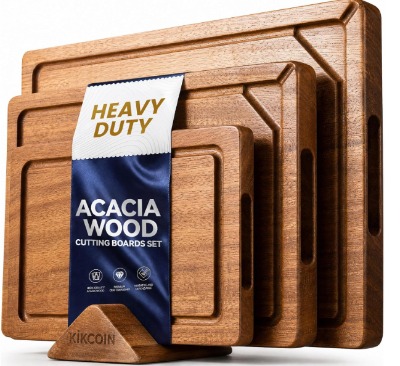
The Kikcoin set is aimed at people who want one purchase to cover almost every cutting and serving need in the kitchen. It comes with three boards in different sizes, all made from solid acacia wood, and all featuring deep juice grooves carved around the edge.
Product Description
This set includes a large board, a medium board, and a smaller board, so you get options depending on the task at hand. The large board is clearly built with meat prep in mind, since it has a wide surface area and a groove deep enough to catch juices from a roast or a whole chicken. The smaller boards work well for quick jobs like slicing fruit, cutting cheese, or prepping a few vegetables for a side dish.
Best Use Cases
This set shines for people who cook regularly and need different board sizes for different tasks. The large board is a solid pick for carving meat, cutting large cuts of beef, or breaking down a chicken. The medium board handles daily vegetable prep well, and the small board is handy for quick snack prep or as a small serving tray for cheese and crackers.
Key Features Explained Simply
- Deep juice grooves: These channels run around the edge of the board and catch liquid from meat or juicy fruit, so it does not spill onto your counter.
- Solid acacia construction: Each board is made from one piece or tightly joined strips of acacia wood, giving it strength and a long lifespan if cared for properly.
- Three sizes in one set: Instead of buying boards separately, you get a range of sizes right out of the box.
- Dual-purpose design: These boards work as both cutting surfaces and serving trays, so they double as charcuterie boards for gatherings.
Real-Life Usage Insight
In daily use, the large board earns its keep fast if you cook meat often. The juice grooves genuinely help keep your counter clean during carving, and the surface area is generous enough for larger cuts. The smaller boards are light and easy to grab for quick jobs, which makes them a natural fit for busy weeknight cooking when you do not want to drag out a huge board for a single onion.
One thing to note is that the largest board is heavy and takes up storage space, so it works best in a kitchen with a dedicated spot for it, like a countertop stand or a wide drawer.
Pros
- Three different sizes cover most kitchen tasks
- Deep grooves genuinely help contain juices and mess
- Doubles as a serving tray for entertaining
- Solid, sturdy build that resists warping with proper care
Cons
- The large board is bulky and can be tricky to store
- Requires regular oiling to keep the wood from drying out
- Heavier than some single boards, which may not suit everyone
Performance Discussion
Cutting performance on all three boards feels stable, with no sliding around the counter during use, thanks to the weight and density of the wood. Knife marks show up over time, as they do on any wood board, but they do not affect the surface in a way that causes real damage as long as you avoid soaking the boards in water.
Ease of Use
Handling the smaller boards is simple and quick. The large board takes a bit more effort to clean and dry fully because of its size, so plan for a few extra minutes after big cooking sessions.
Value for Money
Given that you get three boards in one purchase, this set offers solid value, especially for anyone who currently owns just one all-purpose board and wants to expand their setup without buying pieces separately.
2. Non-Toxic Acacia Wood Cutting Board (16×11 in)
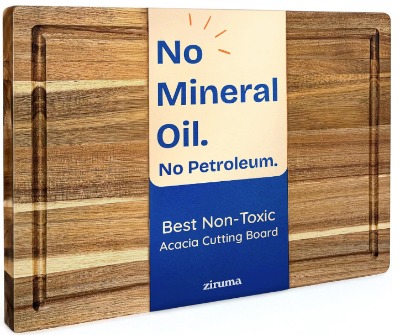
This single board takes a simpler approach. Instead of a multi-piece set, you get one mid-size acacia board, finished without mineral oil or plastic coatings, aimed at people who want a clean, straightforward option free from added chemicals.
Product Description
Sized at 16 by 11 inches, this board sits in that sweet spot between too small for real meal prep and too large to store easily. It is made from acacia wood and finished in a way that skips synthetic coatings, appealing to shoppers who are picky about what touches their food.
Best Use Cases
This board fits well as an everyday, go-to cutting surface for small households or anyone who mostly cooks single meals rather than large family dinners. It is a good fit for slicing vegetables, cutting fruit, prepping sandwiches, or light meat trimming.
Key Features Explained Simply
- Mineral oil and plastic-free finish: The board skips synthetic sealants, so what you are working with is closer to raw, treated wood rather than a plastic-coated surface.
- Mid-size dimensions: At 16×11 inches, it is large enough for real prep work but still light enough to lift, wash, and store with one hand.
- Single-board simplicity: No matching pieces to keep track of, no extra storage puzzle, just one board that handles most jobs.
Real-Life Usage Insight
For anyone living alone or cooking for one or two people, this board covers almost everything you would need on a daily basis. It is light enough to rinse and dry quickly after each use, which matters a lot if you do not want to deal with heavy boards every night. Since it skips added coatings, it does need more frequent oiling with a food-safe oil to stay protected, so keep that step in mind rather than treating it as maintenance-free.
Pros
- Simple, no-frills design that suits smaller kitchens
- Free from plastic coatings, appealing for chemical-conscious buyers
- Easy to clean and store thanks to its manageable size
- Good all-purpose size for daily meal prep
Cons
- Only one board, so no size variety for bigger cooking tasks
- Needs more frequent oiling since it lacks a heavy synthetic seal
- Not ideal for large families or big batch cooking
Performance Discussion
The board holds up well under regular knife use, showing typical light surface marks over time rather than deep gouges. Since it is a single piece rather than a set, performance depends heavily on how consistently you oil and dry it, so treat this as a board that rewards a little extra care.
Ease of Use
This is one of the easiest boards on this list to manage day to day. It is light, quick to clean, and simple to store in a cabinet or on a drying rack without taking up much room.
Value for Money
For solo cooks or small households, this board offers good value since you are not paying for extra pieces you may never use. It is a smart pick if your kitchen space or storage is limited.
3. EDELHAUS Acacia Wood Cutting Boards for Kitchen (Set of 3, Double Sided)
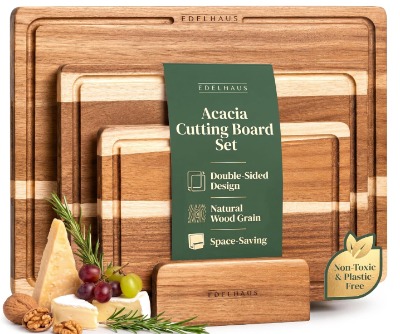
EDELHAUS takes the multi-board approach as well, but adds a double-sided design to each board, which effectively doubles your usable surface area without adding more pieces to store.
Product Description
This set includes three acacia boards, each usable on both sides. That means six total cutting surfaces packed into three physical boards, which is a smart way to add flexibility without cluttering your kitchen storage.
Best Use Cases
Double-sided boards are great for people who like to separate tasks, for example using one side for raw meat and flipping to the other side for vegetables or bread, cutting down on the need for constant washing between tasks during meal prep.
Key Features Explained Simply
- Double-sided cutting surface: Each board offers two usable faces, giving you more flexibility for separating food types during prep.
- Three-piece set: Small, medium, and large sizes cover a wide range of kitchen tasks.
- Solid acacia build: The wood is dense and holds up to daily knife contact without denting easily.
Real-Life Usage Insight
In a busy kitchen, the ability to flip a board over instead of washing it mid-task is a genuine time-saver. If you are prepping a meal with both meat and vegetables, you can use one side for each without pulling out a second board. That said, both sides will eventually need seasoning and care just like a single-sided board, so the “extra surface” is a convenience feature rather than a way to skip maintenance.
Pros
- Double-sided design adds real functional value
- Three sizes fit a wide range of prep tasks
- Sturdy acacia construction resists everyday wear
- Good option for people who prep multiple food types at once
Cons
- Heavier overall since each board is thicker to support two usable sides
- Still requires oiling on both faces, which takes a bit more time
- Larger board can be awkward to maneuver in small sinks
Performance Discussion
Across both sides, the boards perform consistently, without one side feeling weaker or more prone to marks than the other. The extra thickness needed for a double-sided design also adds a bit more resistance to warping compared to thinner single-sided boards.
Ease of Use
Flipping the board is simple and intuitive, and the design does not add any real learning curve. Cleaning takes slightly longer since you technically have double the surface area to wash and dry compared to single-sided boards of the same footprint.
Value for Money
Since you effectively get six cutting surfaces from three boards, this set delivers strong value for anyone who wants flexibility without buying more pieces than necessary.
4. Deer & Oak Non-Toxic 3-Piece Acacia Cutting Board Set with Stand
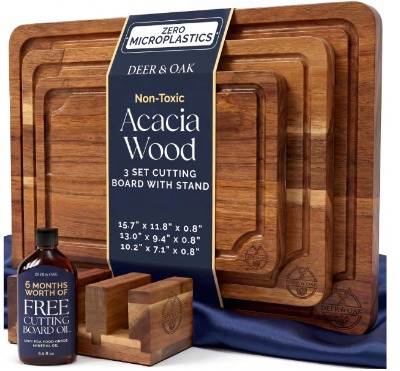
Deer & Oak stands out for one clear reason: it comes with a stand. Instead of stacking your boards in a drawer or leaning them against a wall, you get a dedicated holder that keeps them upright, organized, and easy to grab.
Product Description
This set includes three acacia boards in graduated sizes, along with a wooden stand designed to hold all three upright on your counter. The boards themselves are finished without added chemical coatings, aligning with the non-toxic labeling.
Best Use Cases
This set is a strong pick for anyone who wants their boards visible and easy to access rather than hidden away, and for people who like a bit of countertop styling alongside function. It also works well for kitchens where drawer space is limited.
Key Features Explained Simply
- Included stand: A simple wooden rack that holds all three boards upright, saving drawer space and keeping them dry between uses.
- Non-toxic finish: No plastic or synthetic sealant, appealing to buyers who want a more natural surface.
- Graduated sizing: Small, medium, and large boards handle everything from quick snack prep to full meal cutting.
Real-Life Usage Insight
Having a stand changes the daily routine more than you might expect. Instead of digging through a stack of boards to find the right size, you can see all three at a glance and just grab what you need. It also helps with drying, since air can circulate around the boards instead of them sitting flat and trapping moisture underneath, which is a common cause of warping in wood boards.
Pros
- Stand keeps boards organized and easy to access
- Better air circulation while drying reduces warping risk
- Non-toxic finish suits health-conscious kitchens
- Graduated sizes cover a wide range of prep tasks
Cons
- Stand takes up counter space, which may not suit tiny kitchens
- Boards without added sealant need more frequent oiling
- Style of the stand may not match every kitchen decor
Performance Discussion
The boards themselves perform in line with other solid acacia sets on this list, handling regular chopping and slicing without much fuss. The stand adds a functional bonus by reducing the chances of warping from poor storage, which is often an overlooked cause of board damage over time.
Ease of Use
This set is about as convenient as it gets for daily grab-and-go use. There is no digging through cabinets, and drying is faster thanks to the upright storage design.
Value for Money
Given that you get a stand along with three boards, this set offers good value for kitchens that want both function and a bit of counter display appeal, though buyers tight on counter space might weigh that trade-off first.
5. WALDWERK Cutting Board Set (Solid Acacia, 0.8 in Thick)
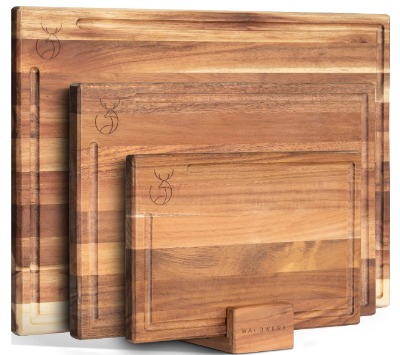
WALDWERK focuses on thickness and solid build quality. This set includes three boards at 15.75 x 12 inches, 13 x 9.5 inches, and 10 x 7 inches, each made from solid acacia and measuring a hearty 0.8 inches thick.
Product Description
The standout detail here is the thickness. At 0.8 inches, these boards are noticeably heftier than many competing sets, which tend to sit closer to half an inch. That extra mass adds stability and a more substantial feel during use.
Best Use Cases
This set is a strong fit for anyone who wants boards that feel closer to a butcher block than a thin cutting surface. It handles heavy-duty tasks like breaking down large cuts of meat, chopping dense vegetables, or any job where a thinner board might flex or slide.
Key Features Explained Simply
- Extra thickness: At 0.8 inches, these boards resist bending and warping better than thinner alternatives.
- Three graduated sizes: From a large primary board down to a compact one for quick tasks.
- Solid acacia wood: Dense, durable, and naturally resistant to absorbing moisture compared to softer wood types.
Real-Life Usage Insight
The added thickness is noticeable the moment you start cutting. There is less flex under pressure, and the boards stay firmly in place without sliding around, even during more forceful chopping. This makes the set a good match for people who cook meat-heavy meals often or who just prefer a heavier, more stable board underfoot, so to speak.
The trade-off is weight. The largest board is not something you will want to lift with one hand repeatedly, so it works best as a board that mostly stays on the counter rather than one you move in and out of storage constantly.
Pros
- Extra thick build adds real stability during use
- Feels closer to a professional butcher block than a standard board
- Solid acacia construction resists moisture and warping well
- Graduated sizes suit a range of prep tasks
Cons
- Noticeably heavier, which can be a downside for some users
- Takes up more storage space than thinner sets
- Longer drying time due to the added wood mass
Performance Discussion
Performance-wise, this set holds up impressively well under heavier chopping tasks, showing minimal flex or movement compared to thinner boards. The thickness also seems to help the boards resist warping over time, assuming they are dried properly after each wash.
Ease of Use
The smaller board is easy to handle day to day, but the largest board demands a bit more effort to lift, wash, and dry given its weight. This is a fair trade for the added stability it offers during use.
Value for Money
For anyone who prioritizes durability and stability over convenience, this set delivers strong value, since the extra material translates into a longer usable lifespan when cared for properly.
Comparison Insights: How These Boards Stack Up
Looking at all five options side by side, a few clear patterns show up.
The Kikcoin set and the EDELHAUS set both lean into the idea of matching multiple boards for different tasks, but EDELHAUS adds double-sided functionality that gives you more usable surface area without extra pieces. If flexibility during meal prep matters most to you, EDELHAUS edges ahead here.
The single board option stands apart simply because it is not a set at all. It is the lightest, easiest to store, and best suited for smaller households or people who do not need multiple sizes on hand.
Deer & Oak brings something none of the others offer: a stand. If organization and easy drying matter to you as much as the boards themselves, this set solves a problem the others leave up to you.
WALDWERK wins on raw thickness and stability. If you cook meat often or just like a heavier, sturdier board, this set will likely feel the most premium in hand, though it does ask you to trade off some convenience in weight and storage.
None of these boards claim to be dishwasher safe, and that is expected, since acacia wood should always be hand washed and air dried regardless of brand or price point.
Buying Guide: What to Look for in an Acacia Cutting Board
If none of the five options above feel like a perfect match, here is what actually matters when comparing acacia boards on your own.
Thickness
Thicker boards resist warping and flexing better, but they are heavier and take longer to dry. A board around half an inch thick works fine for light daily use, while anything closer to three quarters of an inch or more suits heavier meat prep and frequent use.
Grain Direction and Construction
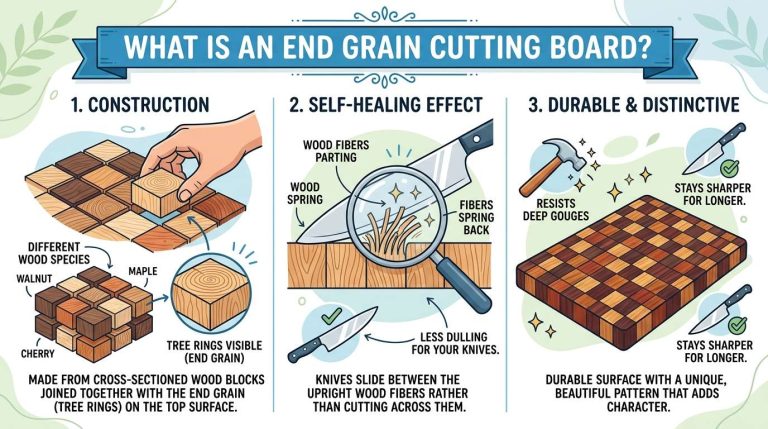
Boards made from edge-grain or end-grain construction tend to hold up better over time than boards made from a single flat slab, since the grain pattern affects how the wood expands and contracts with humidity.
Juice Grooves
If you plan to carve meat or cut juicy fruit often, a groove around the edge saves you from constant counter cleanup. For light vegetable prep only, this feature matters less.
Finish
Some boards come pre-treated with mineral oil or a food-safe wax, and others arrive untreated, expecting you to oil them yourself before first use. Neither option is better across the board, it just depends on how much upfront care you want to do.
Size and Storage
A board that looks great in photos but does not fit your sink or storage space will end up being a hassle. Measure your available counter and cabinet space before committing to a large set, especially with thicker or multi-board options.
Double-Sided vs Single-Sided
Double-sided boards give you more usable surface per piece, which is handy for separating raw meat from produce, though they generally cost a bit more and weigh more per board.
Who Should Buy These Products
- Home cooks who prep meat regularly will benefit most from sets with deep juice grooves and thicker construction, like Kikcoin or WALDWERK.
- Small households or solo cooks will likely find the single 16×11 inch board more practical than a full three-piece set.
- People who like an organized countertop should lean toward the Deer & Oak set with its included stand.
- Anyone who wants maximum flexibility from fewer pieces should look closely at the EDELHAUS double-sided set.
- Buyers focused on durability above all else will likely be happiest with the extra-thick WALDWERK boards.
Common Mistakes to Avoid With Acacia Cutting Boards
Even a great board can wear out fast if it is treated the wrong way. Here are a few habits worth avoiding.
Putting the board in the dishwasher
This is the single fastest way to ruin a wood board. The heat and prolonged water exposure cause warping, cracking, and splitting, even on dense hardwoods like acacia.
Letting the board air dry flat
Water pooling on one side while the other side stays dry creates uneven moisture levels, which leads to warping. Stand boards upright or use a rack so both sides dry evenly.
Skipping regular oiling
Wood naturally dries out over time, especially with frequent washing. Skipping oil treatments causes the surface to crack and lose its resistance to moisture and bacteria.
Cutting only in one spot on the board
Repeatedly cutting in the same small area causes deep grooves that trap food particles and bacteria over time. Rotate your cutting spot across the surface to spread out the wear.
Using the same board for raw meat and ready-to-eat food without cleaning between uses
Cross-contamination is a real risk with any cutting surface. If you only have one board, wash it thoroughly with hot soapy water between tasks, or better yet, keep a dedicated side or board just for raw meat.
Soaking the board in water
A quick rinse and wash is fine, but letting a wood board sit in a sink full of water softens the wood fibers and speeds up warping and cracking.
Final Verdict
All five of these acacia cutting board options bring something different to the table, so the right pick really comes down to how you cook and how much counter or storage space you have.
If you want an all-around solid set with practical juice grooves for meat prep, the Kikcoin set is a dependable, well-rounded choice. If your kitchen is small and you just need one reliable everyday board, the single 16×11 inch non-toxic board keeps things simple without sacrificing usability. For anyone who wants extra flexibility from fewer physical pieces, the EDELHAUS double-sided set stands out as the smartest use of space. If a tidy, organized countertop matters to you, the Deer & Oak set with its stand solves a storage problem most other boards leave unaddressed. And for anyone chasing that heavy-duty, near-professional feel, the WALDWERK thick acacia set delivers the sturdiest, most stable cutting experience of the bunch.
No matter which one you land on, the real key to getting years of use out of an acacia board comes down to care: hand wash it, dry it properly, oil it regularly, and avoid the dishwasher at all costs. Treat the wood right, and any of these boards can become a long-term kitchen staple rather than something you replace within a year.

Mary is a home cooking enthusiast and kitchen gear reviewer with a passion for practical cookware and food preparation tools. She enjoys testing cutting boards, knives, kitchen gadgets, and other cooking essentials to help home chefs make smarter buying decisions. Through KitchenCutting.com, Mary shares honest product reviews, buying guides, and helpful kitchen tips to make cooking easier, safer, and more enjoyable.
3 Comments