5 Best Cheap Knife Sharpener In 2026
As an Amazon Associate we earn from qualifying purchases.
Many home cooks want a sharp kitchen knife but do not want to spend much money on a sharpening tool. This guide is for beginners who are looking for the best cheap knife sharpener and who have little or no experience with sharpening. It explains what the five products have in common, how they differ, and which kind of buyer each one suits.
All five products are manual, low-cost sharpeners that you pull a blade through by hand. They use simple abrasive slots made from materials such as tungsten carbide, ceramic or diamond-coated surfaces. The comparison below rests on the listed features and typical use of each product, not on personal testing. Read it as a guide to what each sharpener is designed to do.
Pull-through sharpeners are popular because they require no oil, no water and no separate stone. You hold the handle, place the blade in the slot and draw it toward you at a steady pace. Because the angle is set by the tool, beginners can get a usable edge without learning freehand technique.



1. AccuSharp Knife Sharpener: best for quick touch-ups on many blade types
What it is and who it suits
The AccuSharp Knife Sharpener is a small handheld tool with a built-in sharpening system. It is marketed for chef’s knives, paring knives, serrated knives, fillet knives and cleavers. It suits buyers who want one simple tool for a mixed set of kitchen knives.
It is a good match for a household with several different knives. A single tool that handles straight and serrated edges can save you from buying separate sharpeners. It is less suited to people who own expensive Japanese blades and want precise control over the final edge.
Best use cases
This sharpener works best for light maintenance on a blade that has become slightly dull. Many people use this kind of tool once in a while, not every day. It is a practical choice for keeping everyday knives in working order.
A common example is a chef’s knife that cuts tomatoes poorly or slips on onion skins. A few passes through the slot can bring back a usable edge. A knife with a chipped or badly rolled edge will usually need a more thorough method.
Key features in simple words
The sharpening blades are made from diamond-honed tungsten carbide, a very hard material. The blades can be reversed, which the maker says doubles their life span. The handle is shaped to fit either hand, and a full-length guard helps keep your fingers away from the blade.
The reversible design means you can use the other side of the sharpening blade once the first side wears down. This is a useful feature if you plan to keep the tool for a long time. Check the maker’s current instructions for how to reverse the blades before you start.
What daily use usually feels like
Using this tool is quick. You draw the blade through the sharpening slot a few times and then check the edge. The guard adds a sense of safety, though you still need to keep your attention on the blade and your fingers.
Work slowly the first few times. Keep the spine of the knife pressed steadily against the guide and pull in one smooth motion. Rushing can cause the blade to skip, which wastes time and can cause a small slip.
Performance and ease of use
The maker states that most blades can be sharpened in about ten seconds. Real results depend on how dull the blade is and how many strokes you use. Beginners will find the pull-through method easy to learn.
A simple test is to slice a sheet of paper or a ripe tomato after sharpening. A clean cut suggests the edge is working well. If the knife still tears or crushes, the blade may need more strokes or a different tool.
Value for money
At a low price, this sharpener offers a broad range of blade compatibility. The maker says the sharpening blades can last several years before replacement, and most users report between five and ten years. That makes it a sensible low-cost option for basic upkeep.
Compare the price with the cost of professional sharpening. If you send knives out only a few times a year, a home tool can pay for itself quickly. Keep in mind that a low price does not mean the tool replaces a stone for very fine or heavily damaged edges.
Pros
- Works on many blade types, including serrated knives
- Handle suits both right-handed and left-handed users
- Full-length guard helps protect fingers during use
- Easy to clean with soap and water or a dishwasher
Cons
- Results on badly damaged blades may need more effort than light touch-ups
- Only one sharpening stage, so it offers less control than multi-stage tools
- The guard can make the tool slightly bulkier to store
2. Smith’s CCKS 2-Step Knife Sharpener: best for portable and outdoor use
What it is and who it suits
The Smith’s CCKS is a small pull-through sharpener with two preset stages. It is designed for outdoor users who need to sharpen fillet knives, pocket knives and hunting knives while away from home. It suits anglers, hunters and anyone who carries a knife on trips.
If you mostly sharpen knives at a kitchen counter, a larger bench tool may feel more convenient. This model is built for situations where carrying a full sharpening setup is not practical.
Best use cases
This tool fits well in a tackle box, hunting pack or pocket. Its size makes it handy for quick fixes in the field, such as touching up a fillet knife between catches. A few pulls through the slots can restore enough edge to get a task done.
It is less suited to heavy restoration of a very worn kitchen blade. A badly chipped or heavily worn edge usually needs more material removal than a small pull-through tool provides.
Key features in simple words
The sharpener has a coarse stage made from tungsten carbide and a fine stage made from ceramic rods. The coarse stage works to reshape a dull edge, while the fine stage refines it. Both stages are built into one compact body.
The angles are preset, so you do not need to guess the right angle. The tool weighs under two ounces, has a lanyard hole for a keychain, and floats in water.
What daily use usually feels like
Using this sharpener is simple. You pull the blade through the coarse slot three or four times, then move to the fine slot to refine the edge. Keep the blade moving at a steady pace and use light pressure rather than forcing it through.
Non-slip rubber feet keep the tool steady on a table or counter. Setting it on a flat, stable surface makes each pull more controlled, especially for beginners.
Performance and ease of use
The coarse slot is meant to restore a dull edge, while the fine slot is meant to polish it. The maker says the preset angles give consistent results. Beginners often find this two-step method easier than freehand sharpening.
Results depend on how dull the blade is and how many passes you make. A lightly dulled knife will usually respond well, while a heavily worn one may need more passes or a different tool.
Value for money
This is one of the lowest-priced options in this group. It is compact and does not need any setup. For someone who needs a spare sharpener for trips, the value is clear, though it is not designed to replace a full kitchen sharpening system.
Think of it as a dependable backup rather than a primary sharpener. Pairing it with a home sharpener is a sensible way to get both portability and deeper restoration when you need it.
Pros
- Very small and light, easy to carry in a pocket or pack
- Preset angles help beginners get consistent results
- Floats in water, which is useful around boats and rivers
- Simple to clean with a damp cloth
Cons
- Small size means less surface area and a slower feel for larger blades
- Not designed for heavy restoration of badly worn kitchen knives
- Limited to two stages, with no dedicated polishing step
3. Professional 4-in-1 Knife Sharpener: best for a wide range of kitchen tools
What it is and who it suits
This manual sharpener has four slots, including one for scissors. It is aimed at home cooks who want one tool for knives and kitchen shears. It suits people with a mixed set of kitchen tools and a modest budget.
If you own several knives and a pair of scissors that have started to feel dull, a single tool that handles all of them can save storage space. It also means you do not need to buy a separate scissor sharpener. The design is simple enough that most people can start using it without reading a long manual.
Best use cases
The sharpener works well for chef’s knives, pocket knives, kitchen scissors and straight-edge blades. It is not suitable for ceramic or serrated knives, so buyers should check their blades first. It is useful for regular maintenance in a busy kitchen.
A common example is a santoku or chef’s knife that has become slightly rounded from daily chopping. Running it through the coarse and medium slots can bring back a workable edge. Because the tool is compact, it can sit near the cutting board for quick touch-ups between bigger sharpening sessions.
Key features in simple words
The four slots cover coarse repair in tungsten steel, medium polishing with diamond, fine finishing with ceramic, and a dedicated scissor slot. A non-slip rubber base keeps the unit steady. The grinding head can be removed for cleaning metal filings.
Each slot has a different abrasive, so the order matters. Starting with the coarse stage removes more metal and fixes damage, while the finer stages refine the edge. Removing the head after use helps keep the filings from building up around the slots.
What daily use usually feels like
You work through the slots in order, pulling the blade through each one without sawing back and forth. The clear guides on the body show where to place the blade. The removable head makes cleanup less of a chore.
Most people find that a few smooth pulls per slot are enough for a light touch-up. Keeping the blade moving in one direction, from heel to tip, helps avoid uneven wear. Wiping the blade after sharpening removes any loose residue before you store it.
Performance and ease of use
Because it has four stages, this tool offers more control than a single-slot design. The guides and non-slip base make it easy to follow the process. Beginners should take their time to keep a steady angle.
Holding the blade at a consistent angle matters more than applying pressure. Pressing hard can damage the abrasive and does not speed up the result. Practising on an older knife first can help you learn the feel before you work on your best blade.
Value for money
This is one of the lowest-priced options here, and it covers more tool types than most. For households that sharpen both knives and scissors, it gives good value. Its build is plastic, so it may not feel as sturdy as heavier metal tools.
The value depends on how you will use it. If you only sharpen one type of blade, a simpler and cheaper tool may do the same job. If you want one tool for several items, the four slots make the purchase more practical.
Pros
- Covers four stages, including a scissor slot
- Removable grinding head makes cleaning easier
- Non-slip base improves stability on the counter
- Compact and can be hung for storage
Cons
- Not suitable for serrated or ceramic knives
- Plastic body may feel less solid than metal alternatives
- Requires care to keep the correct angle across all slots
4. 4-in-1 Kitchen Knife Accessories: best for a complete starter kit
What it is and who it suits
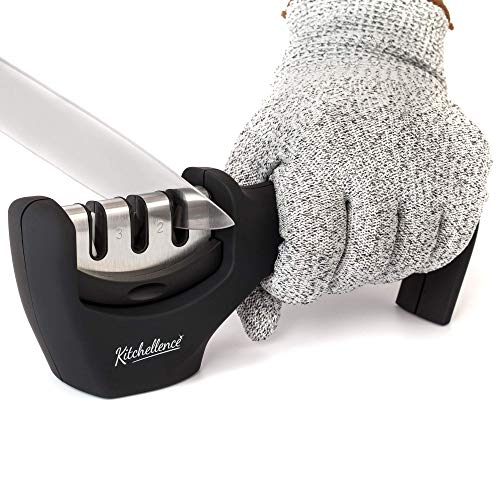
This set combines a three-slot knife sharpener with a cut-resistant glove. The glove is part of the package, which sets this kit apart from the others in the group. It suits beginners who want a sharpener and a safety accessory in one purchase.
Someone setting up a kitchen for the first time may not own a sharpener or a glove. Buying both together can simplify the shopping list. The kit is also a reasonable choice for a gift for a new cook.
Best use cases
The three slots work in sequence, from repairing damage to polishing the edge. This makes the tool useful for kitchen knives that have lost their shape over time. The glove is handy when handling blades during sharpening or cleaning.
A typical example is a paring knife or utility knife that has developed small nicks from hitting bones or hard vegetables. The first slot can straighten the edge, and the later slots bring it back to a smooth finish. Using the glove while handling the blade reduces the risk of cuts during this process.
Key features in simple words
The first slot is a diamond rod that repairs and straightens a damaged blade. The second slot restores the V-shape of the edge, and the third slot fine-tunes it for a clean finish. The handle fits either hand, and the base is non-slip.
The diamond rod is the most aggressive stage, so it is best used on blades that need real repair. The later slots are gentler and suit routine maintenance. Knowing which stage your blade needs will help you avoid removing more metal than necessary.
What daily use usually feels like
You place the blade in each slot and pull it through a few times. The process is steady when the base stays flat on the counter. Wearing the glove during the work can add a sense of security for many users.
Work slowly and check the edge between stages. A quick look under good light will show if the burr has formed along the full length. If it has not, repeat the stage before moving on.
Performance and ease of use
The three-stage design gives a clear path from rough repair to polish. The maker says the process takes only seconds once you are comfortable with it. Beginners should go slowly at first to build a steady rhythm.
Speed comes with practice. The first few attempts may take longer as you learn to keep the angle steady across each slot. Once the motion feels natural, the routine becomes quick and predictable.
Value for money
The price sits at the higher end of this group, but the glove adds value to the package. Buyers who want a ready-to-use kit may find it worthwhile. Those who only need a sharpener may prefer a lower-priced option.
Compare the kit with buying a sharpener and a glove separately. If you already own a suitable glove, paying for it again may not make sense. If you do not, the bundle can be a practical way to start.
Pros
- Includes a cut-resistant glove for added safety
- Three stages cover repair, shaping and polishing
- Ergonomic handle works for both right-handed and left-handed users
- Solid plastic build designed for regular use
Cons
- Higher price than several simpler sharpeners in this group
- Plastic body may feel less heavy-duty than metal tools
- The glove is only useful if you choose to wear it
5. VYKTRIY Premium 3-Stage Knife Sharpener: best for simple everyday sharpening
What it is and who it suits
This three-stage manual sharpener is aimed at home cooks who want to keep straight-edged kitchen knives in good shape. It is simple to use and suits beginners on a tight budget. Many people use a tool like this for routine upkeep, such as touching up a chef’s knife once a week before preparing meals.
Best use cases
The tool works on straight-edged steel knives. It is a good choice for regular touch-ups between longer sharpening sessions, such as when a paring knife starts to tear tomatoes instead of slicing them cleanly. Buyers with serrated knives should look elsewhere, because the slots are not designed for the scalloped edges of bread or tomato knives.
Key features in simple words
The sharpening slots are made from tungsten steel and ceramic. The first stage repairs damage, the second hones the edge, and the third polishes it. The housing is made from ABS plastic, a tough material used for many household tools, including kitchen gadgets and small appliance casings.
What daily use usually feels like
You glide the blade through each slot with gentle pressure, starting from the heel of the knife and moving toward the tip. The fit in the hand is comfortable for most users. The process feels quick once you learn the motion, and most people settle into a steady rhythm after a few sessions.
Performance and ease of use
The maker says the three stages can restore a blade to a sharp, polished state. Results will vary with the blade’s condition, since a knife that has rolled badly or chipped may need more passes or a different tool. A light, steady hand matters more than force, because pressing hard can wear the slots and make the edge uneven.
Value for money
This is one of the lowest-priced sharpeners in the group. It offers the same three-stage design found in higher-priced tools. The maker also offers a satisfaction guarantee, though its terms should be read before buying so you know the return steps and any conditions that apply.
Pros
- Low price with a clear three-stage design
- Comfortable grip that fits most hands
- Tungsten steel and ceramic slots for repair and finishing
- Simple process that suits beginners
Cons
- Not designed for serrated knives
- Plastic housing may wear over long periods of heavy use
- Results depend heavily on using a steady, gentle motion
Comparison insights: how the five sharpeners differ
The five products share the same basic goal, but they differ in how many stages they offer and what tools they handle. Some focus on speed, some on portability, and some on covering a wide range of kitchen items. Looking at these differences helps beginners decide which trade-offs matter most to them.
In terms of performance, the three-stage and four-stage designs give more control over the final edge. The single-focus outdoor tool works well for light touch-ups but is less suited to heavy repair. Multi-stage tools take a little longer but usually give a more even result across the blade.
Ease of use also varies. The preset-angle tool is often the simplest for a first-time user because the angle is set for you. Tools with clear visual guides and non-slip bases make the process easier to follow. Tools without these features rely more on the user’s own steady hand.
On value for money, the lowest-priced options cover the basics well. Kits with extra parts, such as a cut-resistant glove, cost more but add something to the package. The best value depends on if a buyer needs a simple tool or a broader set of features.
Buying guide: key factors for a cheap knife sharpener
The first factor is the type of blade you own. Some sharpeners handle straight-edged knives only, while others also work on serrated blades. Check your knives before you buy, because a tool that does not fit your blades will not help. Look at the product description for a clear list of compatible blade types.
The second factor is the number of stages. A coarse stage repairs a dull or damaged edge. A fine stage polishes it. A tool with two or three stages covers both steps, which suits most home kitchens. A single-stage tool can still help with light touch-ups, but it rarely restores a badly worn edge.
The third factor is the material of the sharpening slots. Tungsten carbide and tungsten steel are hard materials used for the coarse stage. Ceramic and diamond surfaces are commonly used for finer work. In simple terms, harder materials remove metal faster. Faster removal is useful for repair, but it also means you should use gentle pressure to avoid taking off more steel than needed.
The fourth factor is how the tool feels in your hand. A handle that fits the palm and a non-slip base make the process more comfortable and steady. A tool that slides on the counter can cause uneven strokes and wasted effort. These points matter more than most people expect for a first sharpener, especially if you are still learning the pull-through motion.
The fifth factor is where you plan to use it. A small, light tool is handy for trips and outdoor use, and it fits easily in a tackle box or backpack. A larger tool with a sturdy base is better for a kitchen counter, where it can stay in one place during use. Think about your daily routine before picking, since the best tool is the one you will actually reach for.
Finally, consider how often you will sharpen. Occasional touch-ups need a simple tool with minimal setup. Frequent use may call for a model with more stages and a sturdier build that holds up to repeated strokes. A realistic view of your needs keeps the purchase sensible and prevents you from paying for features you will never use.
Who should buy these products
Beginners who want one tool for a mixed set of kitchen knives may suit the AccuSharp. Its wide blade compatibility and simple pull-through design make it an easy starting point. It is a sensible choice for basic upkeep, such as keeping everyday chef’s and paring knives in working order between more thorough sharpening sessions.
Outdoor users, such as anglers and hunters, may prefer the Smith’s CCKS. Its small size, preset angles and floating design suit trips and field work, where a full-size sharpener would be awkward to carry. It is less suited to a busy kitchen, where a larger base and more stages would usually be more convenient.
Home cooks who sharpen both knives and scissors may find the Professional 4-in-1 most useful. Its four slots and scissor section cover more tools than most, so one device can handle several jobs around the house. It suits a household with a mixed set of kitchen tools that all need periodic attention.
Buyers who want a ready-made kit with a safety accessory may look at the 4-in-1 Kitchen Knife Accessories. The included glove adds a practical extra, since handling blades during sharpening carries a risk of small cuts. It suits those who prefer a complete package over buying parts separately and want everything ready to use from the start.
Budget-minded cooks who want a clear three-stage process for straight-edged knives may consider the VYKTRIY. Its low price and simple design suit routine maintenance, and the separate stages make it easy to follow each step in order. It is a good match for beginners who do not need extra features and mainly sharpen straight-edged blades.
Final verdict on the best cheap knife sharpener
No single sharpener is the best for every person. The right choice depends on the knives you own, where you use them and how often you sharpen. Matching the tool to your needs matters more than picking the most features.
For most home kitchens, a multi-stage sharpener with clear guides and a non-slip base offers a sensible balance of ease and control. The three-stage and four-stage options in this group cover repair, shaping and polishing without much extra cost. Beginners should start with one of these and practice a steady, gentle motion. Slow, even strokes teach you more about angle and pressure than fast, forceful passes ever will.
Look at the features that affect daily use. Angle guides help you hold a consistent edge angle, which is one of the hardest skills for new users to learn. A rubber or suction base keeps the tool from sliding on the counter. Sharpeners with a slot for thin blades can also help if you own a paring knife or a small utility knife.
Plan on a short routine rather than a big overhaul. Many people sharpen with a coarse slot once in a while, then use a fine slot for a quick finish. Wipe the blade clean afterward and store knives where the edge will not hit other metal objects. Good habits like these extend the time between sharpenings.
Frequently Asked Questions
Do cheap knife sharpeners work on all types of knives?
Most budget sharpeners work best on straight-edged kitchen knives. Serrated and ceramic knives often need a different tool. Check the product details before you buy.
How often should I sharpen my kitchen knives?
The answer depends on how often you cook and what you cut. Light touch-ups every few weeks suit many home cooks. A knife that slips or tears food may need sharpening sooner.
Is a manual sharpener safe to use?
A manual sharpener is generally safe when you keep your fingers clear of the blade. Guards, non-slip bases and cut-resistant gloves can add safety. Move slowly and keep your attention on the work.
What is the difference between coarse and fine stages?
A coarse stage removes metal quickly to repair a dull or damaged edge. A fine stage smooths the edge and makes it sharper. Using both stages in order usually gives the best result.
Can a cheap sharpener replace a professional service?
A cheap sharpener can handle regular maintenance well. Badly damaged or valuable knives may still need a professional. For most home kitchens, a simple tool covers the everyday needs.

Mary is a home cooking enthusiast and kitchen gear reviewer with a passion for practical cookware and food preparation tools. She enjoys testing cutting boards, knives, kitchen gadgets, and other cooking essentials to help home chefs make smarter buying decisions. Through KitchenCutting.com, Mary shares honest product reviews, buying guides, and helpful kitchen tips to make cooking easier, safer, and more enjoyable.